16 min read • Last updated September 2026
Most buyers spend weeks on the wrong part of this purchase.
They study the floor plans.
They walk the showflat twice.
They watch the review videos.
And then they arrive on booking day with an unsettled loan question, one unit in mind, and about two minutes to decide.
The showflat is where you form a preference.
Booking day is where the purchase either happens or does not.
So this article is about the second part.
What the process is, what the day looks like, what the common failures are, and what a buyer can settle in advance so that the two minutes are uneventful.
1. Booking Day At A Glance
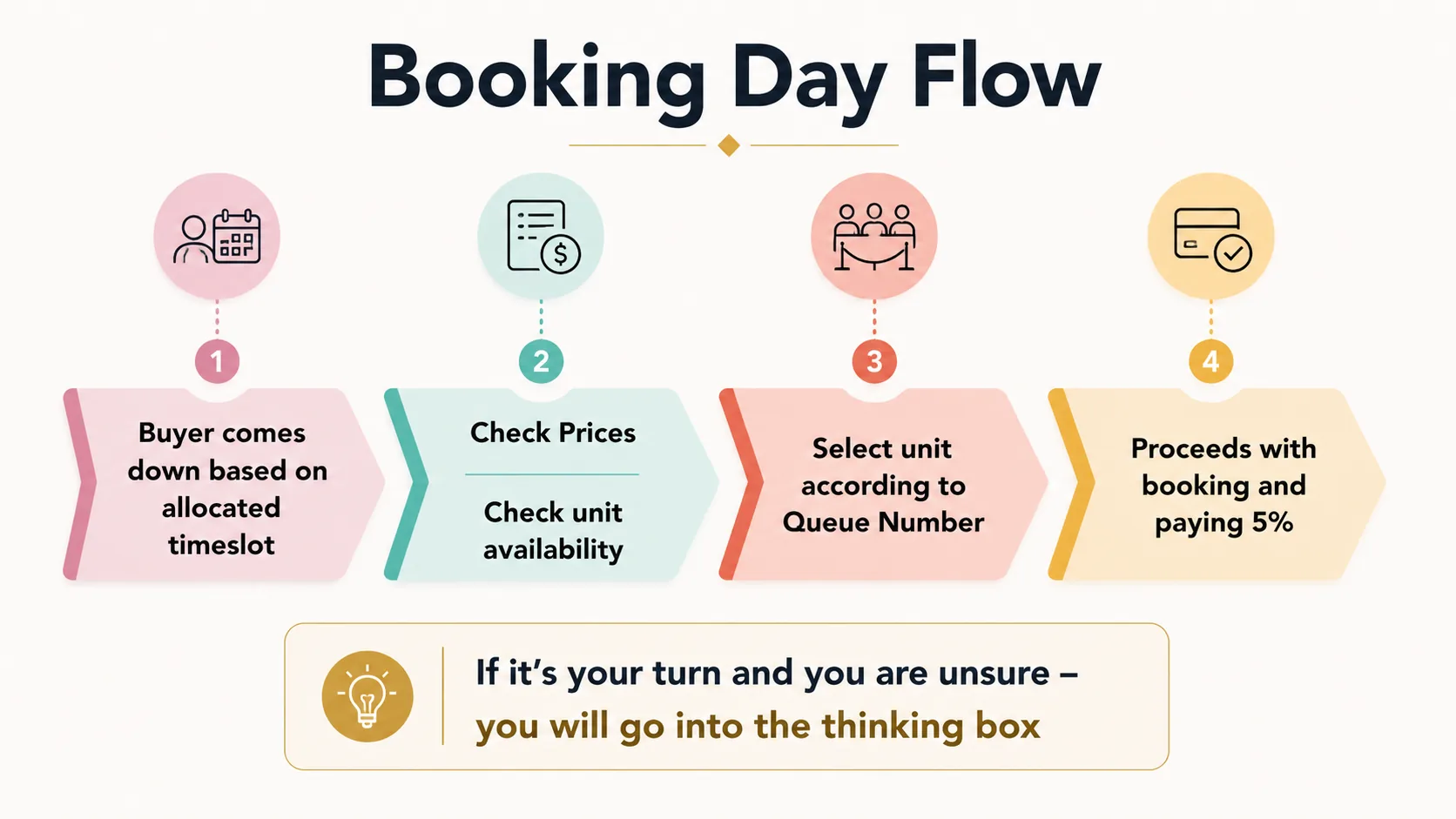
Booking day is the single day in a Singapore new launch when buyers are called in by queue number to choose a unit and pay 5 per cent of the price. Most turns last under two minutes. Everything that decides whether you get a unit, from eligibility and loan approval to budget and shortlist, is settled in the weeks before it.
Key Takeaways
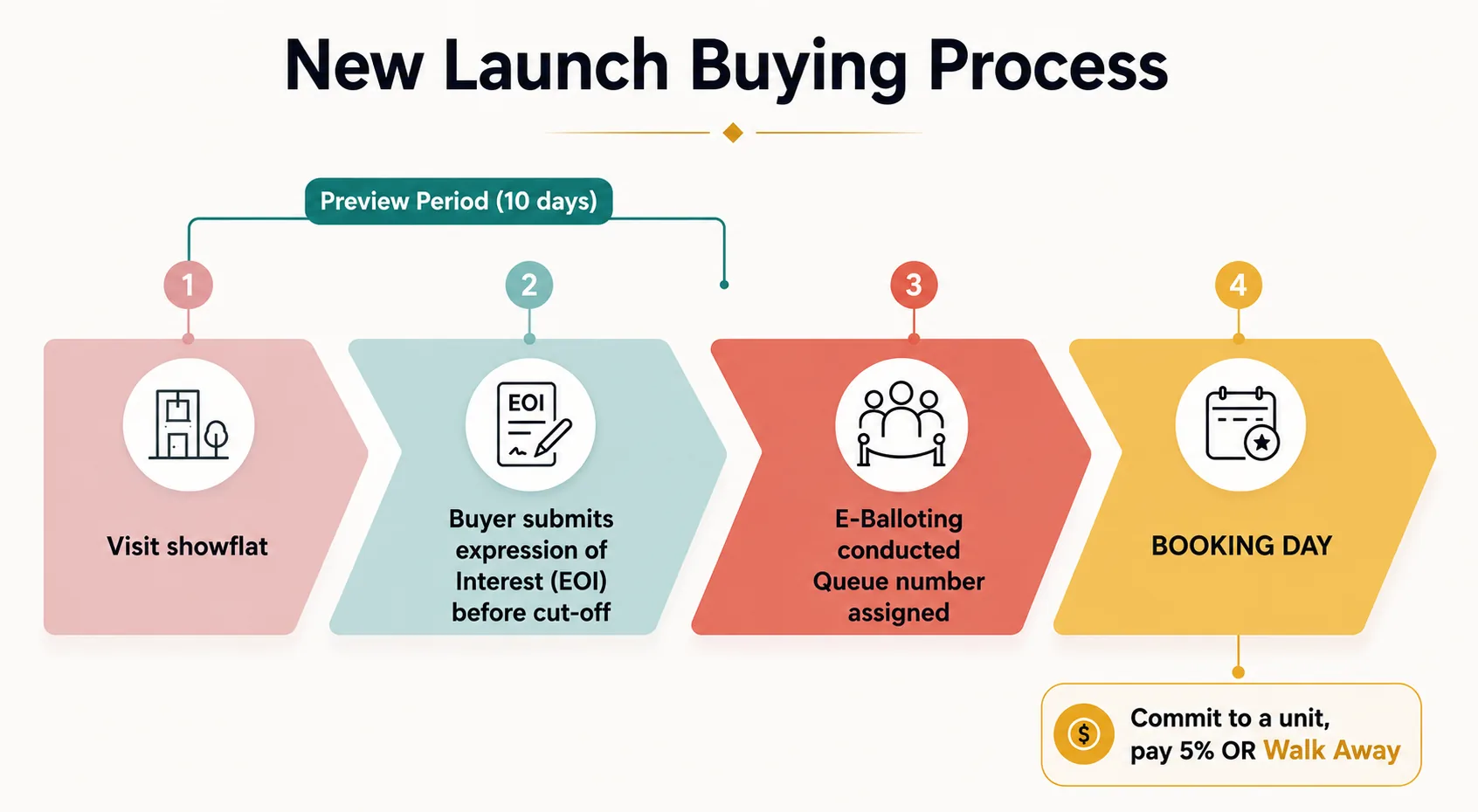
- A private new launch preview typically runs about 10 days. The showflat opens, buyers submit an expression of interest before a cut-off, a computer ballot assigns queue numbers, and booking day falls on the second Saturday.
- On booking day you either commit to a unit and pay 5 per cent, or you walk away. There is no third option and no reservation.
- Turns are called strictly by queue number within an allocated timeslot. Hesitate and you are moved aside into the thinking box while the queue continues.
- A low queue number guarantees nothing. Buyers with good numbers regularly fail to appear, and buyers without bank approval cannot proceed.
- With a 75 per cent loan, an extra $69,000 on the purchase price costs about $17,250 more in cash and CPF upfront, a quarter of the difference. That arithmetic is why a higher floor is usually more affordable than it first sounds.
- Bring your NRIC, the means to pay 5 per cent, your bank’s in-principle approval, and a shortlist of units in three tiers rather than one favourite.
Four terms run through the rest of this article, so here they are once.
- EOI: expression of interest. A form, usually with a cheque attached, telling the developer you intend to buy. It is not a purchase and it does not reserve a unit.
- IPA: in-principle approval. A bank’s written indication of how much it will lend you, based on your income and existing commitments. It is free and it usually lasts about 30 days.
- ABSD: Additional Buyer’s Stamp Duty. An extra tax on top of ordinary stamp duty, charged on second and subsequent residential properties.
- psf: per square foot. The price divided by the floor area, which is how buyers compare a small unit against a large one.
2. How Does A New Launch Actually Get Sold?
In four stages.
And the fourth is the only one where money changes hands.
Stage one: the preview
The showflat opens to the public, usually for about ten or eleven days.
You can view the units, take the floor plans and site plan, and ask questions.
What you will often not get in the first few days is the price list.
That is normal, and it is worth planning around rather than being annoyed by.
Stage two: the expression of interest
If you want a turn on booking day, you submit an EOI before the stated cut-off.
One EOI gives you one turn.
It does not give you a unit, a price, or a hold on anything.
Stage three: e-balloting
After the cut-off, the developer runs a computer ballot and assigns every EOI a queue number.
You are then given a timeslot for booking day.
At heavily subscribed launches this is where the anxiety starts, because the number you receive can be in the thousands.
For the launches everyone is watching, the figure agents are talking about ahead of preview runs past 3,000 expressions of interest against a project of around 1,200 units.
Treat that as market chatter rather than a published number, because it is.
But even if it is roughly right, it is worth reading carefully.
Three thousand cheques against 1,200 units is not three thousand people competing for your unit.
It is a queue, worked through in order, with a steady stream of people dropping out of it.
Two things are worth saying about that.
First, at some launches developers give earlier turns to buyers taking more than one unit within a household group.
Second, if that is not you, it does not lock you out.
It means you are competing inside the single-purchase pool, which is where the great majority of units are actually sold.
Stage four: booking day
Usually the second Saturday of the preview period.
You either commit and pay 5 per cent, or you go home.
| Stage | Roughly when | What you do | Where buyers lose out |
|---|---|---|---|
| Preview opens | Day 1 | View the showflat, collect floor plans, ask about the unit mix | Coming on the final weekend, with no time left to arrange finance |
| EOI cut-off | Around day 7 to 9 | Submit the expression of interest with a cheque | Missing the cut-off, which means no queue number at all |
| E-balloting | 1 to 2 days after cut-off | Receive your queue number and timeslot | Treating a low number as a result rather than a turn |
| Price list released | Shortly before, or on, booking day | Compare the actual prices against your shortlist | Forming a first view of fair value with two minutes to spare |
| Booking day | Second Saturday | Select a unit, sign, pay 5 per cent | Hesitating, or not turning up |
| Exercise the option | Within about 3 weeks | Sign the sale and purchase agreement, pay 15 per cent and stamp duty | Discovering the loan does not reach the price |
Still weighing a new launch against a completed home?
The trade-offs sit in a separate piece on what a new launch and a resale condominium each really cost.
Wondering how much more new launches usually cost per square foot than the resale homes nearby? I measured it across 56 launches in Geek Out #06.
3. What Happens On Booking Day Itself?
Very little, very fast.
You arrive at your allocated timeslot, usually asked to be there about 45 minutes early.
You check the released price list and see what is still available.
Then you wait for your number.
When it is called, the exchange runs something like this.
DeveloperQueue number 89. What is your unit selection?
YouUnit 08-08.
DeveloperUnit 08-08, price $2.15 million. Do you confirm?
YouI confirm.
That is the whole transaction.
You sign, you pay 5 per cent, and you are issued an Option to Purchase.
There is no negotiation on price, because the price list is fixed and the same for everybody.
There is no negotiation on time, because queue number 90 is standing behind you.
The only answer that keeps your turn is yes.
4. What Is The Thinking Box?
Where units get lost.
If you are unsure when your number is called, you are not given extra time at the front.
You are moved aside so the queue can continue.
That holding area is what the industry calls the thinking box.
While you are in it, queue number 90 books.
Then 91.
Then 92.
You re-enter the queue when you are ready, at the back of whoever has arrived in the meantime.
Two turns is often enough for a specific unit to go.
I have seen a buyer step aside to compare a unit against another project, and by the time they came back the stack they were weighing had gone.
Which is not a tragedy if the shortlist has depth.
It is a wasted queue number if it does not.
Booking day is not thinking day.
All the thinking is meant to have happened already.
5. Does A Good Queue Number Mean You Are Safe?
No.
This is the part buyers find hardest to believe.
At most launches there is a meaningful number of no-shows near the front of the queue.
Queue number two, contactable all week, does not appear on the day.
Queue number 16 does the same.
Not because they went cold on the project.
Because they were not ready, and the day arrived anyway.
The usual reasons are ordinary:
- The bank approval had not come through
- The existing home had not sold
- The stamp duty position was still unclear
- The cheque was not arranged
- Husband and wife were not agreed
- Nobody had told them what the day involved
A queue number is a turn, not a unit.
Which cuts the other way too, and this is the useful half.
A buyer at queue number 300 who has loan approval, a budget and a shortlist will regularly book ahead of a buyer at 100 who has none of those things.
Preparation is the only part of booking day you control.
The ballot is not.
6. What Should You Settle Before The Showflat Opens?
Four things.
None of them require the price list, the floor plans, or even a confirmed launch date.
Which is why there is no reason to wait.
1. Whose name the property goes into
This sounds administrative and it is the most consequential of the four.
Sole name or joint names changes your borrowing capacity, your stamp duty exposure, and what you can do next.
It is also close to impossible to unwind cheaply once the option is signed.
If there is a case for restructuring, and often there is not, it has to be made months before, not on a Saturday.
2. An in-principle approval from a bank
An IPA costs nothing and takes a few days.
It turns “what can I afford” into a number.
Two limits sit behind that number.
Your total monthly debt repayments are capped at 55 per cent of gross monthly income, tested at an assumed interest rate rather than the rate you are offered.
And a first housing loan can cover up to 75 per cent of the price, which means you fund the remaining quarter from cash and CPF.
Without the IPA you are shopping for layouts you may not be able to book.
3. Your real budget, not your comfortable number
Ask a buyer their budget and the answer is usually a round figure.
Two million.
One and a half.
That figure is nearly always a feeling rather than a calculation.
Sometimes it sits well below what the bank will lend, and the buyer has quietly ruled out half the project for no reason.
Sometimes it sits above what they should borrow, and nobody has said so.
Both of those are worth knowing before the day. Only one of them is a pleasant surprise.
The honest version of this exercise produces a range with a ceiling you would still be comfortable with if rates moved against you.
Not a stretch figure produced under time pressure.
4. Your stamp duty position
If you already own a residential property, ABSD applies, and it is a large number.
Work out the exact figure early, because it is paid from the same cash and CPF as your down payment.
Confirm current rates at IRAS rather than working from a figure someone quoted you last year.
And if the plan involves selling your current home, the sequence matters as much as the sum. I have set out how that side runs in the guide to selling an HDB flat step by step.
Not sure which of the four is your weak point? Send me your current property, outstanding loan, rough CPF usage and household income. I will come back with the borrowing range, the stamp duty figure and the sale-and-purchase sequence, including the version where you do not buy. Start with a short conversation.
7. Is Paying ABSD Always The Wrong Answer?
Not always.
There is a strong reflex in this industry that ABSD is something to be engineered around.
Sell first.
Decouple.
Restructure.
Anything but pay it.
And often that reflex is right, because 20 per cent of a purchase price is a serious amount of money.
But it is worth checking the alternative properly rather than assuming it wins.
Decoupling means one co-owner buys out the other’s share of the existing home, so that the buying spouse counts as a first-time purchaser on the next property.
The share being transferred is itself a purchase, and it carries ordinary Buyer’s Stamp Duty.
On a larger home, that is not a small sum.
Share transferred on decoupling = $5,000,000
Buyer’s Stamp Duty on $5,000,000 = about $239,600
New purchase at $1,700,000, ABSD at 20% = $340,000
Difference ≈ $100,000
My own calculation using the published residential stamp duty tiers, for a Singapore Citizen buying a second residential property, before any relief.
So on those figures the engineered route saves roughly a hundred thousand dollars.
Against which you have to set the legal fees, the new loan on the transferred share, the time, and the fact that one spouse now owns nothing of the family home.
That last item is not a financial line, and it is regularly the one that stops the whole exercise.
Some couples look at each other across the table and decide that giving up half of a $10 million home to buy a two-bedroom apartment is not a trade they want.
Three other things are worth knowing.
- HDB flats cannot be decoupled at all
- Older owners often cannot get a loan on the transferred share
- Married couples buying jointly may claim ABSD relief if the first home is sold within the stated window
Check the relief conditions at IRAS before relying on it, because the timing rules are strict.
The point is not that ABSD is fine. It is that the cheapest structure on paper is not always the one you would choose.
Have that conversation early enough that it is a decision rather than a scramble.
8. One Dream Unit, Or A Shortlist?
A shortlist, in three tiers.
Most buyers arrive with one unit in mind.
The exact stack, the exact floor, the exact facing.
In a project of 1,268 units, that description might fit fifteen of them.
By the time a mid-range queue number is called, the odds that one of those fifteen is still on the board are not good.
So build the list in three layers instead.
- Ideal: the stack, floor and facing you actually want
- Strong: anything meeting your two or three real priorities
- Acceptable: anything that works at the right price
Fifteen units, then perhaps two hundred, then most of the project.
The third tier is not a compromise you have agreed to in advance.
It is a list you have already thought about, so that if the first two are gone your turn still produces a decision instead of a pause.
Do the family consultations before the day
If a geomancer’s view matters in your household, get it done on the floor plans during the preview.
This happens more often than you would think.
A buyer arrives on booking day holding a slip of paper naming the only three units that were approved, and none of the three is still available.
The same applies to a parent whose opinion will decide it, or a spouse who has not seen the showflat.
Everyone who has a vote should have used it before the queue starts moving.
9. Does A Higher Floor Pay For Itself?
Usually, yes.
But the reason has less to do with the view than with two pieces of arithmetic.
The first is what the extra floors actually cost you on the day.
Because you fund a quarter of the price and borrow the rest, the upfront gap is a quarter of the headline gap.
$69,000 × 25% = $17,250
$32,000 × 25% = $8,000
That is the number to compare against, not the price difference.
A buyer told the higher unit is $69,000 more hears a large figure.
A buyer told they need $17,250 more over the next two months hears a different question.
The second piece of arithmetic is what happened on exit.
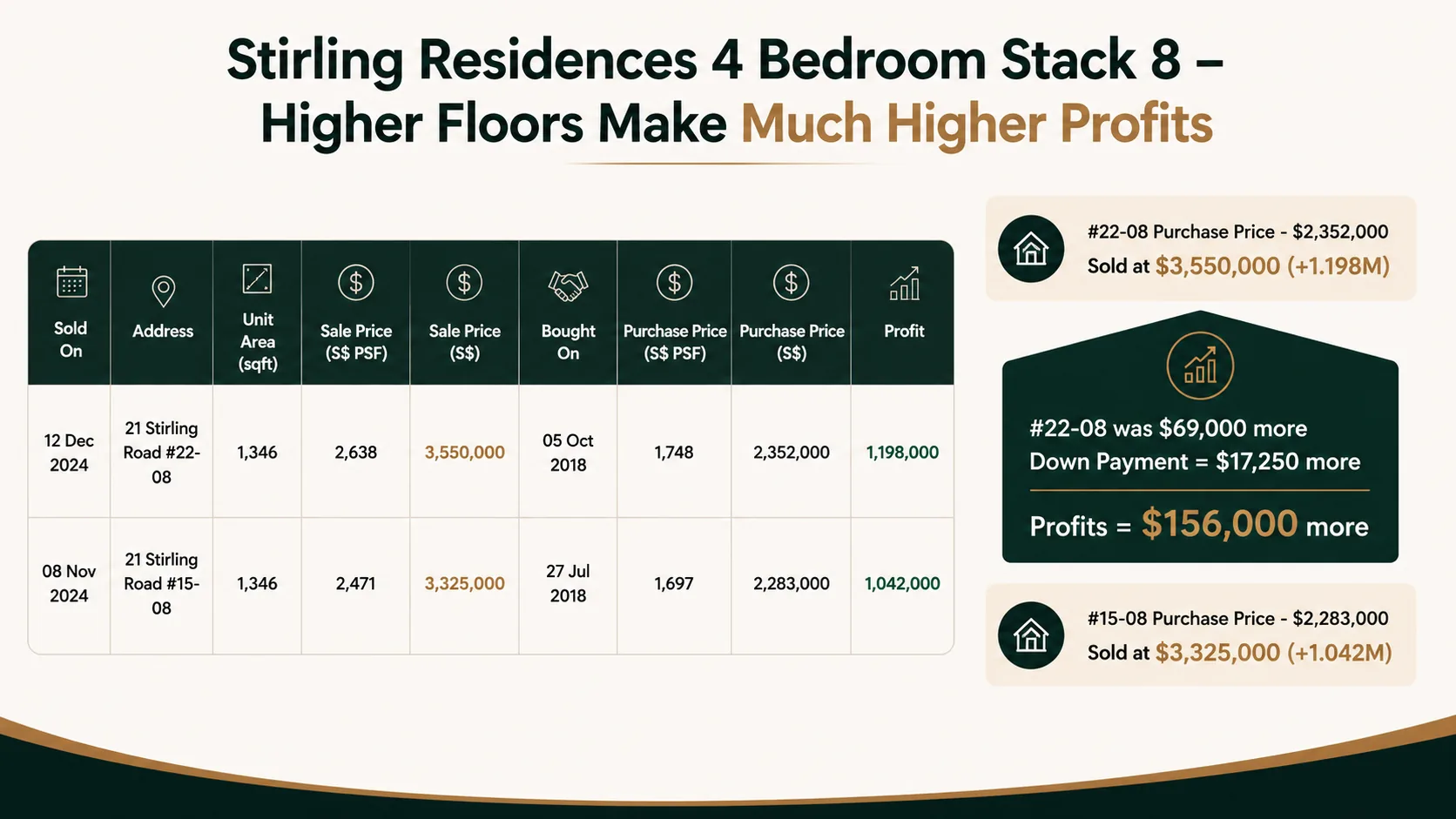
Same project, same stack, same 1,346 sq ft.
The level 15 unit was bought at $2,283,000 and sold at $3,325,000.
The level 22 unit was bought at $2,352,000 and sold at $3,550,000.
So seven floors cost $69,000 at the counter, or about $17,250 in upfront funds.
And produced $156,000 more on the way out.
A similar two-bedroom pair at JadeScape, in the same District 20 stretch, showed the same shape: six floors cost about $32,000 more at purchase and returned roughly $88,000 more on sale four years later.
Now the honest part, because two pairs of units is an illustration and not a study.
Those profit figures are gross.
They are before stamp duty, loan interest, legal costs and agent fees, and the higher unit carries a larger loan throughout.
Both units were also bought and sold in comparable market conditions, which is why they are worth comparing at all. It is exactly that condition a different pair might fail.
What I would not claim from this is that a high floor guarantees a better return.
What it does support is something narrower and more useful.
Higher floors are easier to sell.
Anyone who has marketed a resale listing knows the first question on almost every enquiry.
Which floor?
A low-floor listing gets skipped on the phone.
And a buyer pool that skips your unit is a liquidity problem, whatever the psf says.
Which leads to the version of this argument I do find persuasive for an owner-occupier.
If two units in the same stack end up making a similar gain, the higher one gave you the view, the light and the privacy for ten years at no net cost.
That is a conditional statement, not a promise.
But it is a better frame than treating the floor premium as money spent.
10. Should You Rule Out A Unit Type Before The Day?
No.
This is the most common own goal at a busy launch, and it is usually well intentioned.
A buyer says they are looking at a two-bedroom.
They are told the three-bedroom appreciates better, so the two-bedroom is off the table.
Then their timeslot arrives at 7pm on booking day with a queue number in the four figures, and the three-bedroom compact units sold out hours earlier.
The turn produces nothing, and the reason is that a decision made in advance had already deleted the units that were still available.
The best unit is the one that is available when your number is called.
Two habits follow from that.
First, know the unit mix before the day.
A 1,268-unit project where two- and three-bedroom units make up over a thousand of them behaves very differently from one where the large units dominate. If the four- and five-bedroom types are a small share of the total, a buyer in that segment should be looking at three-plus-study layouts too, not only at the type they named.
Second, be careful with received wisdom about which type makes money.
The usual pattern is that smaller units carry a higher psf than larger ones on the same floor.
At several recent launches that pattern has been inverted, with two-bedroom psf coming in at or below the three- and four-bedroom types.
I would not assume it either way.
Pull the actual price list for your project and check, because entry price is the part of a new launch return you have some control over.
The framework I run through before advising on any launch, including the unit mix question, is set out in the five things I check before advising a buyer on a new launch.
11. What Price Homework Should You Do First?
Three numbers.
The price list often lands a day or two before booking day, sometimes on the morning itself.
If you have not formed a view of what fair looks like by then, you will be forming it in the two minutes you have to decide.
So do it during the preview, with three reference points.
- Recent resale psf at comparable projects nearby, adjusted for age and remaining lease
- Recent new launch psf in the same market region
- What land nearby has recently sold for, since that sets the floor under the next launch
The third one is the least intuitive and the most useful.
A developer who paid more for land will need a higher price to make the project work, which is why the next launch in your area is rarely cheaper than this one.
Region matters here too, because the three market regions behave differently on price, rental demand and resale liquidity.
I have set that out in how the OCR, RCR and CCR actually differ for a buyer.
And worked a full example of land cost feeding through to launch pricing in the Thomson Reserve review.
One caution, and I would rather say it plainly.
This exercise runs in both directions.
A price you can justify against comparables is not the same as a price you should pay.
And an agent quoting comparables at you on booking day is running the same exercise in reverse.
Do the homework so you can judge the price list, not so you can be talked past it.
12. The Dos And Don’ts, In One Place
| Stage | Do | Don’t |
|---|---|---|
| Before the preview | Get an in-principle approval. Settle whose name it goes into. Work out your ABSD figure. | Wait for the price list before thinking about finance. |
| At the showflat | Come on the first weekend if you can. Take the floor plans and the unit mix. | Arrive on the last Monday with the cut-off on Tuesday. |
| Choosing units | Build three tiers: ideal, strong, acceptable. Finish every family and geomancy consultation now. | Rule out a bedroom type, or a floor band, before you know what is left. |
| On pricing | Set your own view of fair value from resale, new launch and land comparables. | Adopt an average-price rule from a video and let it delete half the project. |
| Booking day | Arrive 45 minutes early with NRIC, cheque or transfer ready, and your shortlist printed. | Plan to decide at the counter. That is the thinking box. |
| After booking | Diarise the option deadline and line up the 15 per cent plus stamp duty. | Assume the booking fee is fully refundable if you change your mind. |
13. My Take: Booking Day Is An Administrative Day
Read back over the three ways buyers lose out here.
The thinking box.
The no-show at queue number two.
The buyer whose only permitted unit type sold out at four in the afternoon.
They look like three different problems.
They are the same problem arriving at three different moments.
In each case a decision that belonged weeks earlier turned up on the day instead.
Which is why I do not think of the four checks, the shortlist and the price view as separate pieces of preparation.
They are one piece.
The loan approval tells you which price bands are real.
The price bands tell you which stacks are worth shortlisting.
And the shortlist is what lets you answer in four words when your number is called.
Take any one out and the other two stop working.
There is a second thing worth naming, because it runs against how these launches are usually described.
At a heavily subscribed launch, most buyers who miss out are not outbid.
The price is fixed and published; nobody outbids anybody.
They miss out because they were not in a position to say yes when the queue reached them.
And the corollary is uncomfortable for the industry: a buyer arriving unprepared is not competing with 3,000 other cheques.
They are competing with the version of themselves that could have spent a free afternoon on an IPA.
None of which is an argument for buying.
Preparation is what lets you decide properly, and a good number of the conversations I have end with the buyer choosing to sit this one out.
That is a fine outcome.
It is simply better arrived at in advance than discovered at the counter.
14. The Short Version
If you read nothing else:
- A private new launch runs on a roughly ten-day preview, an EOI cut-off, a computer ballot for queue numbers, and a booking day on the second Saturday.
- Booking day is binding. You pay 5 per cent and receive an Option to Purchase, or you leave with nothing.
- Each turn lasts about two minutes. Hesitation moves you to the thinking box and the queue continues.
- Queue numbers are turns, not units. Prepared buyers at 300 regularly book ahead of unprepared buyers at 100.
- Four things to settle first: whose name, an in-principle approval, a real borrowing range, and your exact stamp duty figure.
- Because you fund a quarter of the price, a $69,000 step up on the price list costs about $17,250 upfront. Judge floor premiums on that number.
- Do not delete a bedroom type or a floor band in advance. The best unit is the one available when your number is called.
- Form your own view of fair value during the preview, from resale, new launch and land comparables.
So what should you do with this?
Three things, and none of them need a launch date.
- Apply for an in-principle approval this month, whether or not you intend to buy this year.
- Work out your ABSD figure and, if you own a home already, price the alternatives properly rather than assuming decoupling wins.
- Write down your three tiers of units for the project you are watching, and get every family consultation done on the floor plans.
Want this run against your own numbers before the next preview? Tell me what you own, what you owe and what you are watching. I will come back with your borrowing range, your stamp duty position and the sale-and-purchase sequence if you are upgrading. Also an honest view on whether the project is worth a queue number at all. The wider methodology sits under asset progression. Start a conversation or message me on WhatsApp.
15. Frequently Asked Questions
What actually happens on booking day at a Singapore new launch?
Buyers attend at an allocated timeslot, usually asked to arrive about 45 minutes early, and check the released price list against what is still available. Turns are then called strictly in queue-number order. When your number is called you name a unit, the developer confirms the unit and price, and you either confirm and pay 5 per cent of the price, or you do not proceed. There is no negotiation on price and no facility to reserve a unit and decide later.
How long does each buyer’s turn take?
Usually under two minutes. The exchange is a unit number, a price confirmation and a yes. At a large launch the developer may be working through hundreds of buyers in a day, so the process is deliberately fast. If you need time to weigh two options you will be moved aside so the queue can continue.
What should I bring to booking day?
Your NRIC or passport, the means to pay 5 per cent of the price by cheque or transfer, your bank’s in-principle approval, and a printed shortlist of units in order of preference. Bring every co-buyer whose signature will be needed. If you have received a family or geomancy consultation, bring the list of approved units, and make sure it runs to more than two or three options.
Do I pay stamp duty on booking day?
No. On booking day you pay the 5 per cent booking fee only. Buyer’s Stamp Duty and, where it applies, Additional Buyer’s Stamp Duty fall due when you exercise the Option to Purchase, which is typically about three weeks later, alongside a further 15 per cent of the price. Plan the cash for both stages, because they come from the same pool as your down payment.
Can I change my mind after paying the 5 per cent booking fee?
You can walk away, but not for free. The 5 per cent buys an Option to Purchase, usually exercisable within about three weeks. Under the standard terms, a buyer who does not exercise forfeits a quarter of the booking fee, which works out to roughly 1.25 per cent of the purchase price, and the balance is refunded. Read the actual Option to Purchase for your project rather than relying on the general rule.
Does a low queue number guarantee I get the unit I want?
No. A queue number is a turn, not a unit. If the specific unit you want has already been booked by an earlier number, your turn simply comes with fewer choices. That is why a shortlist with depth matters more than a good ballot result. Conversely, a high queue number is far from fatal, because a meaningful share of earlier buyers do not turn up or are not in a position to proceed.
What is the thinking box, and can I go back into the queue?
The thinking box is the holding area you are moved to if you cannot confirm a unit when your number is called. You keep your place in the sense that you may rejoin the queue once you have decided, but the queue does not wait for you, so later numbers book ahead of you in the meantime. Two or three turns is often enough for a particular unit to be taken, so the practical cost of the thinking box is the choices you lose while you are in it.
Do I need an in-principle approval before the preview?
It is not compulsory, but it is the single most useful thing to arrange in advance. An in-principle approval is a bank’s written indication of how much it will lend you, it costs nothing, and it usually takes a few days and lasts about 30 days. Without it you are choosing between layouts without knowing which price bands are actually open to you, and buyers who reach booking day without loan clarity are the ones who most often fail to proceed.
Is it better to pay ABSD or to decouple before buying a new launch?
It depends on the value of your existing home, whether it can be decoupled at all, and what the co-owner is giving up. Decoupling avoids Additional Buyer’s Stamp Duty on the new purchase, but the share being transferred attracts ordinary Buyer’s Stamp Duty, plus legal fees and a new loan on that share. On a large home the saving can narrow to around a hundred thousand dollars, which some couples decide is not worth one spouse ceasing to own any part of the family home. HDB flats cannot be decoupled, and married couples buying jointly may instead qualify for ABSD relief if the first home is sold within the stated window. Price all three routes with your own figures before assuming one wins.
16. Sources And Notes
Where the figures on this page come from, and how confident I am in each.
- Process, timings and booking-day mechanics: standard practice for private residential new launches in Singapore, as run at recent previews. Individual developers vary the preview length, the EOI cut-off and any priority rules, so confirm the specifics for your project.
- Stamp duty rates and reliefs: IRAS Additional Buyer’s Stamp Duty and IRAS Buyer’s Stamp Duty. The $239,600 and $340,000 figures in section 7 are my own calculation from the published tiers, for a Singapore Citizen, before any relief.
- Stirling Residences and JadeScape unit pairs: caveat figures as presented in an ERA new-launch training session, September 2026. Profit figures are gross, before stamp duty, loan interest, legal costs and agent commission. Two pairs of units illustrate a mechanism; they are not a study of floor premiums.
- Borrowing limits: the 55 per cent total debt servicing ratio and the 75 per cent loan-to-value limit on a first housing loan are the prevailing rules. Your bank applies its own assumed interest rate in the test, so ask for the number rather than estimating it.
- Expression-of-interest volumes: the 3,000-plus figure in section 2 is agent chatter ahead of a preview, not a developer or regulator disclosure. Nobody publishes EOI counts. I have included it because the scale is plausible and because buyers are hearing it, not because it is verified.
- Unit-mix example: the 1,268-unit figure is Thomson Reserve, covered separately in my review of the District 20 launch.
What would make this page stale: a change to ABSD rates, stamp duty tiers, the total debt servicing ratio or loan-to-value limits, or a material change in how developers run previews and balloting.
Published 3 September 2026. Last reviewed 3 September 2026.
Disclaimer: This article is provided for informational purposes only and should not be construed as financial advice, investment recommendation, or an offer to buy or sell property. While we have made efforts to ensure the accuracy of the information presented, market conditions, developer plans, and regulatory environments are subject to change. Property prices, launch dates, unit availability, stamp duty rates, financing limits and other details mentioned are based on current market intelligence and may be subject to revision. Prospective buyers should conduct independent research, verify all information directly with developers and relevant authorities, and consult with qualified financial and legal advisors before making any property purchase decisions. We are committed to accuracy and transparency; however, the information provided should not be regarded as an offer, statement, representation, or guarantee. While we strive to ensure the information is correct, it may not always be complete, up to date, or free from errors. Users are strongly encouraged to exercise due diligence and verify details through direct inquiries. Our agents and this website shall not be held liable for any decisions or actions taken based on the information provided here.