
12 min read • Published 4 June 2026 • Last updated 16 September 2026
What Is A GLS Site, In One Paragraph?
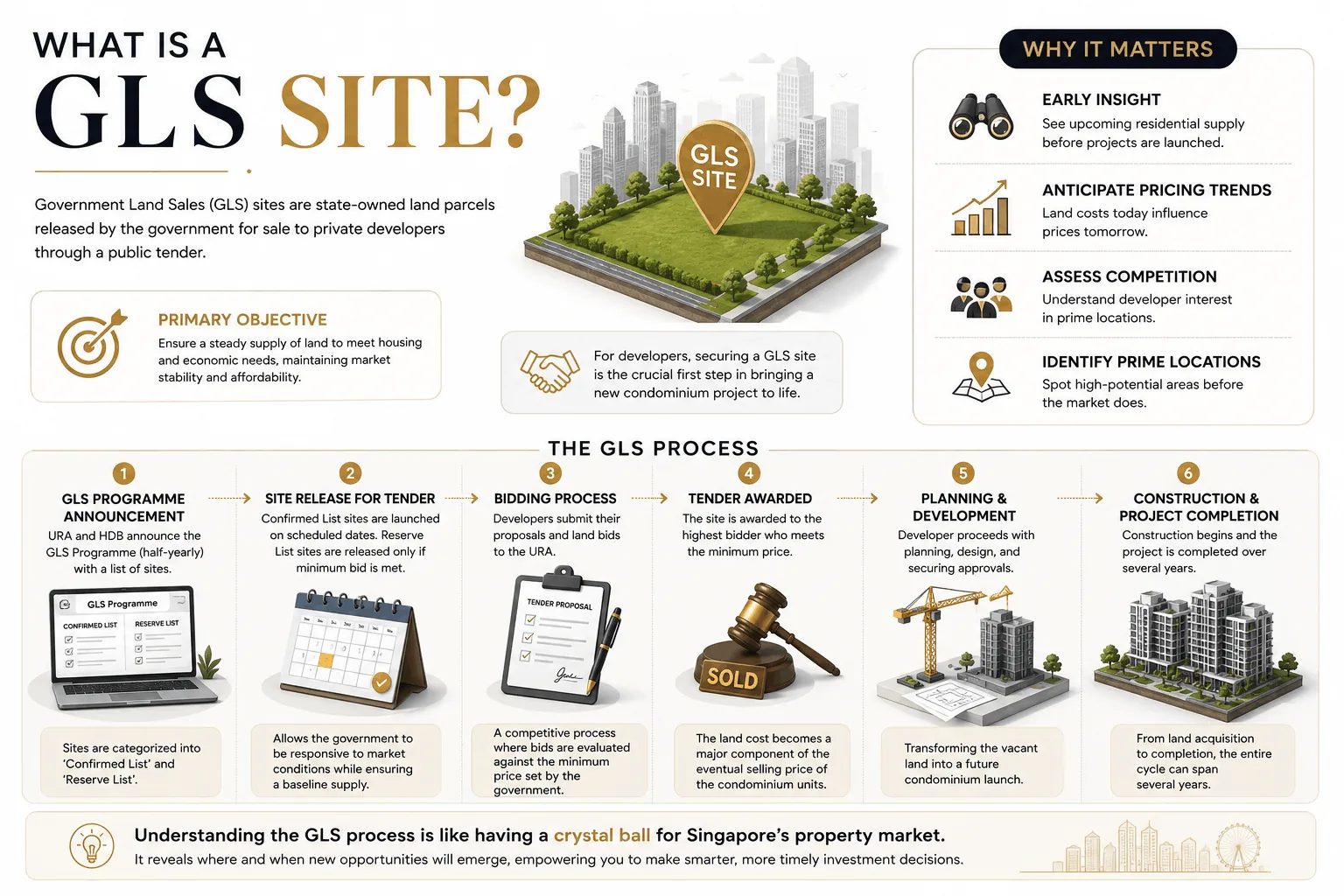
A Government Land Sales site is state land the Singapore government sells to developers by public tender. The winning bid, quoted in dollars per square foot per plot ratio, is the earliest hard number on what the future condominium must charge. Land is roughly half of a project's total cost. The rest is construction, interest, fees and the developer's margin.
Key takeaways
- A tender result is public the day it closes. The launch price it produces arrives 9 to 15 months later.
- Land is a median 54% of total development cost across the 28 awarded sites with a published cost stack, so cheap land does not guarantee a cheap launch.
- The median awarded land rate in the current pipeline is $1,334 psf ppr, against a median estimated breakeven of $2,449 psf ppr.
- 33 sites are being tracked across the 2025 and 2026 programmes, carrying roughly 18,623 future homes. 25 already have a developer attached.
- Figures on this page come from the PropertyInsider.sg GLS pipeline tracker, updated 2 September 2026.
What Is A GLS Site?
State land, sold by tender.
Government Land Sales is the programme the Urban Redevelopment Authority and HDB use to release state-owned plots to private developers. Almost every new private condominium in Singapore starts life this way.
The programme is published twice a year, and it comes in two halves.
| List | How it works |
|---|---|
| Confirmed List | Tendered on a fixed schedule whether or not developers ask for it. Supply is certain. |
| Reserve List | Released only when a developer commits to an acceptable minimum bid. Supply responds to demand. |
Source: URA Government Land Sales programme.
A tender runs for a few weeks, then closes on a set day.
Bids are opened in public and the numbers are reported the same afternoon.
The site is normally awarded to the highest bidder, provided the bid clears the government's undisclosed reserve price.
From award to showflat is usually 9 to 15 months. From award to keys is closer to four or five years.
So the tender result and the price list you eventually see are the same event, separated by about a year.
How Does A Land Bid Turn Into A Launch Price?
Through the breakeven.
Most people treat the land price as the story. It is only the first line of the bill.
The full stack looks like this.
Breakeven + developer margin = launch price
Breakeven is the price per square foot a project has to sell at just to avoid losing money.
Construction currently runs about $600 to $1,000 per square foot, depending on the product. Building over an MRT station or a shopping podium adds another $100 to $150.
On top of the breakeven, a developer needs a margin. PropertyInsider.sg tests a 15% to 30% band against 42 projects that have already launched, and publishes the working in its pricing methodology.
Here is the arithmetic on a real site.
Thomson Reserve in District 20 was won at $1,178 psf ppr. Its estimated breakeven is $2,058 psf ppr. Add the margin band and the estimated launch range is $2,370 to $2,680 psf.
Notice what happened between the first number and the second.
The land was only 57% of the cost.
Across the 28 awarded sites with a published cost breakdown, land is a median 54% of the total.
That single fact does more work than anything else on this page.
It is why a cheap plot can still produce an expensive launch, and why two sites with similar land rates can land in different price brackets. Sembawang Road EC has the cheapest land in the current pipeline at $692 psf ppr, and it still has to clear an estimated $1,477 to break even.
Two things push the gap wider. A low plot ratio spreads the same building cost across less saleable floor area. A long construction period stacks up more interest on the land loan.
Breakeven figures quoted here are EdgeProp Singapore cost-stack estimates as compiled in the PropertyInsider tracker, not developer disclosures. Treat them as informed estimates.
Why Should A Buyer Care Before The Showflat Opens?
Because you get a year's notice.
A showflat is designed to compress your decision into a weekend. The land data is the opposite. It arrives early, it is public, and nobody is standing next to you while you read it.
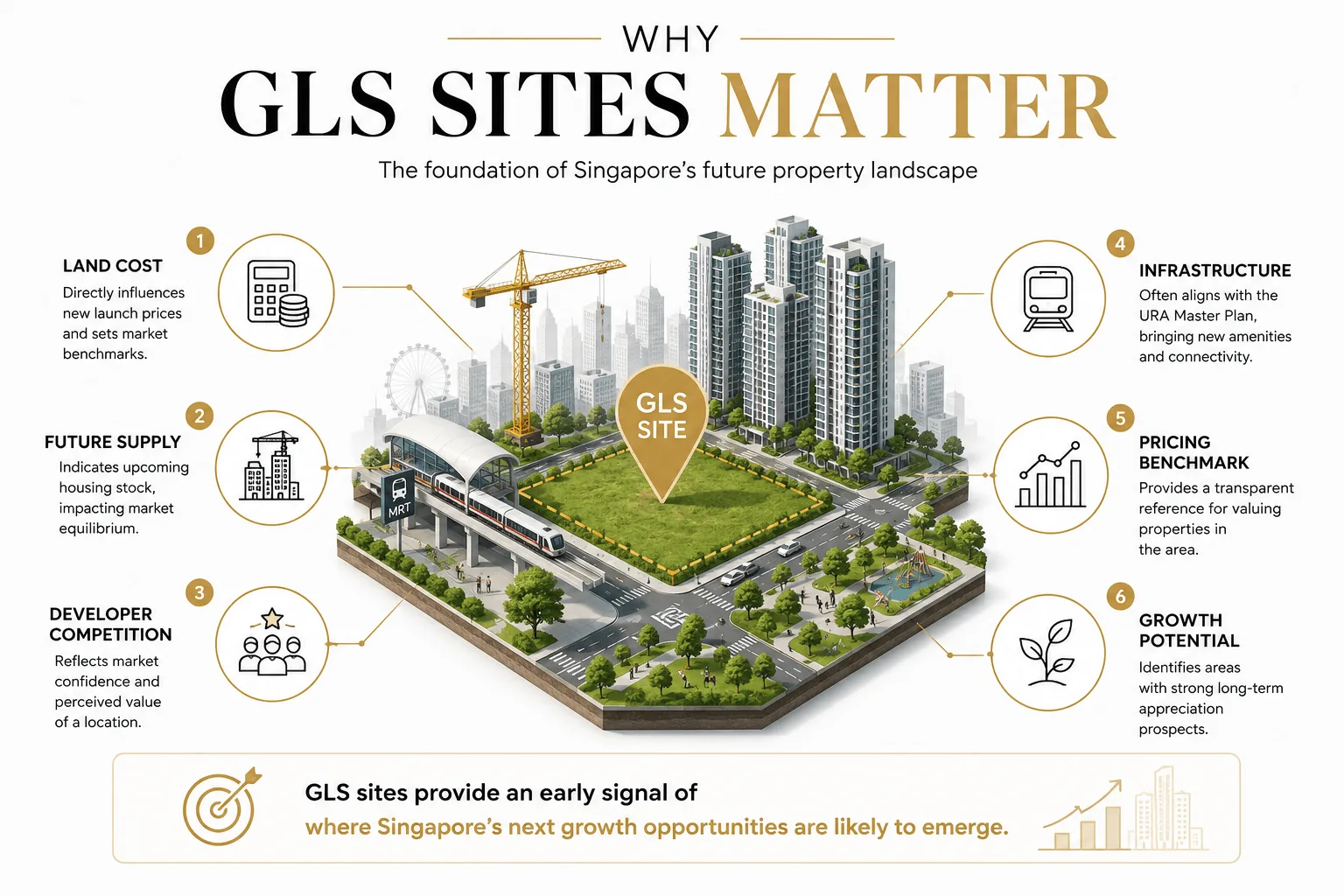
Four things a tender result tells you before any marketing exists:
- The floor under the eventual price
- How many homes are coming to that estate, and when
- Whether developers competed for the location or ignored it
- What the government thinks the area is becoming
That third one gets underrated.
Bid count is a confidence reading. Four bids for a suburban plot says one thing. One bid at the reserve price says something quite different about how the people with the most money at stake see that location.
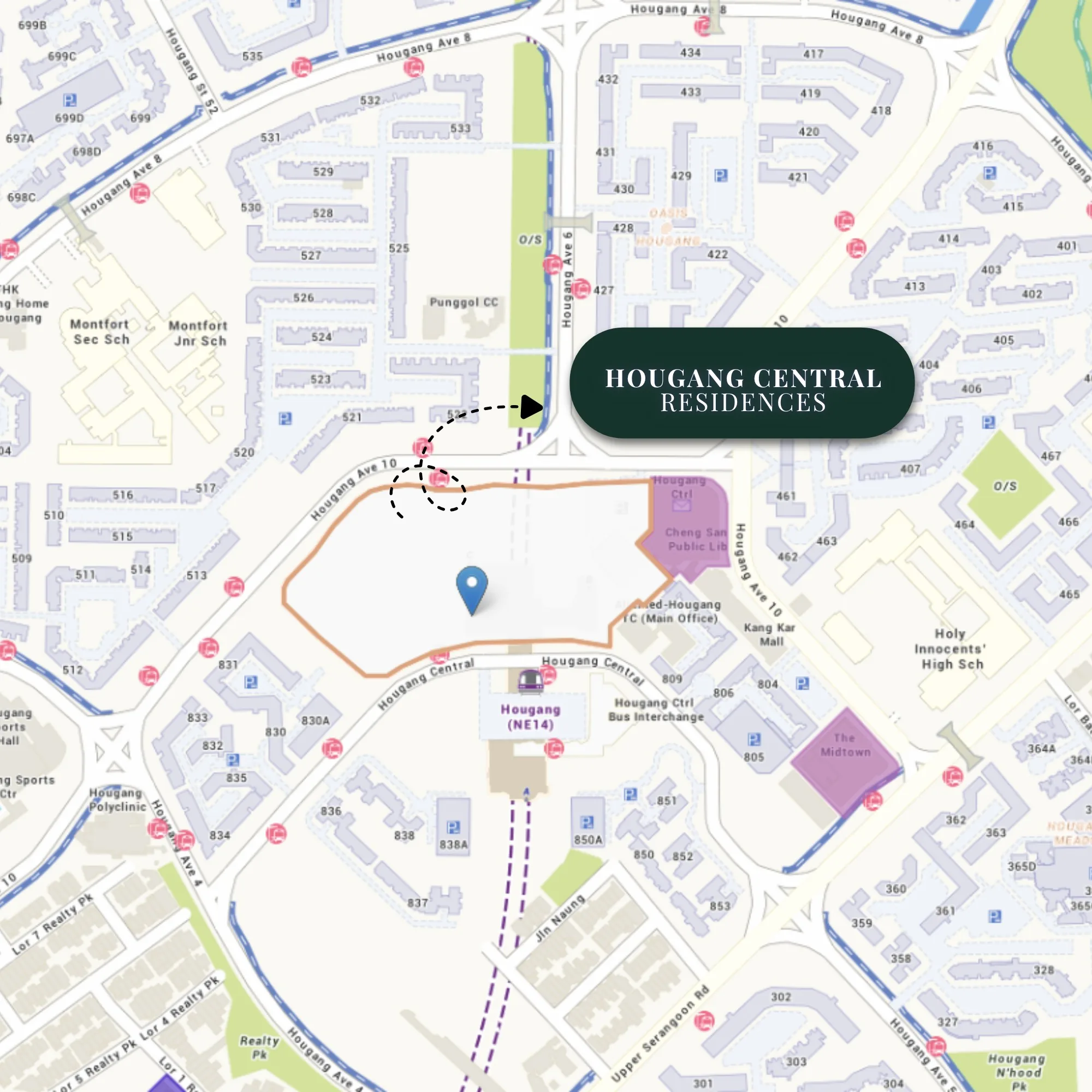
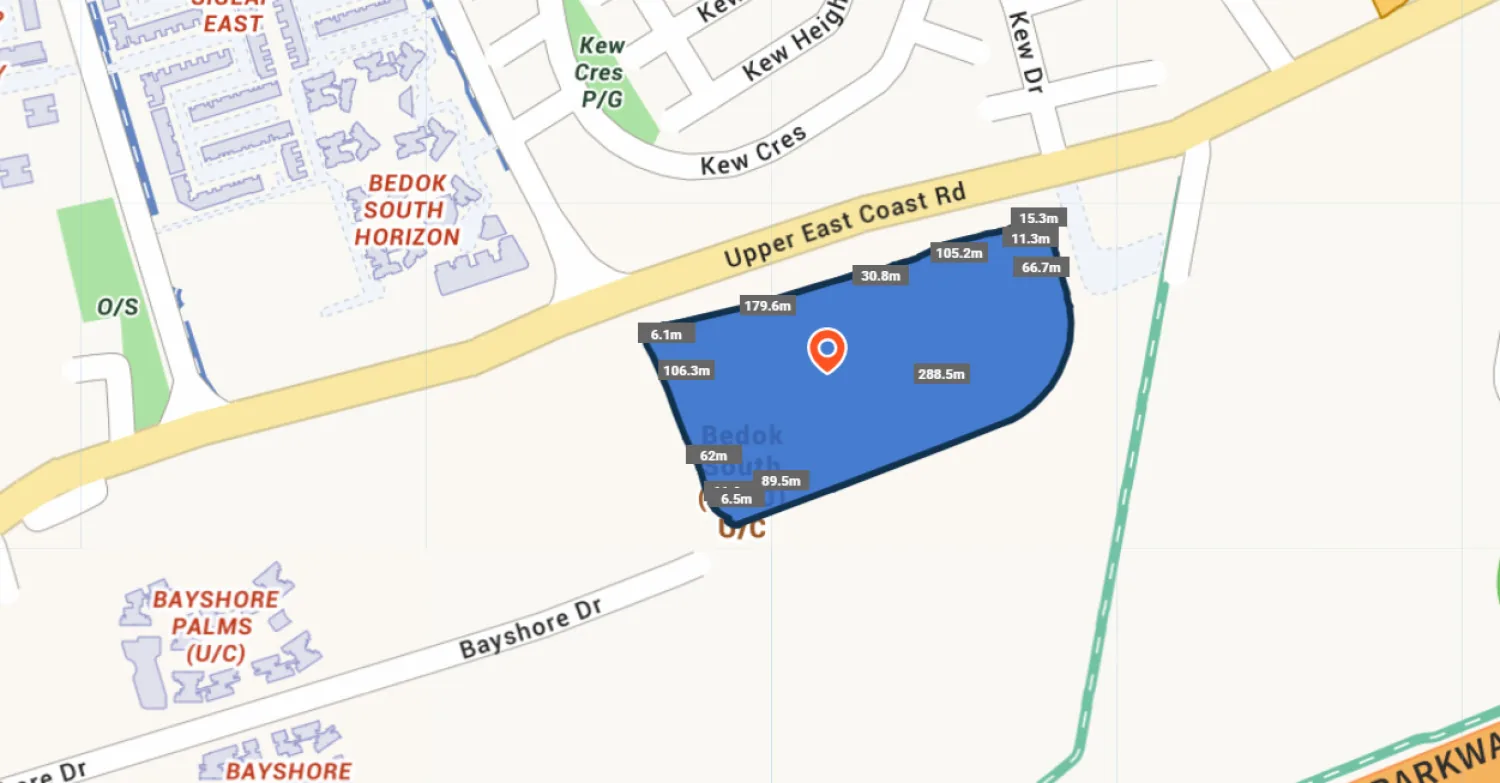
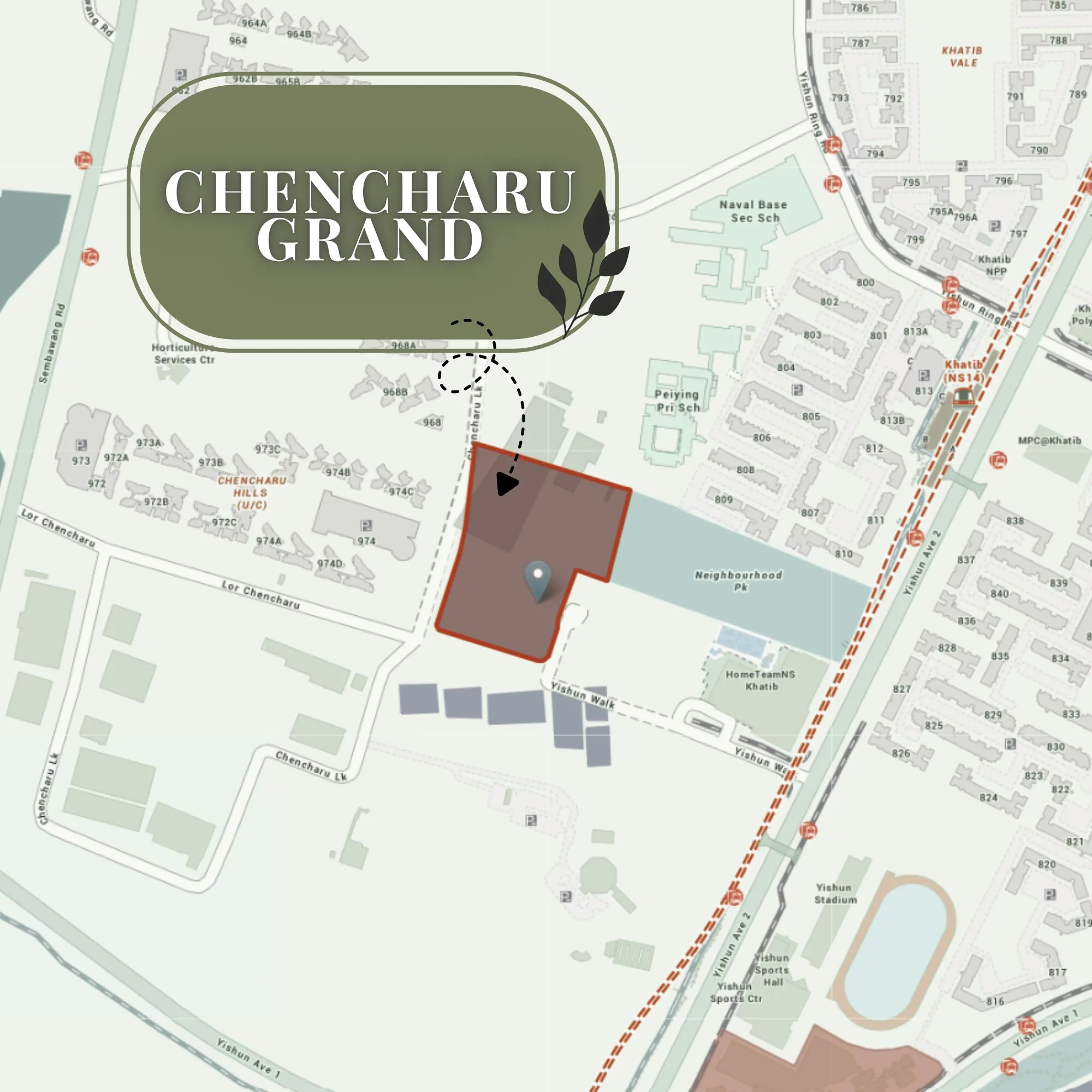
There is a pattern worth knowing. Every suburban mixed-use site sold above $1 billion in this cycle drew exactly three bids. Every one of those bids came from a consortium rather than a single developer. That covers Tampines Avenue 11, Chencharu Close, Hougang Central and Bayshore Drive.
Big sites are now syndicated, not contested.
The fourth one matters over a longer horizon. GLS releases follow the URA Master Plan. So a new plot in a quiet estate is often the first physical sign of a precinct that has sat on a planning map for a decade.
What Does The Pipeline Look Like Right Now?
Deep, and priced apart.
As at the tracker's 2 September 2026 update, 33 sites are being followed across the 2025 and 2026 programmes, carrying roughly 18,623 future homes. Twenty-five already have a developer attached. Seven are still waiting for a tender.
That is about three years of normal demand, visible in advance.
The spread between the top and the bottom of the pipeline is the thing to look at.
| Measure | Figure | What it means |
|---|---|---|
| Median awarded land rate | $1,334 psf ppr | The middle of the current cycle |
| Median estimated breakeven | $2,449 psf ppr | What the median site must clear to avoid a loss |
| Highest awarded rate | $1,865 psf ppr, Peck Hay Road | Prime central land has repriced upward |
| Lowest awarded rate | $692 psf ppr, Sembawang Road EC | Executive condominium land remains the cheap corner |
| Largest single site | Bayshore Drive, 1,280 units | One tender that reshapes a whole estate |
Source: PropertyInsider.sg GLS pipeline tracker, updated 2 September 2026, compiled from URA tender results, developer announcements and EdgeProp development cost estimates. Breakeven figures are estimates.
Two recent tenders show how far apart the ends of this market now sit.
Peck Hay Road in District 11 went for $1,865 psf ppr in June 2026, and Bukit Timah Road for $1,825 psf ppr seven months earlier. Those are the two dearest residential state land rates since 2018, and both now break even above $3,100 psf ppr.
Executive condominium land, meanwhile, sits at $692 to $794 psf ppr. Roughly half the private median.
That gap is why EC launches keep clearing quickly to HDB upgraders.
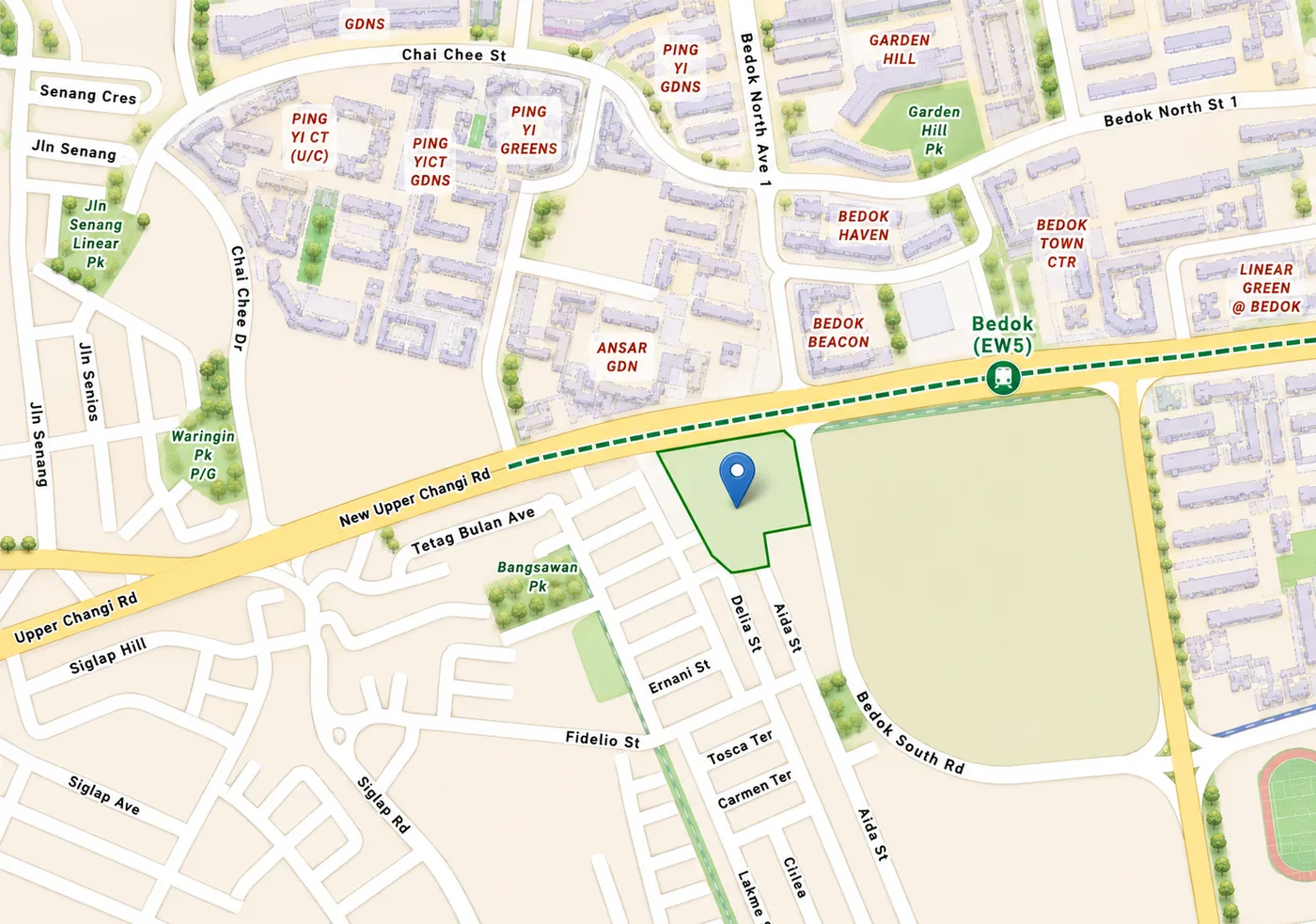
The East is carrying the volume. New Upper Changi Road closed on 1 September 2026 at $1,537 psf ppr for about 1,010 units. That is a record for a pure residential state site in the Outside Central Region, and 15.6% above the $1,330 the nearby Bedok Rise plot fetched ten months earlier. Add Bayshore Drive's 1,280 units and Bedok Rise's 380, and District 16 sits at the centre of supply from 2026 to 2028.
I worked through what that record does, and does not, imply in my analysis of the New Upper Changi Road tender.
Two weeks later the city fringe went higher still. Eco World topped seven bids for the small Lorong Puntong/Sin Ming Avenue plot opposite Ai Tong School at $1,612 psf ppr, for about 140 homes. I explain why developers bid that far above forecasts for scarce Bishan land.
Where Can I See Every Site On One Map?
On PropertyInsider.sg.
I write the analysis on this site. The live dataset behind it sits on PropertyInsider.sg, the research platform I founded. A tracker has to update as tenders close. A written page does not.
The launch map plots every selling project, every named upcoming launch and every GLS site on the same base map.
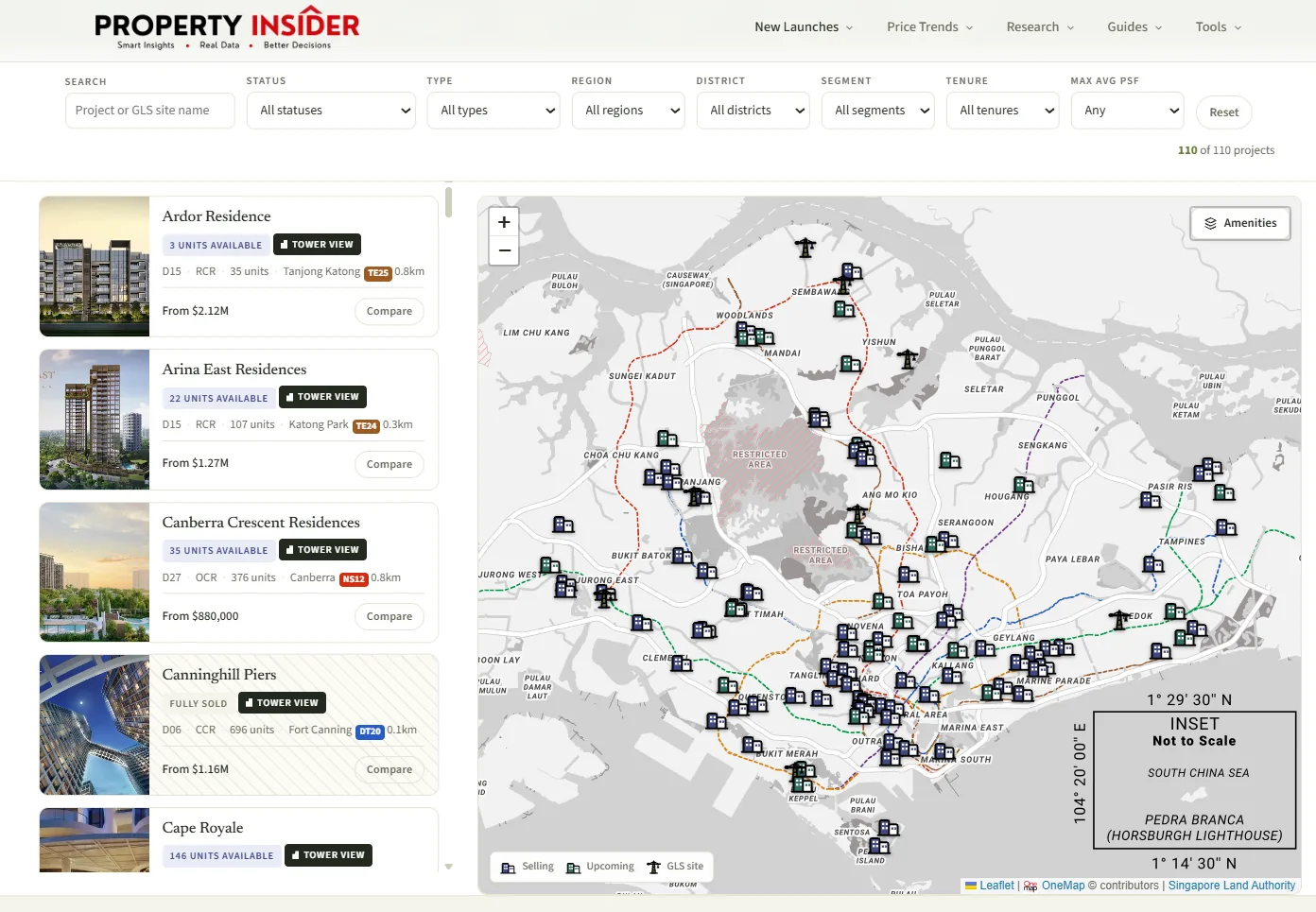
Each card carries the district, the market segment and the total unit count. It also shows the nearest MRT station with its line code and walking distance, the units still available, and the entry price. Two projects can be set side by side with Compare, and a tower view shows which stacks are left.
The map answers "what is near me and what does it cost".
The other page answers "what is coming and what will it cost".
That is the GLS pipeline tracker. It is a sortable table of all 33 sites. Each row shows the status, district, estimated units, awarded land rate, estimated breakeven, an indicative launch range, a target preview window and the winning consortium. It updates as each tender closes, and it carries a log of what changed and when.
Every figure on this page is drawn from those two pages, so they are the primary sources rather than a footnote.
Use both, in this order. Start with the pipeline tracker to see what land in your area cost and what it implies. Then open the new launch map to see what is already selling nearby at what price. The gap between those two numbers is the question worth asking me about.
Which Sites Have I Written Up?
Five, so far, plus the programme overview.
These are the sites where the tender result changed something worth explaining at length. A record rate. An integrated development. A new housing district. A precinct built from scratch.
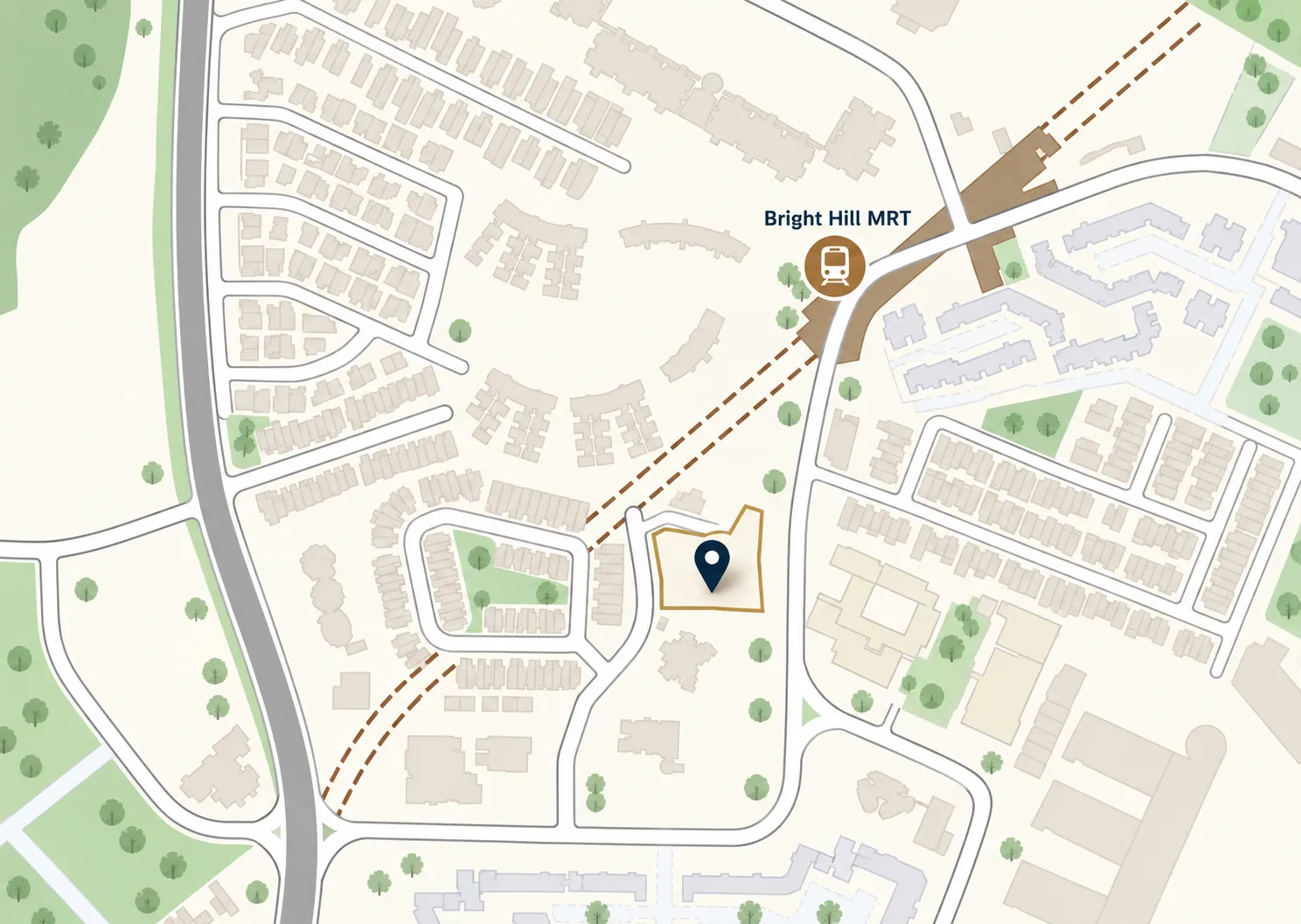
Every GLS Site I Track
Below is every site with a written analysis on this website, with the land rate that anchors it.
| Site | District and nearest MRT | Land (psf ppr) | Status | Why it matters |
|---|---|---|---|---|
| Lorong Puntong | D20 · Bright Hill TE7 | $1,612 | Top bid in, award pending | Seven bids above every forecast for a scarce Bishan site |
| New Upper Changi Road | D16 · Bedok EW5 | $1,537 | Top bid in, award pending | Record suburban land rate, and the read-across to Thomson Reserve |
| Bayshore Drive | D16 · Bayshore TE29 | $1,323 | Top bid in | 1,280 units in a precinct being built from scratch |
| Hougang Central | D19 · Hougang NE14 | $1,179 | Awarded | Integrated development above the interchange |
| Chencharu Close | D27 · Khatib NS14 | $980 | Awarded | Yishun's first private site in a new housing district |
| 2026 programme overview | Island-wide | Varies | Confirmed and Reserve | The full 2026 confirmed and reserve list, site by site |
Land rates are top or awarded bids as recorded in the PropertyInsider.sg GLS pipeline tracker, 2 September 2026. The other 29 sites in the pipeline, with their estimated breakevens and indicative launch ranges, are in the full tracker.
How Do I Read A Tender Result?
Backwards, from the exit.
Most commentary starts at the bid and works forward to a price. I start at the day the eventual owner wants to sell. Then I work back, and ask whether today's land cost leaves room for that sale to go well.
The question is not "is this a good site". It is "at the price this land forces, who is the next buyer, and what will they be comparing it against".
Eight things I check, in this order:
The same eight questions run through every project review on this site, which is what makes them comparable to each other. The longer version, with the client-facing worksheet, is in my five-point framework for advising a new launch buyer.
What A Record Land Bid Does Not Tell You
Whether you should buy.
Every record tender produces the same message in my inbox within about eighteen hours.
"Land prices are up. Buy now before launch prices follow."
I understand the logic. It is also the wrong shape.
A land bid is a floor, not a forecast. It tells you what a project cannot sell below without losing money. It says nothing about how far above that floor buyers will actually go, and buyers, not developers, set that.
Three things a high bid does not settle:
- Whether the estate can absorb the units
- Whether the developer prices at the top of the range or under it to move volume
- Whether the same money buys you more somewhere else
That last point is where most of the money is won and lost, and it never appears in the tender headline.
There is a second failure worth naming, because it runs the other way. A cheap land rate gets read as a bargain. Sembawang Road EC has the cheapest land in the pipeline and still needs an estimated $1,477 psf to break even. A low plot ratio and a long build spread the same construction bill over less floor area to sell.
Cheap land is not a discount. It is a different cost structure.
Both readings fail the same way. They treat one number as the answer when it is one input.
My Take: Land Data Buys You Time, Not Certainty
The advantage of watching tenders is not that it tells you the future price. It is that it gives you a year to get your own position ready before anyone asks you to decide.
In that year you can sell an HDB flat properly rather than under a deadline. You can get an in-principle approval and find out what you can actually borrow. You can visit the estate on a weekday evening and see what the commute is really like. You can look at what already-completed condominiums nearby are transacting at, which is the number that will still matter when you eventually sell.
None of that requires a forecast. It requires notice.
What I would not do is treat a tender result as a signal to move. The buyers I see get hurt are rarely the ones who bought the wrong project. They are the ones who bought the right project at the wrong point in their own finances, because a headline made the decision feel urgent.
Land data is public precisely so it does not have to be urgent.
Use the year it gives you.
Frequently Asked Questions
What is a Government Land Sale?
A Government Land Sale is how the Singapore government sells state-owned land to private developers. The Urban Redevelopment Authority and HDB run it, by public tender. It is the main source of land for new private condominiums. It also lets the government control how much new housing supply reaches the market, and when.
What does psf ppr mean?
Dollars per square foot per plot ratio. It is the land price divided by the maximum floor area a developer may build on the site. Quoting land this way lets you compare a small dense plot against a large low-rise one fairly. That is why tender results are reported in psf ppr rather than in total dollars.
Does a higher land bid always mean a higher launch price?
It raises the floor, not the ceiling. A higher bid pushes up the breakeven, which is the price a project must clear to avoid a loss. So it limits how low the developer can go. What buyers will pay above that floor is set by demand, competing supply and unit sizes. Land is also only a median 54% of total development cost, so construction, interest and margin move the final figure too.
How long after a tender does the project launch?
Usually 9 to 15 months from award to the showflat opening. That window covers the design, the approvals, building the showflat and setting prices. Completion and keys follow roughly four to five years after the tender. So a site awarded in late 2025 should preview somewhere between late 2026 and the end of 2027.
What is the difference between the Confirmed List and the Reserve List?
Confirmed List sites go to tender on a fixed schedule whether or not developers ask for them, so they produce certain supply. Reserve List sites are only released when a developer commits to an acceptable minimum bid, so they respond to demand. Both are published in the half-yearly Government Land Sales programme.
How many GLS sites are in the pipeline right now?
Thirty-three sites across the 2025 and 2026 programmes, carrying roughly 18,623 future homes. That is the count in the PropertyInsider.sg GLS pipeline tracker as at 2 September 2026. Twenty-five of those sites already have a developer attached. Together they hold about three years of normal demand, visible well before any of it reaches a showflat.
Which was the most expensive GLS site awarded recently?
Peck Hay Road in District 11 holds the highest awarded rate in the current pipeline at $1,865 psf ppr. Bukit Timah Road follows at $1,825. Those are the two dearest residential state land rates since 2018. In the suburbs, New Upper Changi Road drew a top bid of $1,537 psf ppr on 1 September 2026. That is a record for a pure residential site in the Outside Central Region.
Where can I track every GLS site and its land price?
The PropertyInsider.sg GLS pipeline tracker lists all 33 sites in one sortable table. Each row carries the status, district, estimated units, awarded land rate, estimated breakeven, an indicative launch range and the winning consortium. Its companion new launch map plots those sites alongside every project currently selling. That lets you compare tomorrow's supply against today's prices in the same area.
Should I wait for a GLS site to launch instead of buying now?
That depends on your own timeline rather than the land price. Waiting two to three years works if your current home is not under pressure, your borrowing position is stable, and you actually prefer that location. It works badly if it means holding a flat past a lease decay point, or missing a better-value completed unit nearby. The land data is useful because it lets you plan the wait. Not because waiting is always right.
The Short Version
Six things to take away.
- A GLS site is state land sold by tender, and the winning bid is the earliest hard number on what the future condominium must charge.
- Land is a median 54% of total development cost. Breakeven, not the land rate, is the number that sets the floor.
- The current pipeline holds 33 sites and roughly 18,623 homes, with a median awarded land rate of $1,334 psf ppr.
- Prime central land has repriced to $1,825 and $1,865 psf ppr, while Executive Condominium land sits at $692 to $794.
- District 16 carries the volume from 2026 to 2028, after New Upper Changi Road set a suburban record at $1,537 psf ppr.
- A tender result gives you nine to fifteen months of notice. That notice is the real asset.
So what should you do with this?
Find the site nearest the area you are shopping in, and read its estimated breakeven rather than its land price. Compare that against what completed condominiums within walking distance are actually transacting at today. If the gap is wide, work out what specifically is meant to close it, and whether you believe that.
Then check your own numbers before you check anything else.
Working out whether a pipeline site fits your plan? Send me the estate you are watching and where you stand today, and I will show you the land maths alongside what is already selling nearby. Request a consultation, or message me directly on WhatsApp.
Where To Go Next
A land tender is the first data point in a chain that ends with a price list and a decision. These pages carry the rest of the chain.
Sources And Update Log
Land rates, unit counts, pipeline totals, median figures, breakeven estimates and developer names on this page come from the PropertyInsider.sg GLS pipeline tracker, as updated on 2 September 2026. The tracker compiles them from the URA Government Land Sales programme, published tender results and developer announcements. Its cost stacks are EdgeProp Singapore estimates.
Breakeven figures and indicative launch ranges are estimates, not developer disclosures. Developers set real prices days before a launch and can land outside any published range.
3 September 2026. Page rewritten. Added the land-to-launch cost stack with a worked example, current pipeline figures, the launch map and pipeline tracker sections, land rates in the site index, and a sources section. The previous "future GLS research" list was removed. Several sites on it, including Dover Drive, Chuan Grove, Bedok Rise and Lakeside Drive, have since been awarded, and one has launched.
Disclaimer
The information provided on this website is for educational and informational purposes only. It should not be construed as financial advice, investment advice, or a recommendation to buy or sell any property. Property investment carries inherent risks, and past performance does not guarantee future results.
Always consult with qualified professionals, including financial advisors, legal counsel, and property agents, before making any property investment decisions. Jamus Lee and JamusProperty.com are not liable for any direct or indirect losses resulting from the use of information on this website.