15 min read • Last updated August 2026
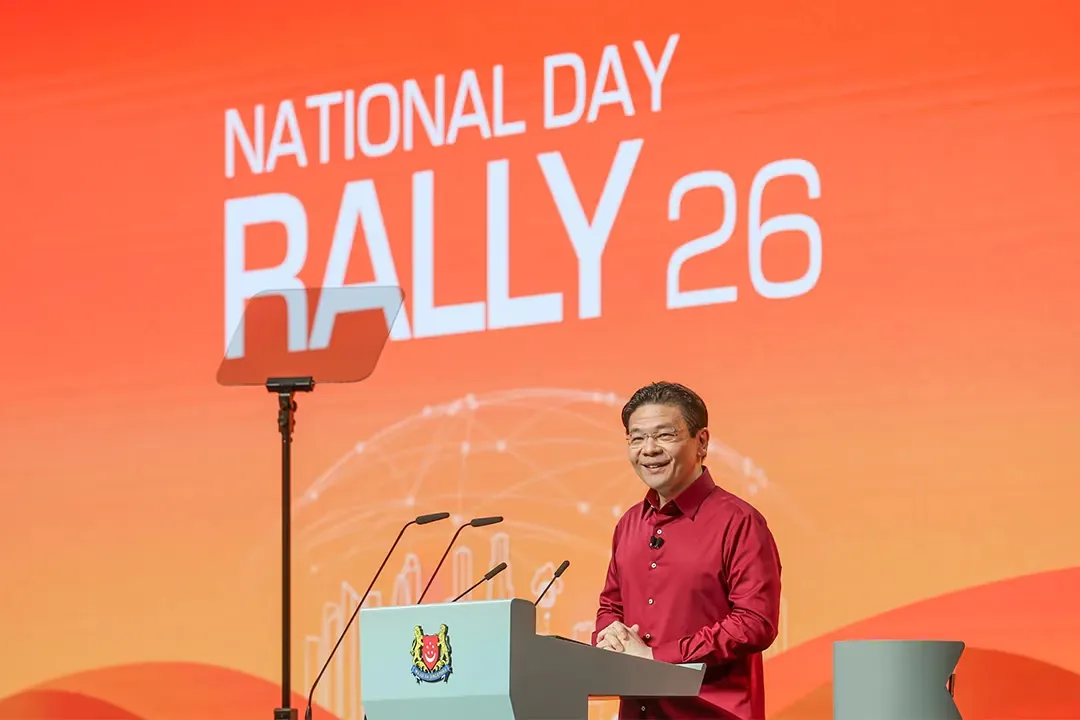
Every year, National Day Rally is one of those evenings where those of us in real estate find ourselves glued constantly to the screen.
Not because we expect a new cooling measure.
But because housing policy can change the directions and options of Singaporean families overnight.
And this year there were several things worth discussing.
The biggest changes announced were not about cooling the market.
They were about widening access and giving families more options to consider.
Among the key changes:
- Family income ceiling for a new HDB flat raised to $16,000
- Singles' income ceiling raised to $8,000
- Executive Condominium income ceiling raised to $18,000
- One extra BTO and Sale of Balance Flats ballot chance for every child
- Further housing support for larger families under review
- The October 2026 BTO exercise moved to November
Just as importantly, there were no new property cooling measures announced.
ABSD, Seller's Stamp Duty, TDSR, MSR and loan-to-value limits remain unchanged.
So what do these changes mean for us?
More importantly:
Who benefits — and what should buyers do now?
1. What Changed at National Day Rally 2026
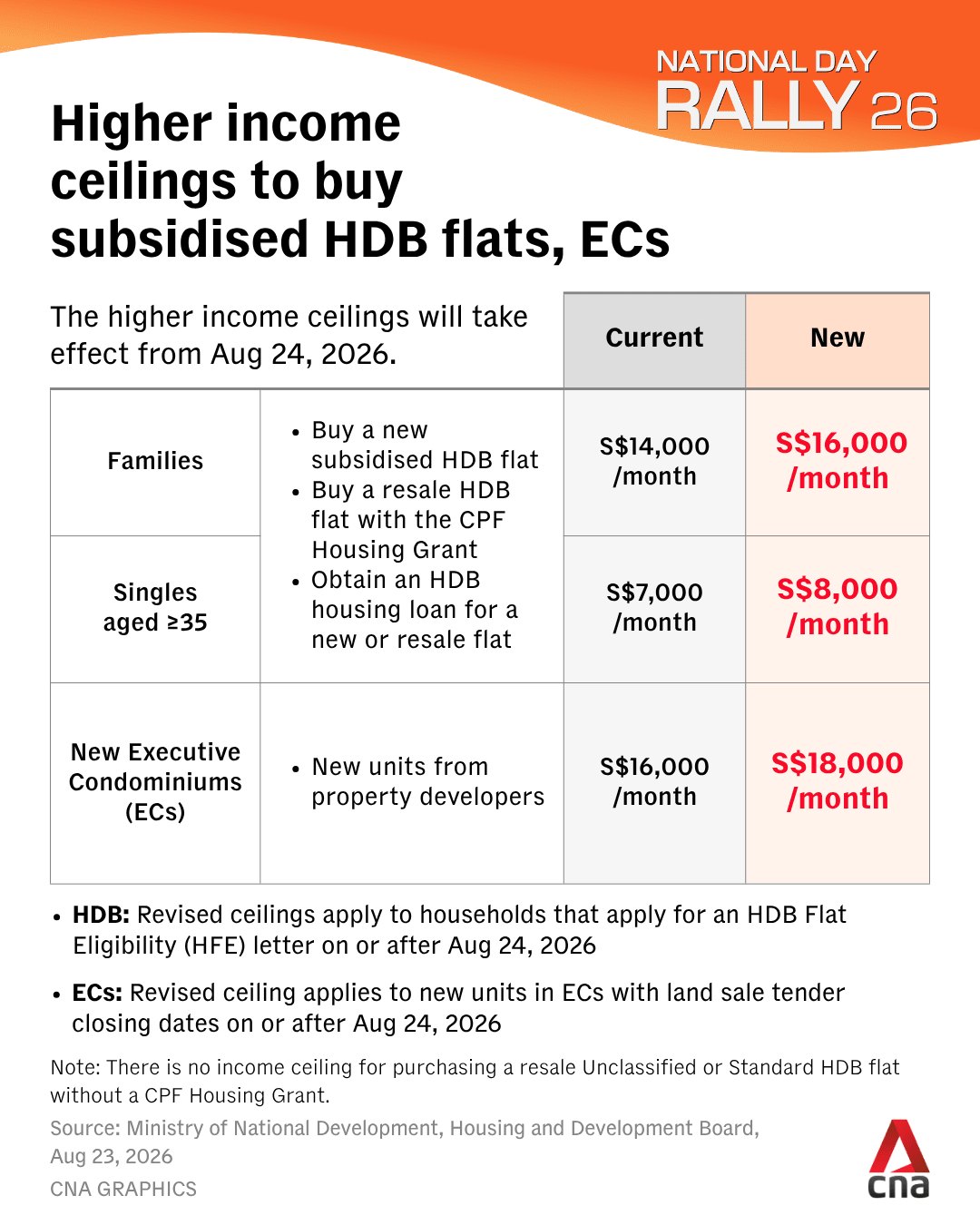
Income ceilings are increased from 24 August 2026.
For families buying a new HDB flat, the monthly limit went from $14,000 to $16,000.
For singles aged 35 and above, from $7,000 to $8,000.
For a new Executive Condominium, from $16,000 to $18,000.
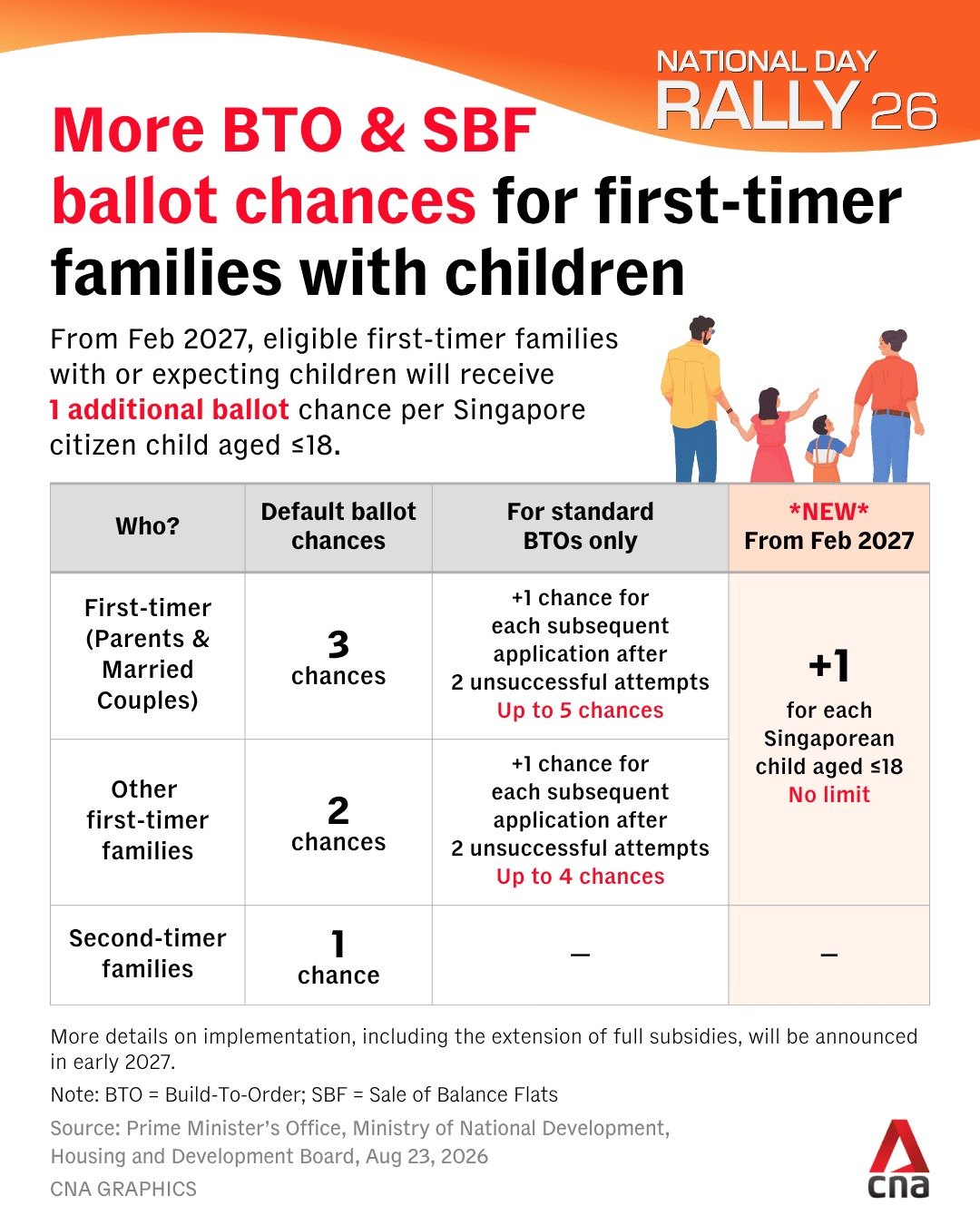
And first-timer families gain one extra ballot chance per child from February 2027.
Key Takeaways
- Family ceiling for a new HDB flat: $14,000 to $16,000 a month, for households applying for an HFE letter on or after 24 August 2026.
- Singles aged 35 and above: $7,000 to $8,000 a month, on the same date.
- New Executive Condominium ceiling: $16,000 to $18,000, but only for projects whose land tender closes on or after 24 August 2026.
- From the February 2027 sales exercise, first-timer families get one extra ballot chance for every Singapore citizen child aged 18 or below, with no stated cap.
- The October 2026 BTO exercise moves to November, with about 7,960 flats. HFE documents are due by 25 September 2026.
- Nothing changed on ABSD, Seller's Stamp Duty, TDSR, MSR or loan-to-value limits.
Three short definitions before we go further, because the rest of this article leans on them.
- HFE letter — HDB's formal assessment of what your household may buy, which grants you qualify for, and how much you may borrow. It also fixes which income ceiling applies to you.
- MOP — the Minimum Occupation Period. The years you must live in the home first. During it you cannot sell on the open market, rent out the whole unit, or buy another residential property.
- psf ppr — per square foot per plot ratio. What a developer paid for land, per square foot of floor area it may build. It is the biggest single input into what a new project costs a buyer.
| Who | What the ceiling covers | Until 23 Aug 2026 | From 24 Aug 2026 |
|---|---|---|---|
| Families | Buying a new subsidised HDB flat, buying a resale flat with the CPF Housing Grant, or taking an HDB housing loan | $14,000 a month | $16,000a month |
| Singles aged 35 and above | The same three uses as above | $7,000 a month | $8,000a month |
| Households buying a new Executive Condominium | New units bought from the developer | $16,000 a month | $18,000a month |
Two further changes sit alongside the ceilings.
| What changed | Before | After | Who it applies to |
|---|---|---|---|
| Extra BTO and Sale of Balance Flats ballot chances | None tied to children | +1 per childSingapore citizen, aged 18 or below, no stated cap | Eligible first-timer families, from the February 2027 sales exercise |
| Next BTO sales exercise | October 2026 | November 2026about 7,960 flats | Bedok, Geylang, Sembawang, Tengah, Toa Payoh and Yishun, plus Community Care Apartments in Toa Payoh |
2. Why Were The Ceilings Raised Now?
Two reasons, and here's why it is interesting.
The first is the one the Prime Minister gave plainly.
Singaporeans are marrying later.
By the time couples settle down, many are further along in their careers and earning more.
The stated goal is that the large majority of Singaporean couples keep access to subsidised public housing.
The second reason is easier to miss.
The Government said the changes were possible because the housing situation improved first.
Booking success rates are higher.
Waiting times are shorter.
The resale market has stabilised.
That is visible in the data. The HDB Resale Price Index fell 0.1 per cent in the first quarter of 2026, then a further 0.3 per cent in the second.
Those were its first declines in close to seven years.
Supply is arriving too. About 13,500 flats reach the end of their MOP in 2026. That rises to 15,000 in 2027 and 19,500 in 2028, on HDB and MND figures from July 2026.
That order matters for how you read the whole announcement.
This is not stimulus aimed at a soft market. It is a widening of access made on the back of a market the Government judges to have already cooled.
That distinction matters.
3. Who Gains From The $16,000 BTO Ceiling?
Couples earning between $14,000 and $16,000 a month.
Until now, that household was locked out of new HDB flats entirely.
Its realistic options were a resale flat, an EC, or private property.
On paper that sounds comfortable.
In practice, a combined $14,000 to $16,000 is often two mid-career professionals in their mid-thirties buying a first home.
They are also planning for children, childcare, a renovation and ageing parents.
The ceiling was last moved in 2019, when it went from $12,000 to $14,000.
Seven years of wage growth pushed a lot of ordinary dual-income households across a line that had not moved.
The practical effect is that this group is now back inside the public housing system.
That means access to new flats, to the CPF Housing Grant on a resale flat, and to an HDB housing loan.
Now this loan is worth pausing on.
The HDB housing loan works differently from a bank loan.
For some households, it changes how much cash is needed for the downpayment.
4. Will This Push New Flat Prices Higher?
My answer is:
Not directly.
And the reason is structural rather than a matter of opinion.
New HDB flats are not auctioned to the highest bidder.
HDB sets the selling price and applies subsidies so flats stay affordable to the group they are meant for.
A household earning $16,000 pays the same as a household earning $9,000 to secure the same unit.
So simply allowing more households to qualify does not push BTO prices up.
Where I do expect an impact is on application demand.
A project in an attractive location now has a larger eligible buyer pool.
And the households joining that pool sit at the upper end of the income range.
In other words:
The pressure shows up in ballot competition, not on the price list.
5. Could This Lead To More Aggressive Offers In The HDB Resale Market?
Possibly.
But I would not expect it across every segment, because two forces are pulling in opposite directions.
Pulling demand out of resale: households earning $14,000 to $16,000 who previously had to buy resale can now apply for a new flat.
Every household that switches is one fewer bidder on resale.
Pushing demand into resale: households that need a home now cannot wait several years for one to be built.
Many borrow more comfortably than the average resale buyer.
They also now know the Government counts them as part of the public housing target group.
So I do not expect:
"Higher ceiling = all resale HDB prices rise."
I expect something more selective:
more competition for scarce, desirable flats while ordinary units with abundant alternatives remain price-sensitive.
The scarce end means large five-room flats, Executive Apartments and Executive Maisonettes, newly completed flats just past their MOP, and premium spots in mature estates.
One more policy sits underneath this.
On 28 July 2026 the Government removed the 15-month wait-out period that private property owners served before buying a unsubsidised resale flat.
Two conditions still bind.
First, the change covers only purchases made without subsidies or an HDB loan.
Second, a 30-month wait still applies if you want a new flat, a resale flat with grants, or a new EC.
Even so, it widened the buyer pool for exactly the large flats described above.
That is where the two policies meet.
That is the part I would watch most carefully.
6. What Does The $8,000 Singles Ceiling Actually Change?
Three things.
Access to a subsidised new flat, access to the CPF Housing Grant on a resale flat, and access to an HDB housing loan.
The group this helps was in an awkward position.
Earning $7,500 a month is comfortable.
But in most of Singapore it is not enough for larger private properties.
Losing HDB financing and grants over a few hundred dollars a month pushed some into a compact private unit they would not otherwise have picked.
What Should Singles Do?
My advice here is the same advice in reverse.
Do not buy private because it used to be the only door open.
Do not buy public because a door has now opened.
Run the comparison again across:
- A larger resale flat
- A compact private unit
- Staying put while investing elsewhere
Then be honest with yourself.
Do you need space?
Do you want capital growth?
How much cash do you want to keep outside property?
There is no universal best answer.
The cheapest home is not automatically the right one.
Neither is the most aspirational.
The Prime Minister also said the Government is looking at how to support singles more broadly, with further steps intended within this term.
Treat that as a signal, not a plan you can budget against.
7. Why The $18,000 EC Ceiling Matters Most
Because ECs are sold by private developers, who price against what buyers can pay.
An Executive Condominium is a hybrid.
A private developer builds and sells it, with full condo facilities.
But you buy it under HDB eligibility rules, and those rules hold for the first decade or more before it becomes fully private.
Households earning $16,000 to $18,000 are the direct beneficiaries.
Before this, they sat above both the HDB and the EC ceiling, which pushed them straight into resale flats or the private market.
They now have access to a middle option that typically prices below a similar private condo.
Median new EC prices reached about $1,836 psf in the first quarter of 2026. New 99-year non-landed private homes in the suburbs ran at roughly $2,278 psf as at late April 2026, on developer sales data compiled by SRI.
The important qualifier is in the fine print.
The $18,000 ceiling applies to new units in ECs whose land sale tender closes on or after 24 August 2026.
It does not apply to balance units in existing EC projects, and it does not apply to projects whose land was tendered earlier.
If you take one sentence from this article, take that one.
8. The Bigger EC Change Happened In May, Not August
This is where buyers need to pay attention.
On 8 May 2026, National Development Minister Chee Hong Tat announced the biggest revision to the EC framework in over a decade.
It applies to EC sites whose tender closes on or after that date.
- The MOP doubles from five years to ten
- Full privatisation moves from ten years after TOP to 15
- The Deferred Payment Scheme is removed
- First-timer allocation rises from 70 per cent of units to 90 per cent, with the priority window extended from one month to two years
So future ECs now have two forces moving in opposite directions.
Supporting prices:
The income ceiling rises to $18,000.
Limiting speculative demand:
The holding period doubles and future resale flexibility is cut.
To me, this reinforces what an EC is supposed to be:
an owner-occupation product first, and an investment product second.
9. Which EC Rules Apply To You? The Two-Date Test
It depends entirely on one date.
Not the launch date you see advertised.
The land tender closing date.
Because the two cut-offs are different, ECs now come in more than one regulatory generation.
| Rule | Land tender closed before 8 May 2026 | Tender closes 8 May to 23 Aug 2026 | Tender closes 24 Aug 2026 onwards |
|---|---|---|---|
| Minimum Occupation Period | 5 years | 10 years | 10 years |
| Full privatisation | 10 years after TOP | 15 years after TOP | 15 years after TOP |
| Deferred Payment Scheme | Available | Removed | Removed |
| First-timer allocation | 70%, one-month priority | 90%, two-year priority | 90%, two-year priority |
| Household income ceiling | $16,000 | $16,000 | $18,000 |
| Sites known to fall here | Senja Close; Sembawang Road; Miltonia Close; Woodlands Drive 17 (two parcels) | Check each site's tender closing date before assuming | Canberra Drive, tender scheduled to close October 2026; Jurong East Avenue 1, tender scheduled to open December 2026 |
The five already-awarded sites are the last group under the older framework.
That framework will not be repeated.
For a household under $16,000 that qualifies, five years of MOP against ten is a real difference in flexibility, not a marketing line.
It is also why those five launches should draw firm interest.
But here is where I think buyers need to be careful.
A shorter holding rule is not the same thing as a better buy.
It is worth something only if the launch price, the location, the layout and the competing supply also work.
Weighing this against a private purchase? My comparison of new launch and resale condos sets out the trade-offs.
The EC to private property upgrading path covers what the holding period does to a longer plan.
10. Will Future EC Prices Rise?
My base case is yes, gradually.
But the next few land tenders should be more disciplined than the higher ceiling alone suggests.
The case for higher prices is simple. Land is already expensive, construction costs have not fallen, and the buyer pool is now bigger and better paid.
Here is what developers have actually been paying:
| EC land parcel | Tender closed | Top bid | Winning developer |
|---|---|---|---|
| Woodlands Drive 17, first parcel | August 2025 | $782 psf ppr | City Developments |
| Woodlands Drive 17, second parcel | January 2026 | $794 psf ppr, about $484 million | Sim Lian Group |
| Miltonia Close, Yishun | 14 April 2026 | $732 psf ppr, about $340.9 million | Hoi Hup Realty |
Two things stand out.
Land has not come cheap, so a return to the EC prices buyers remember from several years ago is not on the table.
But the trend is not a straight line either. Miltonia Close closed 7.8 per cent below the Woodlands Drive 17 record set three months earlier, and drew fewer bidders.
That is what measured bidding looks like when regional supply is building up.
Now add the ten-year MOP.
A developer bidding today is pricing a home whose buyer cannot sell for a decade.
That buyer also cannot use a deferred payment plan to bridge the purchase.
My expectation? That argues for larger family layouts, owner-occupier appeal, and bids set for steady take-up rather than a launch-weekend rush.
The Canberra Drive tender closes in October 2026.
It is the first real read on how developers weigh $2,000 more buyer income against five more years of lock-in.
Jurong East Avenue 1 follows. At 735 units, it is the only EC plot on the second-half 2026 Confirmed List. It is also the first EC land in Jurong East since 1996.
For the wider view of how land prices feed into launch prices, start with my running record of Government Land Sales tenders and awarded land rates.
11. One Extra Ballot Chance Per Child: How Much Does It Help?
It improves probability.
It does not improve certainty.
From the February 2027 sales exercise, eligible first-timer families receive one additional ballot chance for every Singapore citizen child aged 18 or below.
Couples expecting a child may also qualify, subject to a medical certificate.
It covers both Build-To-Order and Sale of Balance Flats applications, and no cap has been stated.
| Applicant group | Default ballot chances | Standard BTO top-up | New from Feb 2027 |
|---|---|---|---|
| First-timer Parents and Married Couples | 3 chances | +1 per subsequent application after two unsuccessful attempts, up to 5 | +1 per childSingapore citizen, aged 18 or below, no limit |
| Other first-timer families | 2 chances | +1 per subsequent application after two unsuccessful attempts, up to 4 | +1 per childSingapore citizen, aged 18 or below, no limit |
| Second-timer families | 1 chance | Not applicable | Not applicable |
A first-timer couple with two children moves from three chances to five, so their odds rise roughly in proportion.
In a project where thousands of applicants chase a few hundred flats, better odds still leave a real chance of failure.
Why I Think This Makes Sense
Once children arrive, housing stops being a plan and becomes a constraint.
Space matters.
Bedrooms matter.
School location matters.
Living with extended family gets harder each year.
Renting while you wait gets more expensive.
A family of five has a different urgency from a couple with no near-term plans, and the ballot now reflects that.
What Should Families Do?
The trap is waiting for February 2027 purely for the extra chances.
Say a project that suits you appears in November 2026.
Better odds on a future project you may not want is a poor reason to skip it.
Ask instead:
- How urgently do we need a home?
- Is our preferred town in this launch?
- How competitive is it likely to be?
- What priority schemes do we already qualify for?
- Will this flat still work when the children are teenagers?
- Would resale solve the problem better?
More ballot chances improve the odds.
They do not guarantee anything.
12. Larger Families: Is The Extra Support Confirmed?
Not yet.
The Prime Minister has asked the housing minister to look at extra support for larger families.
This sits alongside a bigger MediSave top-up and more help with transport costs.
But nothing about the housing piece has been settled.
No amount. No qualifying number of children. No income ceiling. No list of eligible flat types. No word on whether resale flats count. No start date.
So treat it as a policy review, not a confirmed grant.
What Should Larger Families Do?
Do not buy based on money that has not been announced.
Plan with the grants that exist today.
Meanwhile:
- Keep your household details current with HDB
- Watch for the MND and HDB announcements
- Compare larger new flats against older resale alternatives
- Look at five-room flats, Executive Apartments and Executive Maisonettes where space is the priority
An older large flat often gives a family more usable space than a newer flat of the same nominal size.
The cost is a bigger renovation budget and a shorter remaining lease.
Do that sum on paper before any new grant is announced, not after.
13. The November BTO Exercise And The 25 September Deadline
The exercise set for October has moved to November 2026.
The reason given was to let buyers review their plans and apply for an HFE letter under the revised ceilings.
About 7,960 flats are expected across Bedok, Geylang, Sembawang, Tengah, Toa Payoh and Yishun, with Community Care Apartments in Toa Payoh.
HDB has advised buyers who intend to apply to submit all required HFE documents by 25 September 2026.
That date is the most important date in the whole announcement.
An HFE letter takes time to process.
An incomplete submission is the most common reason a household misses a launch it was ready for.
So do not wait for the launch brochure.
Start now.
That last one matters more than people think.
Most households plan only for "what if I get the flat?"
You should also plan for "what if I don't?"
The households that planned for both move faster and pay less when the ballot fails.
14. What Was NOT Announced Is Equally Important
For owners and investors, the absences are as informative as the announcements.
Nothing changed on:
- Additional Buyer's Stamp Duty
- Seller's Stamp Duty
- The Total Debt Servicing Ratio and the Mortgage Servicing Ratio
- Loan-to-value limits on HDB and bank loans
- The Standard, Plus and Prime flat framework
- Restrictions on private property ownership
- Any rule aimed specifically at million-dollar resale flats
That tells me something.
National Day Rally 2026 was about housing access and family support, not about cooling the market.
The Government widened the entrance to subsidised housing without adding a new brake on demand elsewhere.
That is a different posture from 2022 or 2024.
15. My Take: The Most Interesting Change Is What Happens Between The Segments
When I put the announcements together, I do not just see four higher numbers.
I see movement between housing segments that used to be walled off from one another.
A $15,000-income household that was resigned to resale can now apply for a new flat.
A $17,000-income household that had to choose between resale and private now has a future EC option.
A household under $16,000 has a short window to buy one of the last five ECs under the five-year MOP framework.
And a private owner moving into a large resale flat no longer serves a 15-month wait — as long as the purchase is made without subsidies or an HDB loan.
These policies were not designed in isolation, and they land on the same market at the same time.
They change who competes with whom.
And whenever the buyer pools change, price behaviour can change too.
Which is why the segment I would watch over the next 12 to 24 months is the large-flat end of HDB resale.
Not the new flat price list everyone else is watching.
For the wider backdrop on rates and supply, my 2026 Singapore property market outlook covers the forces working on prices from the other direction. The rally also covered where Singapore plans to find land. That is the companion piece on Long Island, Pulau Tekong and the Western Island.
16. More Eligibility Does Not Mean You Should Spend More
This is probably my biggest caution.
When a ceiling rises, a lot of buyers hear:
"Great. I qualify for more."
I would read it differently.
"Great. I have more options."
There is a big difference.
Eligibility and affordability are not the same thing. The Government sets the first. Your own cash flow sets the second.
A mortgage still has to survive:
- Childcare
- Renovation
- An emergency reserve
- Retirement saving
- The MOP
- Your next upgrading move
- Whatever you would otherwise invest outside property
It also has to survive a job market that does not consult your loan schedule.
Being permitted to borrow to a limit has never been an argument for borrowing to it.
17. What I Would Do In The Next 90 Days
Grouped by where you sit today.
Not sure which of these applies to you? Every one of these decisions turns on your own numbers, not the headline ones. The sequencing usually matters more than the choice itself. Send me your situation and I will work through the options with you.
18. Frequently Asked Questions
Will BTO prices rise because the income ceiling has gone up to $16,000?
Not directly. New HDB flats are not auctioned to the highest bidder, so a household earning $16,000 cannot offer $20,000 more than a household earning $9,000 to secure the same unit. HDB still sets the selling price and applies subsidies so flats stay affordable to the group they are aimed at. What the higher ceiling changes is how many people may apply, so the pressure shows up in ballot competition on popular projects rather than on the price list.
When exactly do the new HDB and EC income ceilings take effect?
The revised HDB ceilings apply to households applying for an HDB Flat Eligibility (HFE) letter on or after 24 August 2026. The revised Executive Condominium ceiling of $18,000 applies to new units in EC projects whose land sale tender closes on or after 24 August 2026. The two cut-offs are keyed to different things, which is why buyers keep getting caught out.
Will the higher ceiling push HDB resale prices up?
Possibly, but not across the board. Some households earning $14,000 to $16,000 who previously had no choice but to buy resale can now apply for a new flat, which takes demand out of resale. Others still need a home now, cannot wait years for one to be built, and tend to borrow comfortably. My expectation is more competition for the scarce end of the market: large five-room flats, Executive Apartments and Executive Maisonettes. Ordinary flats with plenty of alternatives should stay price-sensitive.
Does the $18,000 EC ceiling apply to the five EC projects already awarded?
No. Senja Close, Sembawang Road, Miltonia Close and the two Woodlands Drive 17 parcels all had tenders closing before 24 August 2026. Their buyers are still assessed against the $16,000 ceiling. Those same five sites also closed before 8 May 2026, so they keep the five-year Minimum Occupation Period rather than the new ten-year one.
Does the $18,000 ceiling apply to balance units in existing ECs?
No. The change applies to new units in EC projects whose land sale tender closes on or after 24 August 2026. Balance units in launched projects are not covered.
What exactly changed for Executive Condominiums in May 2026?
On 8 May 2026, the housing ministry announced major changes for future ECs. The MOP doubles from five years to ten. Full privatisation moves from ten years after completion to 15. There is no more Deferred Payment Scheme. And 90 per cent of units go to first-timer families, with a two-year priority window instead of one month. That was the bigger change of the two, and it got far less attention.
Are the five already-awarded ECs an opportunity?
Potentially, for a household under $16,000 that qualifies. They are the last projects under the five-year MOP framework, and that framework will not be repeated. But a shorter holding rule is only worth something if the launch price, the location, the layout and the competing supply also work. Compare them properly against a resale private condo, which carries no holding restriction at all.
Will future EC prices rise?
My base case is that EC prices keep drifting upward, because land and construction costs remain elevated and the buyer pool is now bigger and better paid. But I would not expect reckless bidding. The ten-year MOP means developers are pricing a home whose buyer cannot sell for a decade. That pushes them towards family-sized layouts and bids set for steady take-up.
I earn $17,000 a month. Should I wait for a future EC?
Possibly, because you now have an option that did not exist before. But waiting is not automatically better. A site tendered in late 2026 launches roughly 15 months later, takes several years to build, then carries a ten-year MOP from completion. Price that wait honestly against a resale private condo you could buy and live in today.
How many extra BTO ballot chances will families with children get?
From the February 2027 sales exercise, eligible first-timer families receive one additional ballot chance for every Singapore citizen child aged 18 or below, with no stated cap. Couples expecting a child may also qualify, subject to a medical certificate. These chances are added on top of the family's existing chances under its first-timer category, and they apply to both BTO and Sale of Balance Flats applications.
Should families wait until February 2027 for the extra ballot chances?
Not automatically. If a project that genuinely suits you appears in November 2026, skipping it for better odds on a future project you may not want is a poor trade. Ask how urgently you need a home, whether your preferred town is in this launch, and whether the flat will still work when your children are teenagers.
Is the extra housing support for larger families confirmed?
Not yet. The Prime Minister has asked the National Development Minister to consider it, but no amount, qualifying number of children, income ceiling, eligible flat type or start date has been announced. Treat it as a policy review, not a grant you can budget against.
When is the next BTO launch and what is the deadline to prepare?
The exercise planned for October 2026 has moved to November. About 7,960 flats are expected across Bedok, Geylang, Sembawang, Tengah, Toa Payoh and Yishun. HDB has advised buyers who intend to apply to submit all required HFE documents by 25 September 2026. That date is the most important date in the whole announcement.
Were any new property cooling measures announced at National Day Rally 2026?
No. Nothing changed on Additional Buyer's Stamp Duty, Seller's Stamp Duty, the Total Debt Servicing Ratio, the Mortgage Servicing Ratio or loan-to-value limits. The rally widened access to subsidised housing rather than restraining demand elsewhere, and that is a different posture from 2022 or 2024.
What is the biggest thing EC buyers should understand after these changes?
That there are now different generations of EC operating under different rules, and the land tender date decides which one you are looking at. It sets which income ceiling applies, whether the MOP is five or ten years, whether the Deferred Payment Scheme is available, and how long until full privatisation. Establish the generation before you compare the projects. These days that matters almost as much as which EC you buy.
19. My Thoughts
National Day Rally always gets our industry talking.
What new policies?
Any cooling measures?
Who benefits?
This year the housing announcements feel less dramatic than some previous policy changes.
But I think they are meaningful, because they change who gets access to which part of the housing market.
And that shapes family decisions for years.
The short version, if you read nothing else:
- Three ceilings moved on 24 August 2026: families to $16,000, singles aged 35 and above to $8,000, new ECs to $18,000.
- The HDB changes are keyed to your HFE letter date. The EC change is keyed to the project's land tender closing date, which is a different thing from its launch date.
- Higher ceilings do not raise new flat prices, because HDB sets those prices. They raise ballot competition instead.
- On resale, expect concentrated competition for large and scarce flats rather than a broad rise.
- ECs now come in generations. The May 2026 ten-year MOP and the August 2026 income ceiling have different cut-off dates, so check both before comparing two projects.
- Families with children get one extra ballot chance per child from February 2027, with no stated cap.
- No cooling measures were announced. ABSD, SSD, TDSR, MSR and loan-to-value limits are unchanged.
For me, the numbers that matter are not simply the new ones.
$16,000.
$8,000.
$18,000.
One additional ballot chance per child.
The bigger message is this:
Singapore is trying to widen the housing ladder while keeping speculation and affordability under control.
The BTO ceiling expands access without changing how new flats are priced.
The EC ceiling expands access while the longer holding rules push future ECs back towards owner-occupation.
And families with children get better odds without another broad stimulus.
That balance is important.
So the opportunity here is not that you can now qualify for more.
It is that you now have more pathways — and some of them exist only for a limited window.
Use them carefully.
Because ultimately, the best property decision is not the one that lets you buy the most expensive home today.
It is the one that puts your family in the strongest position tomorrow.
Working out which path fits your household? I help families compare the new flat, resale, EC and private routes against their real numbers, including the sale of an existing home. Get in touch to talk it through.
Disclaimer: This article is provided for informational purposes only and should not be construed as financial advice, investment recommendation, or an offer to buy or sell property. While we have made efforts to ensure the accuracy of the information presented, market conditions, developer plans, and regulatory environments are subject to change. Property prices, launch dates, unit availability, and other details mentioned are based on current market intelligence and may be subject to revision. Prospective buyers should conduct independent research, verify all information directly with developers and relevant authorities, and consult with qualified financial and legal advisors before making any property purchase decisions. We are committed to accuracy and transparency; however, the information provided should not be regarded as an offer, statement, representation, or guarantee. While we strive to ensure the information is correct, it may not always be complete, up to date, or free from errors. Users are strongly encouraged to exercise due diligence and verify details through direct inquiries. Our agents and this website shall not be held liable for any decisions or actions taken based on the information provided here.