14 min read • Last updated August 2026
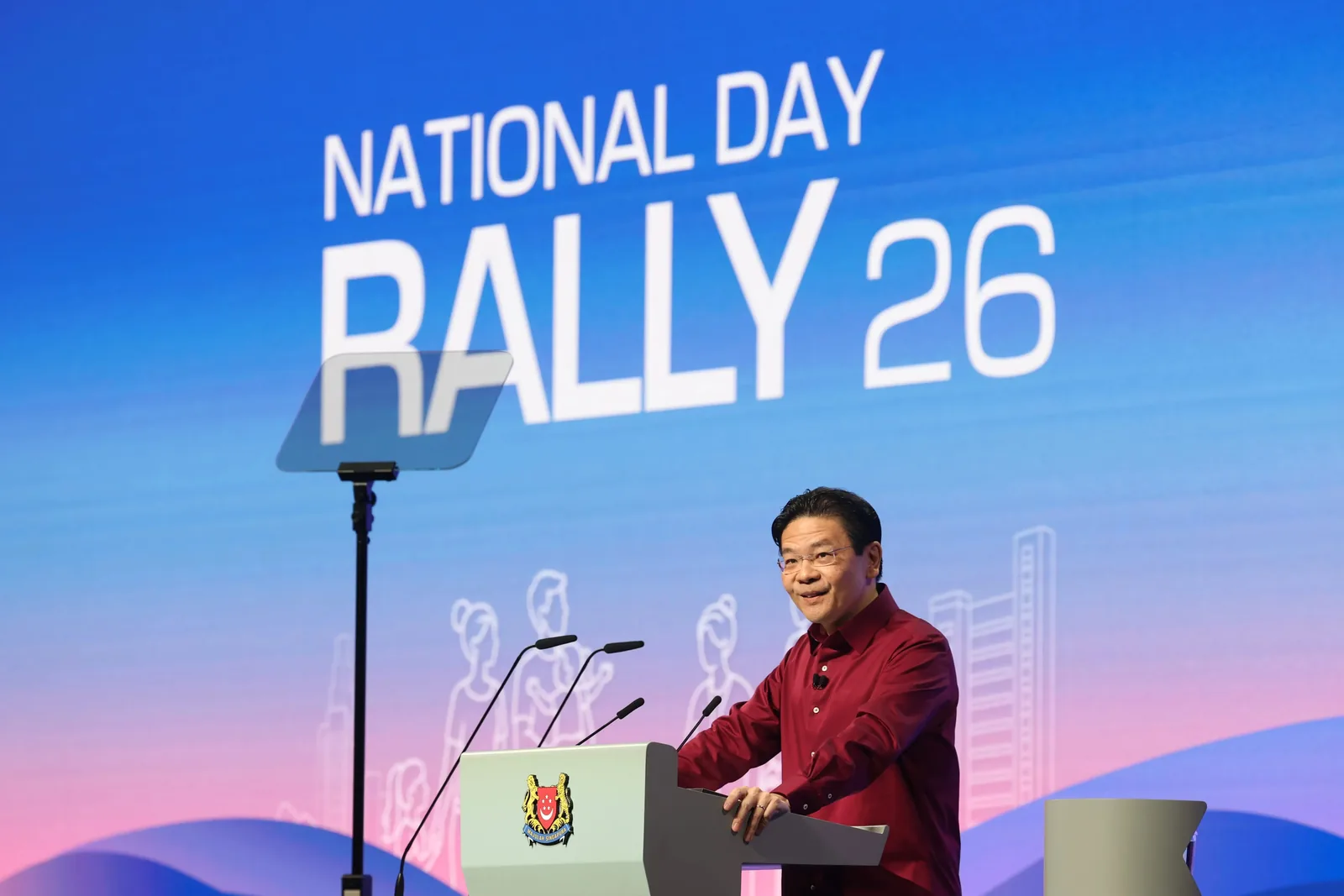
Part two of two. Part one covers the housing changes that affect buyers right now. It runs from the higher HDB and EC income ceilings to the extra ballot chances for families with children. This part looks much further out.
This is Part 2 of my National Day Rally 2026 property series.
In Part 1, I looked at the housing changes that affect buyers today.
In Part 2, I want to zoom out much further.
Not to the next BTO exercise or the next property cycle, but to what Singapore could look like several decades from now.
The immediate housing changes took most of the attention. I thought this part of the speech was potentially more significant.
Not for someone buying a property tomorrow.
Perhaps not even for someone buying over the next five years.
But for the Singapore our children will eventually inherit.
Because Singapore is preparing for another major chapter of land creation.
Four long-term projects stood out:
- Long Island off the East Coast
- Further reclamation at Pulau Tekong
- A new Western Island, formed by merging several offshore islands
- An integrated Sentosa and Pulau Brani
These are projects measured not in years, but in decades.
They answer a question we have been asking for a long time:
If Singapore is already so built up, where do we find the land for the next generation?
The answer, apparently, is that we may not simply find it.
We may create it.
1. What Was Announced, In One Table
About 800 hectares of reclamation at Long Island, off the East Coast.
Further reclamation at Pulau Tekong, leaving roughly 500 hectares for civilian use.
A new Western Island merging Semakau, Bukom and Sudong.
And an integrated Sentosa and Pulau Brani destination.
Undersea tunnels to Tekong are being studied.
Key Takeaways
- Long Island involves about 800 hectares off the East Coast, roughly twice the size of Marina Bay. It runs in three tracts from Tanah Merah to Marina East, with a new freshwater reservoir and about 20km of waterfront parks.
- At Pulau Tekong, about 500 hectares will be left for civilian use once the Singapore Armed Forces' needs are met. The Prime Minister compared that to the size of Toa Payoh town. No decision has been made on how to use it.
- The Western Island would merge Pulau Semakau, Pulau Bukom, Pulau Sudong and smaller islands into one larger island for advanced manufacturing, power generation and defence.
- On Pulau Brani, NTUC will build a Downtown South resort once port operations move to Tuas. Land will be reclaimed to link Brani and Sentosa. A new people mover system will serve both.
- Undersea vehicular tunnels to Tekong are at the study stage, because bridges would cross busy shipping channels.
- None of this changes what you can buy in 2026. Long Island preparatory works were scheduled to start from the end of 2026. Reclamation follows only after the technical studies and public consultation.
| Project | What is planned | Scale | Where it stands |
|---|---|---|---|
| Long Island, off East Coast | Three tracts of reclaimed land from Tanah Merah to Marina East, a new freshwater reservoir, waterfront parks, and land for future housing and other uses | About 800 hectares, roughly twice Marina Bay; about 20km of new waterfront parks | Technical studies from 2024; preparatory works scheduled from end-2026; reclamation only after studies and consultation |
| Pulau Tekong, southern end | Further reclamation for SAF training, with land left over for civilian uses that have not been decided | About 500 hectares for civilian use, about the size of Toa Payoh town | Announced at NDR 2026; no decision on eventual use |
| Western Island | Merge Semakau, Bukom, Sudong and smaller islands into one larger island for advanced manufacturing, power generation and defence | Not stated | Long-term plans described as under careful study |
| Sentosa and Pulau Brani | Improved public access to Sentosa's western coastline; NTUC Downtown South resort on Brani; reclamation to link Brani and Sentosa; new people mover system; water taxi under exploration | Not stated | Port operations relocating to Tuas; announced at NDR 2026 |
2. Why Does Singapore Need To Create More Land?
Because housing is only one claimant on it.
Whenever we talk about land scarcity, the conversation collapses into housing within about thirty seconds.
Where will the next BTOs go?
Where will the next GLS sites come from?
Which forest gets cleared?
Which golf course eventually disappears?
But the same finite island has to hold:
- Public and private housing
- Roads, MRT lines and transport links
- Employment centres
- Industry
- Power generation
- Defence training
- Greenery and nature
- Coastal protection
- Schools and healthcare
- Recreation and community facilities
Every hectare given to one is a hectare unavailable to the rest.
That is the actual constraint.
It is also why the debate over places like the Maju site runs so hot. It is a direct trade between two uses that both have real support.
There are levers other than clearing green space.
We can keep intensifying existing areas.
We can recycle brownfield sites.
We can redevelop golf courses and old industrial estates.
We can build higher.
We can even build underground.
But eventually there are limits.
So Singapore is reaching for the oldest lever in the box.
We are redrawing the coastline again.
3. Long Island: What Is Confirmed And What Is Not
Long Island is the project most people already recognise.
It is also where the gap between what is settled and what is assumed runs widest.
So it is worth being precise.
What Is Settled
URA's plan reclaims about 800 hectares off the East Coast, roughly twice the footprint of Marina Bay.
It runs in three tracts from Tanah Merah to Marina East.
The new land sits higher than today's coastline, which pushes Singapore's coastal defence seaward and lets East Coast Park stay largely as it is.
Between the park and the new land, an enclosed body of water becomes a freshwater reservoir, regulated by tidal gates and pumping stations.
Around 20 kilometres of new waterfront parks come with it.
Technical studies began in 2024 and run in phases. By March 2026, more than 14,000 people had given feedback.
Preparatory works were scheduled from the end of 2026, starting west of Bedok Jetty. A second phase follows the 2029 SEA Games, because those waters are used for competition.
That is clever planning, and it is worth naming why.
If we have to spend billions defending the East Coast from rising seas anyway, can that same infrastructure create land at the same time?
Instead of simply building a wall against the sea…
Can we build a new part of Singapore?
What Is Not Settled
How many homes.
The mix of public and private housing.
Density.
MRT connections.
Where the commercial centres and schools go.
The phasing.
The completion date.
Those are the things that would actually determine the effect on property.
None of them has been announced.
What the Prime Minister added was not a number but a frame.
He talked about his parents buying an HDB flat in Marine Parade in the early 1970s, on land that had been sea.
People worried at the time that those homes would sink.
They are now among the most sought-after flats in Singapore, precisely because they sit close to the water.
His point was that Long Island will one day be another new waterfront, and the children raised there will tell the same story.
It is a good story.
It is also a fifty-year story.
Buyers should hold it as one.
4. What Could Long Island Mean For Existing East Coast Property?
This is where I think buyers need to be careful.
Whenever a transformation of this scale is announced, the immediate instinct is:
"Good news. East Coast property must go up."
Not necessarily.
Long Island creates both opportunity and competition.
On the opportunity side, coastal protection removes a real long-term risk from a low-lying area. Around 30 per cent of Singapore's land sits less than five metres above mean sea level.
Add a reservoir, 20 kilometres of parks, and eventually new transport and amenities.
The whole eastern corridor becomes more attractive than it is today.
On the competition side, a new district of that scale eventually delivers a lot of housing.
Now imagine a twenty-year-old leasehold development in Marine Parade that is comfortable today.
One day it sells into a market that also holds brand-new waterfront homes with better facilities.
So I would not simply conclude:
Long Island = all East Coast properties benefit.
The winners will depend on how the new district connects with existing neighbourhoods.
Some locations become gateways into it.
Some gain a station.
Some gain new commercial amenities.
And some older developments simply find themselves next door to newer stock.
That distinction matters, and it becomes answerable only when the transport and land-use plans are published.
If you want the current picture of one of the affected areas, my guide to living in Bedok covers what is already there.
5. Should You Buy In The East Today Because Of Long Island?
I wouldn't.
Or more accurately:
I wouldn't buy a property that does not work today because of a project that may take decades.
The test is simple.
Strip Long Island out of the picture entirely.
Then look at:
- MRT accessibility
- Schools
- Amenities
- Tenure
- Layout
- Condition
- Entry price
- Surrounding supply
- How it actually lives
If those already work and Long Island later adds something, that is a bonus you did not pay for.
If they do not, you are paying today for an artist's impression.
This is not scepticism about the project.
It is scepticism about pricing very long-dated news.
Reclamation has not started. Preparatory works were scheduled from the end of 2026, and they do not determine the final design.
The full build-out runs across several terms of government.
A premium paid in 2026 has to be carried through all of it.
6. Pulau Tekong: 500 Hectares With No Decided Use
This one got less attention, and I find it the more interesting of the two eastern projects.
Pulau Tekong is Singapore's largest outlying island.
It used to be two islands, Tekong Kecil and Tekong Besar. Reclamation around Tekong Besar and a completed polder around Tekong Kecil have joined them.
A polder is land held below sea level behind a dyke and drained by pumps. Tekong was Singapore's first polder project, sitting about 1.2 metres below mean sea level behind a six-metre coastal dyke.
Further reclamation is planned at the southern end.
Most of the new land serves the Singapore Armed Forces.
But even after those needs are met, the Prime Minister said around 500 hectares will remain for civilian use.
For perspective, that is roughly the size of Toa Payoh town.
Think about that for a moment.
Then he said the part I keep coming back to.
The Government has not decided what to use it for, and does not have to decide now.
This Is National Land Banking On A Massive Scale
In property, we talk about land banking all the time.
A developer buys a site today expecting it to be worth more, or more useful, later.
Singapore is doing it on a horizon measured in generations rather than five-year cycles.
Singapore is doing the same thing on a national scale.
Except the investment horizon is not five years. It could be thirty, forty or fifty.
The state does not need to know what Singapore in 2070 requires.
It needs to make sure Singapore in 2070 has options.
So to be clear: there is no confirmed Tekong town.
No housing numbers, no MRT stations, no schools, no timeline.
Anyone telling you otherwise is filling in blanks the Government deliberately left empty.
7. Why Does The Undersea Tunnel Study Matter?
Because transport is what converts land into useful land.
Creating land on an island is one problem. Getting people to it is another.
Tekong has no land connection to the mainland.
Bridges are the obvious answer and the wrong one here, because they would cut across busy shipping channels.
So instead of travelling over the sea, we may eventually travel underneath it.
Singapore has built underground road tunnels before, but never undersea tunnels at this scale. The Prime Minister called it a major engineering undertaking.
And we have watched transport rewrite places repeatedly.
An MRT station reshapes a neighbourhood.
An expressway rewrites commuting patterns.
A causeway turned a cluster of islands into an industrial hub.
A tunnel would move the eastern outlying islands much closer to the rest of Singapore.
But a study is not a funded project with an alignment, a cost and a completion date.
There is nothing here to price into a purchase.
File it as the thing that would matter enormously if it happens, and check back when it moves to the next stage.
8. The Western Island: A Second Jurong Island
South of Jurong Island sits a cluster of islands.
Semakau holds Singapore's offshore landfill.
Bukom is where the first refinery still runs.
Pulau Sudong has an airstrip the SAF uses in emergencies.
Reporting on the rally video noted the reclamation profile could also take in areas around Pulau Hantu, Pulau Jong and Pulau Sebarok.
Over the coming decades, Singapore intends to merge several of these into one larger island.
The stated purpose is deliberately broader than petrochemicals. It covers advanced manufacturing, new power generation to meet future energy needs, and space for defence.
A second road link to Jurong Island is planned, plus a new link from Jurong Island to the western island.
Does this sound familiar?
It should.
Jurong Island was itself made by joining seven separate islands through reclamation.
It has anchored Singapore's energy and chemicals industry for decades.
The Prime Minister drew the parallel himself. Jurong Island shaped the economy for the last fifty years, and this one is meant to shape the next fifty.
9. What Does An Industrial Island Have To Do With Property?
Potentially quite a lot.
Just indirectly.
Run the sums on land use rather than on housing.
A new power facility needs a site.
An advanced manufacturing cluster needs a larger one.
Defence needs training and support land.
On a mainland of roughly 730 square kilometres, each of those sites is taken from something else.
Now imagine those uses sitting offshore instead.
Suddenly the mainland land they would have consumed either becomes available, or never gets consumed in the first place.
And that freed capacity can hold housing, commercial centres, parks, schools, healthcare and transport.
This is worth holding onto, because it reframes what counts as housing policy.
Sometimes the decision that creates room for homes has nothing to do with homes.
Moving a refinery, a power station or a port is a housing decision wearing an industrial jacket.
Singapore has done it before. Moving port operations from Tanjong Pagar, Keppel and Brani to Tuas is what releases about 1,000 hectares for the Greater Southern Waterfront.
The same logic is already running in the west, one generation ahead.
Jurong Island was made by joining seven islands. The Jurong Innovation District is phasing in beside it. Tuas Port is consolidating the port that the Greater Southern Waterfront needs to vacate.
Which is why the western island plan is not an abstract question for buyers in that part of Singapore. I work through how much of it belongs in a purchase decision today in my review of Lucerne Grand at Lakeside Drive, where the whole marketing case rests on Jurong's next fifty years.
10. Sentosa And Pulau Brani: The Nearest-Term Of The Four
Of the four projects, this one shows visible change soonest.
The land is already there, and the port is already leaving.
Sentosa's last major transformation was more than fifteen years ago, with Resorts World and Universal Studios.
The refresh has two halves.
On Sentosa itself, part of the western coastline is closed to the public today. It holds rich marine life and unusual geology, including distinctive coastal cliffs. The plan is to improve access while preserving that character.
On Pulau Brani, new attractions are planned once port operations move out. NTUC will build its Downtown South resort there.
Some land will also be reclaimed to connect Brani and Sentosa, so the two work as one destination.
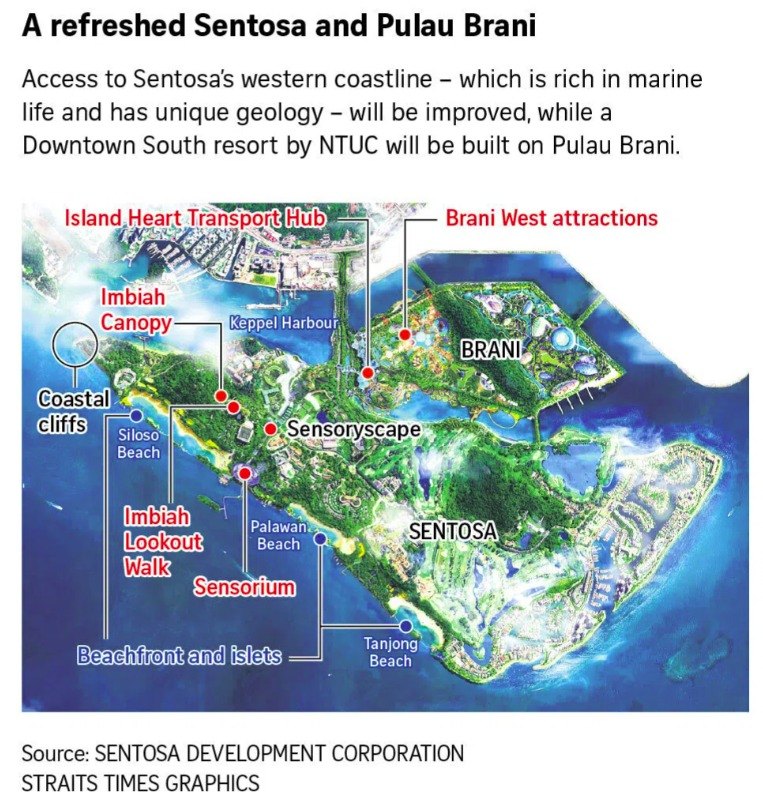
Getting there changes too.
Sentosa is already reachable by cable car, the gateway bridge and the monorail. More attractions need more capacity.
A new people mover system is planned to connect the mainland, Sentosa and Brani. A water taxi service is being explored.
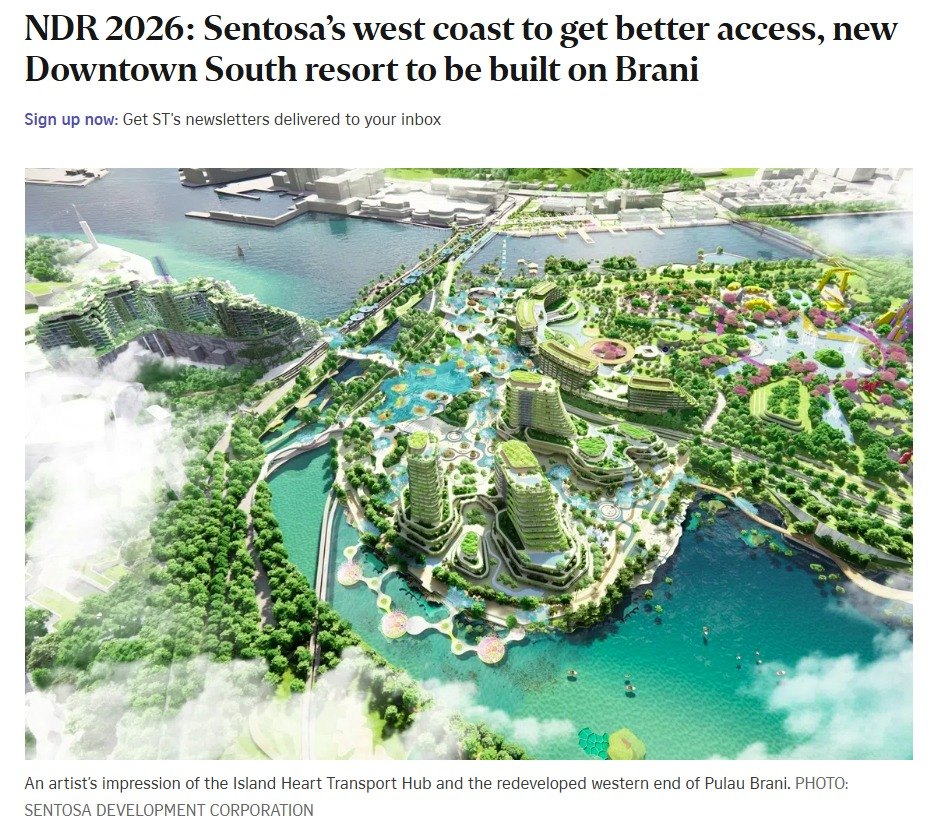
The property relevance here is the closest to hand of anything in this article.
Brani and Keppel sit at the eastern end of the Greater Southern Waterfront, the roughly 1,000 hectares released as the port moves to Tuas.
Put a leisure and tourism anchor on Brani, add a transport spine, and you change what the waterfront next door is worth developing into.
That is still a multi-year story.
But it is measured in years, not decades.
11. But Don't Invest Based On A 30-Year Artist's Impression
This is probably the most important practical point for buyers.
Every announcement of this kind produces the same two mistakes.
People treat a study as a plan, and a plan as a completion date.
The fix is to sort announcements by the certainty they actually carry, before deciding how much of your money they justify.
| Planning stage | Examples in this article | How I would treat it |
|---|---|---|
| Broad concept or feasibility study | Western Island; undersea tunnels to Tekong; Tekong's eventual civilian use | Useful context. Not something to pay a premium for. |
| Approved long-term plan, studies and consultation underway | Long Island | Relevant to a twenty-year view. Not a reason to change what you buy this year. |
| Confirmed infrastructure with funding and a timeline | Jurong Region Line, opening in stages from around mid-2028; Cross Island Line Phase 2 in 2032 | Reasonable to factor into value, discounted for the years of waiting. |
| Under construction or already delivered | Tuas Port; the completed Tekong polder | Can be priced in with confidence. |
Long Island, Pulau Tekong and the Western Island are mainly long-term planning stories.
They are not reasons to rush out tomorrow and buy the nearest condo.
Plans evolve.
Timelines change.
Alignments move.
Land uses get revised.
And sometimes projects conceived decades earlier look very different when they are finally built.
12. My Take: Singapore Isn't Simply "Running Out Of Land"
We hear this argument constantly in my industry:
"Singapore property must go up because Singapore has no more land."
I think that's far too simplistic.
Singapore is land-scarce. Absolutely.
But our response to scarcity has never been to accept it.
We reclaim.
We redevelop.
We intensify.
We decentralise.
We build underground.
We move industries.
And increasingly, we design one piece of infrastructure to do several jobs at once.
Long Island defends a coastline while creating land and a reservoir.
Tekong meets defence needs while banking civilian land.
The Western Island houses industry while relieving mainland pressure.
That is a good deal more sophisticated than "no land, therefore prices rise."
None of which means supply is unlimited.
Reclamation is expensive, technically hard and environmentally costly. Marine habitats are affected. Coastlines change. It consumes enormous quantities of material.
That is part of why Tekong used empoldering — a method that uses roughly half the sand of normal reclamation.
Every option has a cost.
But having more options means Singapore does not have to lean too heavily on any single one.
And it means the blunt scarcity argument should not be the foundation of anyone's investment case.
Not because it is wrong.
Because it is not specific enough to act on.
13. The Real Scarcity Is Well-Located, Well-Connected Land
Here is the distinction I would ask buyers to carry away.
Singapore can create land.
Singapore cannot create a mature neighbourhood.
Reclaiming 800 hectares is an engineering problem with a known solution and a known price.
Turning it into somewhere thousands of families actively want to live is a different job. It needs MRT lines, schools with reputations, employment nearby, shops that survive, and the slow build-up of familiarity that makes a place feel established.
That takes decades.
Some places never get there.
So I would distinguish between land scarcity and scarcity of desirable, connected, mature locations.
They are not the same thing.
And this cuts both ways, which is why I think it is the right frame.
It should stop buyers paying a speculative premium on a reclamation announcement.
It should equally stop existing owners panicking that new supply will hollow out their holdings.
The right question is never whether Singapore is running out of land.
Ask instead:
What kind of land is being created, where, for what, and how well will it connect to everything that already exists?
How does the same rally land on buyers today rather than in fifty years? That is the companion piece on the new $16,000 HDB and $18,000 EC income ceilings. For the shorter-cycle forces working on prices, start with my 2026 market outlook on interest rates and supply.
14. What I Am Watching Next
Six things, in rough order of how soon they could matter.
To follow the hard signals rather than the headlines, my record of Government Land Sales tenders and awarded land rates is where they show up first.
15. Frequently Asked Questions
What land projects did Singapore announce at National Day Rally 2026?
Prime Minister Lawrence Wong set out four long-term projects: Long Island off the East Coast, further reclamation at the southern end of Pulau Tekong, a new Western Island formed by merging Semakau, Bukom, Sudong and smaller islands, and an integrated Sentosa and Pulau Brani destination. He also said the Government is studying the possibility of undersea tunnels to Tekong.
How big will Long Island be?
URA's plan involves reclaiming about 800 hectares off the East Coast, roughly twice the size of Marina Bay, in three tracts running from Tanah Merah to Marina East. It includes a new freshwater reservoir formed between East Coast Park and the reclaimed land, and around 20 kilometres of new waterfront parks. Note that the 800-hectare figure comes from the November 2023 URA plan, not from the 2026 speech.
Will there be HDB flats on Long Island?
Housing is part of the stated purpose of the reclaimed land, but the number of homes, the mix of public and private, the density and the phasing have not been announced. Those are precisely the details that would determine any property effect. Do not assume a specific future project or timeline.
Will Long Island push East Coast property prices up?
Not automatically. Long Island brings coastal protection, new parks and eventually new infrastructure, all of which support the wider east. It also eventually brings a large amount of new housing that existing developments will compete against. The outcome depends on connectivity, density and how the new district joins onto today's neighbourhoods, and none of that has been decided.
Should I buy an East Coast property now because of Long Island?
I would not buy on that basis alone. Reclamation has not started, preparatory works were scheduled to begin from the end of 2026, and the full build-out runs for decades. Buy a property that works on today's basics: price, transport, schools, layout and supply. Treat Long Island as possible upside, not the reason for the purchase.
When does work on Long Island actually start?
Technical studies began in 2024 and run in phases, and by March 2026 more than 14,000 people had given feedback. Agencies said preparatory works would begin from the end of 2026, starting west of Bedok Jetty, with a second phase after the 2029 SEA Games because those waters are used for competition. Reclamation itself follows only after the studies and public consultation.
How much land will be created at Pulau Tekong, and what will it be used for?
After meeting SAF training needs, about 500 hectares will remain for future civilian use. The Prime Minister compared that to the size of Toa Payoh town. He also said the Government has not decided what to use it for and does not have to decide now. That is deliberate optionality, not an unannounced town.
Is Singapore building a new HDB town on Pulau Tekong?
Not yet, and nothing suggests it has been decided. There is no confirmed housing number, tenure mix, MRT station, school or timeline. Anyone telling you otherwise is filling in blanks the Government left empty on purpose.
Why is Singapore studying undersea tunnels to Pulau Tekong instead of a bridge?
A bridge would cut across busy shipping channels. The Government is therefore studying undersea vehicular tunnels instead. The Prime Minister called it a major engineering task that Singapore has not tried at this scale. It is still a study, not a funded project with a route, a cost or a date.
What is the proposed Western Island?
The plan is to merge several islands south of Jurong Island into one. The main ones are Semakau, Bukom and Sudong, plus smaller islands nearby. It is intended to support advanced manufacturing, new power generation and defence. A second road link to Jurong Island is planned, plus a new link from Jurong Island to the western island.
Is the Western Island another Jurong Island?
In principle, yes. Jurong Island was itself made by joining seven separate islands through reclamation, and it has anchored Singapore's energy and chemicals industry for decades. The Prime Minister drew the parallel himself: Jurong Island shaped the economy for the last fifty years, and this one is meant to shape the next fifty.
How does building an industrial island help Singapore's housing supply?
Indirectly, and more than people expect. Power generation, advanced manufacturing and defence all need large sites, and on a mainland of roughly 730 square kilometres each site is taken from something else. Move those uses offshore and the mainland land they would have consumed either becomes available or never gets consumed at all. It adds no homes directly, but it reduces the competition for the land homes are built on.
What is happening at Sentosa and Pulau Brani?
Sentosa's western coastline, currently closed to the public, will get improved access while keeping its natural character, including its coastal cliffs and marine habitats. On Pulau Brani, NTUC will build a Downtown South resort once port operations move to Tuas, and some land will be reclaimed to connect Brani and Sentosa. A new people mover system linking the mainland, Sentosa and Brani is planned, and a water taxi service is being explored.
Does reclamation mean Singapore will never run out of land?
No. Reclamation is expensive, technically difficult and environmentally costly, including effects on marine habitats. It is one option alongside redevelopment, higher density, underground construction and moving uses offshore. Having more options means Singapore does not have to lean too heavily on any single one, and that is a different claim from having unlimited supply.
Does Singapore's ability to reclaim land weaken the argument that scarcity supports property values?
Not exactly, but it should change how you use the argument. Singapore can create physical land. It cannot create a mature, well-connected, well-served neighbourhood quickly. The meaningful scarcity has never been physical land, so a blunt scarcity claim is not wrong so much as too unspecific to act on.
Will these projects affect Singapore property prices in the next five years?
Their direct effect is likely to be small, because the timelines run in decades rather than years. What could move specific areas sooner is the next layer of detail: confirmed transport alignments, housing numbers, phasing and land-use plans. Those are the announcements worth watching, not the concept itself.
What should property buyers watch next?
For Long Island, watch for land-use plans, transport alignments, housing numbers and phasing. For Tekong, whether the 500 hectares gets a stated purpose and whether the tunnel study moves to a funded project. For the Western Island, the reclamation boundaries and which mainland uses eventually relocate. And across all of them, the Government Land Sales programme, because land releases are the earliest hard signal of where the state is actually directing development.
What is the biggest property lesson from these announcements?
Stop asking whether Singapore is running out of land. Ask instead: where is Singapore creating land, what will it be used for, and which existing places gain value because of how the future city connects? That is a far more useful question, and unlike the first one, it has answers you can actually act on.
16. Perhaps This Is The Most Singapore Story Of All
Before the reflection, the short version.
- Four long-term projects: Long Island (about 800 hectares off the East Coast), Pulau Tekong (about 500 hectares for future civilian use), the Western Island (merging Semakau, Bukom and Sudong), and an integrated Sentosa and Pulau Brani.
- Long Island's numbers come from URA's plan, not from the rally speech. It protects a low-lying coast, creates a reservoir and adds about 20km of waterfront parks, and it will take decades.
- Tekong's 500 hectares has no decided use, and the Government said it does not need to decide now. That is deliberate optionality, not an unannounced town.
- The Western Island helps housing indirectly, by moving industry, power generation and defence off the mainland.
- Sentosa and Brani are the nearest-term of the four, and sit next to the roughly 1,000 hectares released by the port's move to Tuas.
- Sort every announcement by planning certainty before you let it influence a purchase. A feasibility study and a funded project are not the same input.
- The scarcity that drives Singapore property values is connected, mature, well-served land. Physical land is the easier half.
I find these announcements strangely inspiring.
Singapore began as a small island with very few natural resources.
Generations before us looked at the limitations they inherited and asked what could be done with what they had.
They reclaimed Marina Bay.
They created Jurong Island.
They built Changi Airport partly on reclaimed land.
They expanded Tuas.
They moved our ports.
Now another generation is looking at a different set of challenges.
Climate change.
Housing.
Energy security.
An ageing population.
Nature conservation.
And once again, the answer seems to be:
Plan early. Create options. Think decades ahead.
None of this will materially affect the property you buy in 2026.
But our children, or their children, may one day live and work and raise families on land that does not exist today.
That is the scale on which Singapore is planning.
And perhaps the biggest takeaway isn't simply that we need more land.
It is that when we eventually reach the edge of today's map…
we are prepared to draw a new one.
Planning a move that has to work across the next twenty years? Long-term land plans are one input among many. The sequencing of your own sale and purchase usually matters more. Get in touch and we can map it out together.
Disclaimer: This article is provided for informational purposes only and should not be construed as financial advice, investment recommendation, or an offer to buy or sell property. While we have made efforts to ensure the accuracy of the information presented, market conditions, developer plans, and regulatory environments are subject to change. Property prices, launch dates, unit availability, and other details mentioned are based on current market intelligence and may be subject to revision. Prospective buyers should conduct independent research, verify all information directly with developers and relevant authorities, and consult with qualified financial and legal advisors before making any property purchase decisions. We are committed to accuracy and transparency; however, the information provided should not be regarded as an offer, statement, representation, or guarantee. While we strive to ensure the information is correct, it may not always be complete, up to date, or free from errors. Users are strongly encouraged to exercise due diligence and verify details through direct inquiries. Our agents and this website shall not be held liable for any decisions or actions taken based on the information provided here.