11 min read • Last updated 16 September 2026
A land tender closed on Monday and by Tuesday morning my phone had three versions of the same question.
"Does this mean Thomson Reserve is going to be expensive?"
I understand why people jump there.
The consortium that just paid a record price for land in Bedok is the same consortium launching Thomson Reserve next month.
So the mental shortcut writes itself.
Record land bid = confident developer = higher launch price.
Two of those three things are true.
The arrow between them is not.
1. What Happened At The New Upper Changi Road Tender?
A joint venture of UOL Group, CapitaLand Development and Singapore Land Group submitted the top bid of $1,425,388,000, or $1,537 psf ppr, for the New Upper Changi Road Government Land Sales site when the tender closed on 1 September 2026. Four bids were received. If awarded, it becomes the highest land rate ever paid for a pure residential state site in the Outside Central Region.
Key Takeaways
- Top bid $1.425 billion, or $1,537 psf ppr, from UOL, CapitaLand Development and SingLand. Four bids in total.
- That is 13.8% above the second bid, 15.6% above the nearby Bedok Rise site at $1,330 psf ppr, and 10.7% above the previous suburban record of $1,388 psf ppr.
- Analysts had projected $1,250 to $1,450 psf ppr. The winning bid cleared the top of that band.
- The 99-year site spans 331,198 sq ft with a maximum gross floor area of 927,362 sq ft, and can yield about 1,010 homes beside Bedok MRT.
- Thomson Reserve's land was secured separately at $1,178 psf ppr in November 2024, and that cost cannot be re-priced by anything that happened in Bedok.
- The site had not been formally awarded by URA at the time of writing. Everything below reads the top bid, not a completed award.
Two terms before we go further, because the rest of this piece leans on them.
- psf ppr — per square foot per plot ratio. What a developer pays for land, divided by the floor space it is allowed to build. It is the earliest hard number available on what a future project must charge.
- Breakeven — land plus construction, financing, professional fees, taxes and marketing, divided by that same floor space. The price below which the developer loses money.
Here is the full bid table, not a selection from it.
| Rank | Tenderer | Bid price | psf ppr |
|---|---|---|---|
| 1 | UOL Group, Singapore Land Group and CapitaLand Development | $1,425,388,000 | $1,537 |
| 2 | City Developments and Hong Realty | $1,252,000,000 | $1,350 |
| 3 | GuocoLand, Hong Leong Holdings and TID | $1,242,664,619 | $1,340 |
| 4 | Sim Lian Group | $1,215,000,000 | $1,310 |
I checked the headline number myself rather than repeating it.
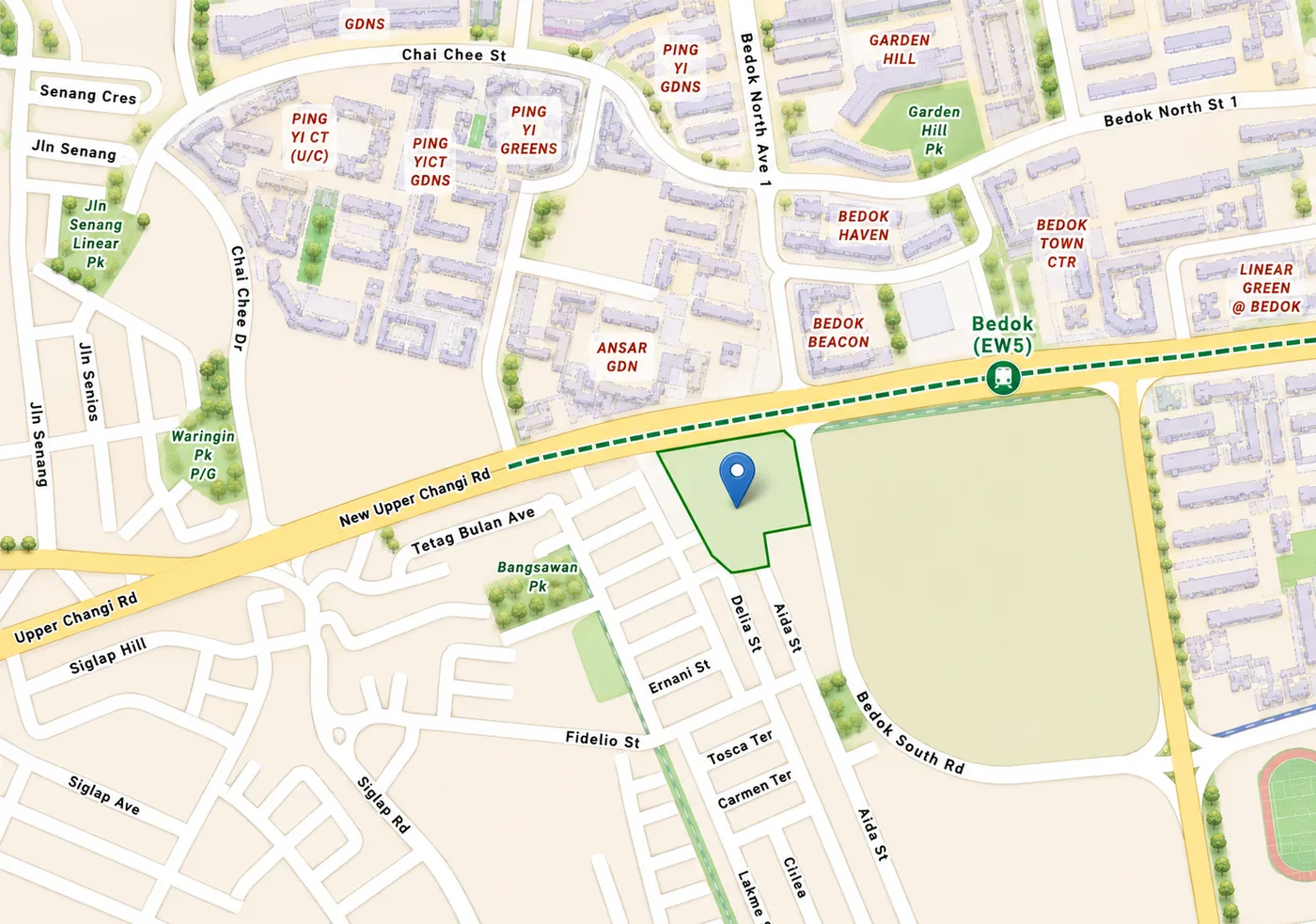
The plot sits on the former Temasek Primary and Secondary school grounds, within walking distance of Bedok MRT and the Bedok integrated transport hub.
Bedok Mall and Heartbeat @ Bedok are on the doorstep.
It is a genuinely good site. That part is not in dispute.
2. Why Is $1,537 psf ppr Such A Big Number?
Because of the gap, not the level.
A record on its own means little. Land records get broken in most cycles.
What makes this one worth stopping for is how far it sits above everything around it.
It cleared the second-highest bid by 13.8%.
It cleared the Bedok Rise site, awarded to Allgreen Properties in late 2025, by 15.6%.
It cleared the previous suburban record — the Bayshore Road plot that became Vela Bay — by 10.7%.
And it cleared the top of the analyst range, which ran to about $1,450 psf ppr.
Huttons Asia chief executive Mark Yip described it as a benchmark price for a pure residential parcel in the suburbs.
A developer does not overshoot the field by that margin absent-mindedly.
That is a considered view on where selling prices go, not a clerical error.
The contrast with what happened in the same fortnight is instructive.
A Sustained Land-led consortium secured a central District 11 site through a private treaty deal at $1,297 psf ppr at 8 Thomson Lane, about 16% below this suburban bid.
Same land market. Same month. Two very different routes to a site.
And the ceiling did not hold for long. Two weeks later, Eco World bid $1,612 psf ppr for a small city-fringe plot in Bishan. I set out why a developer would pay that much at the Lorong Puntong tender.
Set against the land rates of nearby and comparable sites, the outlier is obvious.
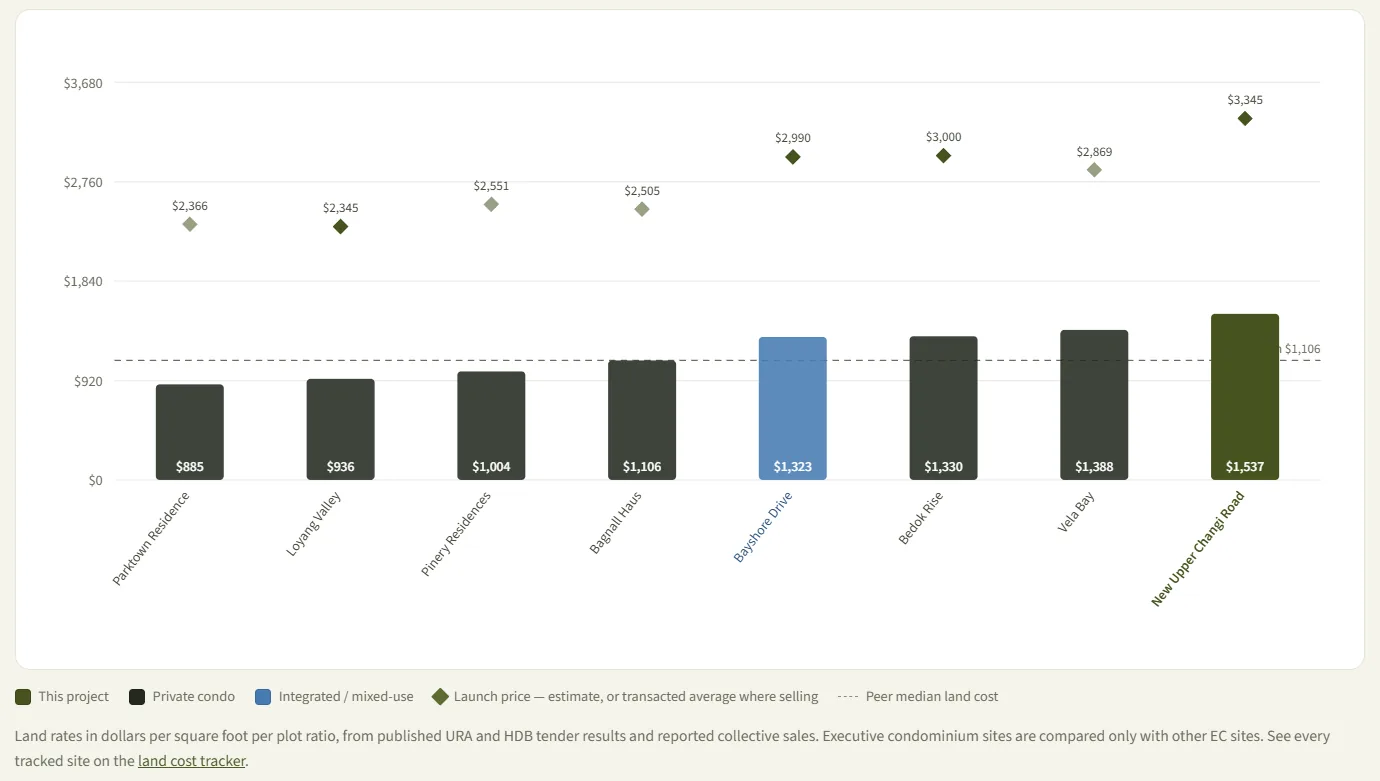
The peer median land cost across that set is $1,106 psf ppr.
New Upper Changi Road is 39% above it.
| Site or project | Land ($psf ppr) | Launch price ($psf) | Price to land |
|---|---|---|---|
| Parktown Residence | $885 | $2,366 | 2.67× |
| Loyang Valley | $936 | $2,345 | 2.51× |
| Pinery Residences | $1,004 | $2,551 | 2.54× |
| Bagnall Haus | $1,106 | $2,505 | 2.27× |
| Bayshore Drive (mixed-use) | $1,323 | $2,990 (est.) | 2.26× |
| Bedok Rise | $1,330 | $3,000 (est.) | 2.26× |
| Vela Bay | $1,388 | $2,869 | 2.07× |
| New Upper Changi Road | $1,537 | $3,345 (est.) | 2.18× |
Notice what the last column does.
The cheaper the land, the wider the multiple.
That is not developers being greedier on cheap sites. It is arithmetic.
Construction, financing and taxes cost roughly the same whether the land was cheap or dear.
So on a cheap site, those fixed costs make up a bigger share of the total.
A high land price compresses the multiple. It does not compress the price.
3. What Does That Land Cost Imply For The Bedok Project?
Somewhere near $3,000 psf. Possibly well above.
Run the cost stack and the floor becomes visible.
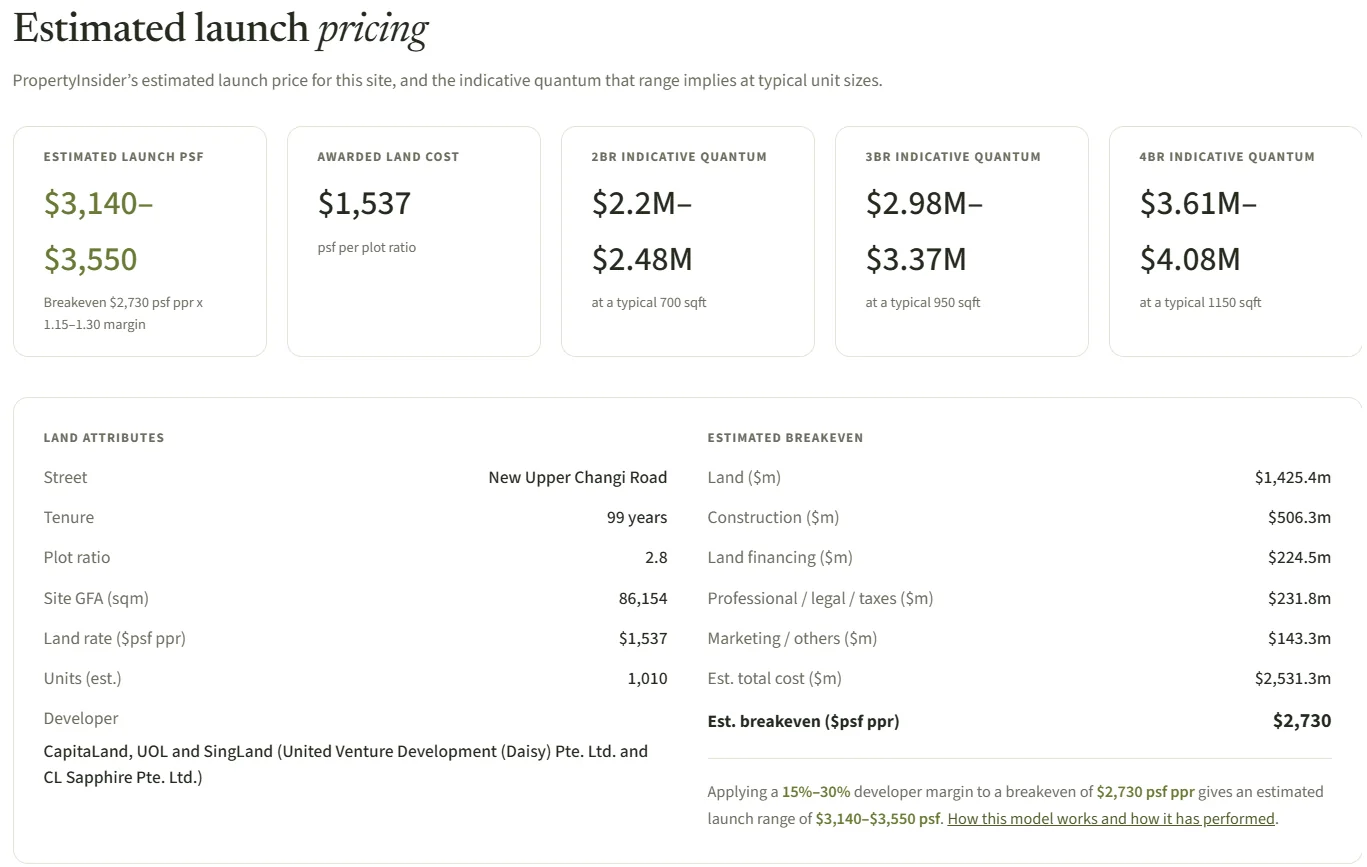
Land at $1,425.4m. Construction at $506.3m. Land financing at $224.5m. Professional fees, legal and taxes at $231.8m. Marketing and other costs at $143.3m.
Total $2,531.3m.
That is an estimate built from public tender figures and standard construction cost assumptions. It is not the developer's accounts.
And it is not the only estimate on the table.
Delasa chief executive Karamjit Singh, reading the same land rate against Bedok's selling prices, put the future project at $2,900 to $3,000 psf.
Those two views are meaningfully apart, and the gap is worth naming rather than smoothing over.
At $2,900 psf against a $2,730 breakeven, the developer is working on a margin of about 6%.
That is thin for a $1.4 billion commitment on a site that also carries school demolition and asbestos checks.
So one of three things is true.
The breakeven estimate is too high, the launch price ends up above $3,000, or the consortium is accepting a slimmer return than the market assumes.
My read is that the first and second are more likely than the third.
But that project is years away, and none of it is the interesting question.
4. Does This Change What Thomson Reserve Costs To Build?
No.
Not by a single dollar.
Thomson Reserve's land came from a collective sale in November 2024, at $1,178 psf ppr.
That figure is locked. It was locked before the Bedok tender was even launched.
A developer's land cost is site-specific and sunk. It does not travel between projects.
Here is the thing people miss when they hear "same developer".
UOL, CapitaLand and SingLand are not running one pot of money across two projects. Each site has its own land parcel, its own financing, its own cost stack and its own profit-and-loss.
Thomson Reserve's breakeven does not move because a different site in a different region cost more.
On the same PropertyInsider model, Thomson Reserve's estimated breakeven is $2,058 psf ppr, giving an estimated launch band of $2,370 to $2,680 psf. I set out that working in full in my commentary on Thomson Reserve's land cost, unit mix and October preview.
There is one more distinction worth making, because it gets flattened constantly.
New Upper Changi Road is in Bedok, District 16, which is Outside Central Region — the suburbs.
Thomson Reserve is in District 20, city fringe.
A suburban land record does not automatically re-rate a city-fringe project. They answer to different buyer pools and different comparables. If the regional bands are unfamiliar, my note on how OCR, RCR and CCR actually differ for a buyer covers the distinction.
Two records, two markets.
5. So Will Thomson Reserve Launch High Or Low?
Neither, I suspect.
There are two competing forces here, and the honest answer is that they mostly cancel.
Supporting a firmer price
The consortium has just told the market, in $1.4 billion of committed capital, that it expects Singapore selling prices to keep rising.
A developer holding that view does not deliberately underprice the project it is launching six weeks later.
There is also a reputational point. The same three names now have to sell Bedok at close to $3,000 psf in a few years' time.
A cheap Thomson Reserve print would sit awkwardly against that.
Limiting the price
Thomson Reserve is 1,268 units.
That is the single most important fact in this whole discussion, and it points the other way.
You cannot price 1,268 units the way you price a 150-unit boutique block.
A mega-launch lives or dies on take-up in the first weekend, because the sales rate sets the story for every subsequent phase.
Price too hard and you get slow sales and a visible unsold stack.
Then buyers learn to wait, and the later discounts annoy everyone who bought early.
The Bedok site does not launch for years. Thomson Reserve launches in mid-October.
Between now and then, the consortium needs a clean sell-through far more than it needs an extra $100 psf.
Size is the constraint, not confidence.
6. What Does The Land Gap Look Like In Actual Dollars?
Large. And that is the part worth holding on to.
The land cost difference between the two sites is $359 psf ppr.
New Upper Changi Road cost 30% more per square foot of buildable space than Thomson Reserve did.
Carried through both cost stacks, here is what the two estimated launch ranges imply at typical layout sizes.
| Layout | Thomson Reserve (est.) | New Upper Changi Road (est.) | Difference |
|---|---|---|---|
| 2-bedroom, 700 sq ft | $1.66m to $1.88m | $2.20m to $2.48m | About $540k to $600k |
| 3-bedroom, 950 sq ft | $2.25m to $2.55m | $2.98m to $3.37m | About $730k to $820k |
| 4-bedroom, 1,150 sq ft | $2.73m to $3.08m | $3.61m to $4.08m | About $880k to $1.00m |
A three-bedroom gap of roughly three-quarters of a million dollars is not a rounding difference.
But read it carefully, because the temptation is to read it as a discount.
"So Thomson Reserve is cheap."
Not quite.
Cheaper land lowers the floor under a price. It does not lower the ceiling.
What it buys the developer is room to move if a quarter goes soft.
What it buys the buyer is a project that should price below the launches that follow it.
Not below every home already standing nearby.
Those are different claims, and only the second one is safe to act on.
7. Is "Same Developer" A Reliable Signal At All?
Weakly.
Developers do not price a launch off what they paid somewhere else.
They price off what is actually selling within a few kilometres of the showflat.
For Thomson Reserve, that means the District 20 resale set and the recent Lentor and Thomson launches, not a plot in Bedok.
The Bedok bid tells you something real, but it tells you about the consortium's 2029 to 2031 view, not its October pricing sheet.
Look at what actually happened in Bedok for the shape of this.
Bedok Residences launched in 2011 at around $1,300 psf.
Over the past year its resale transactions have averaged $1,757 psf.
Sky Eden@Bedok launched in September 2022 at around $2,100 psf and sold out by 2024.
Vela Bay, one MRT stop away in Bayshore, has transacted between $2,532 and $3,302 psf since launching in April.
That is the ladder the New Upper Changi Road project has to climb, and the consortium clearly thinks it climbs further.
None of those transactions happened in District 20.
8. What Does "Keeping Total Price Quantum Realistic" Mean?
Smaller units, usually.
Spokespersons from UOL and CapitaLand Development said the future project would feature two- to four-bedroom formats, keeping total price quantum realistic.
That is a sensible thing to say and I do not doubt the intention.
But there are only two levers behind it.
Lower the price per square foot, or shrink the square footage.
With land at $1,537 psf ppr, the first lever barely moves.
So the honest translation is that layouts get more efficient, and probably tighter.
This matters for anyone comparing the two projects later.
A "$2.2 million two-bedroom" tells you nothing until you know how many square feet it is.
Quantum can be engineered. Price per square foot is harder to hide.
Compare both, always, and compare them against layouts of the same size.
9. How Much New Supply Is Bedok Absorbing?
A lot, and quickly.
Four state sites have been sold in the Bedok planning area since 2025.
- Bayshore Road, $1,388 psf ppr, now Vela Bay
- Bayshore Drive mixed-use, $1,323 psf ppr, to a Frasers Property joint venture
- Bedok Rise, $1,330 psf ppr, to Allgreen Properties
- New Upper Changi Road, $1,537 psf ppr, top bid
Together they add about 3,185 private homes between 2025 and 2028.
Analysts have flagged that this may take the market some time to absorb.
That is the counterweight to the bullish reading, and it deserves equal billing.
Delasa's Karamjit Singh made the case for the demand side.
Bedok is a mature estate where many HDB flats and landed homes are fully paid off.
And the last major condominium launch there was fifteen years ago.
A large, underserved local buyer pool is a genuine advantage.
Whether it is a 3,185-home advantage over three years is the open question.
Weighing the estate rather than the project? My guide to living in Bedok covers the schools, the transport and the everyday texture of the place.
The wider tender pipeline sits in my overview of the 2026 GLS programme. The neighbouring integrated site is covered in my Bayshore Drive analysis.
10. My Take: The Record Tells You About 2029, Not About October
Put the two projects side by side and the interesting thing is not the price gap.
It is the sequencing.
The consortium is launching its cheap-land project first and its expensive-land project second.
That ordering is not an accident of the calendar. It is how a balance sheet works.
You sell the project that funds the commitment before you have to fund the commitment.
Which means Thomson Reserve is carrying a job beyond its own profit-and-loss.
It has to move volume.
And that pushes towards a launch price in the sensible middle, not the aggressive top.
My expectation, and it is an expectation rather than a forecast:
Thomson Reserve prices in the middle of its modelled band, with early phases at the friendlier end and later stacks stepping up as take-up allows.
That is the standard mega-launch playbook and I see nothing here that argues against it.
Now the part that actually matters for a buyer.
Say Thomson Reserve launches around $2,450 to $2,550 psf.
Meanwhile the same consortium is holding land at $1,537 psf ppr for a project that must sell near $3,000.
In two or three years, that Thomson Reserve price list will read very differently.
Not because Thomson Reserve was underpriced.
Because the market moved past it.
That is the real read on this tender, and it cuts both ways.
The same logic that made 2019 buyers look clever made 2013 buyers wait a decade.
Land records tell you what developers believe. They do not tell you when they will be proved right.
11. What I Would Watch At The October Preview
Not the headline average. It is the least useful number in the room.
A developer can announce an attractive average and still place the units you actually want well above it.
Floor premiums, stack premiums and layout sizing all do that quietly.
Ask:
- What is the psf on the specific stack and floor, not the project average?
- How does that psf compare with District 20 resale in the last six months?
- What is the actual square footage behind the quantum?
- How many units are released in phase one, and at what spread?
- Which layouts are priced below the project average, and why?
- What is the gap between the cheapest and dearest stack?
Then compare it against what is already standing nearby.
AMO Residence. JadeScape. Thomson Three. Lentor Modern.
On both psf and quantum, layout by layout.
The question is never whether a project is cheap. It is which units in it are cheap relative to what a buyer could otherwise own today.
My five-point framework for assessing a new launch sets out how I work through that. Every tender I am tracking sits under my GLS site analysis.
12. Frequently Asked Questions
Who submitted the top bid for the New Upper Changi Road GLS site?
A joint venture of UOL Group, CapitaLand Development and Singapore Land Group submitted the highest of four bids at $1,425,388,000, or $1,537 per square foot per plot ratio, when the tender closed on 1 September 2026. The same three developers are behind Thomson Reserve, the 1,268-unit District 20 project launching in October 2026.
Has the New Upper Changi Road site actually been awarded?
Not at the time of writing. The tender closed on 1 September 2026 and the bids were published, but URA had not formally announced an award. Every figure discussed here reads the top bid rather than a completed award, and the analysis would need revisiting if the tender were not awarded.
Why is $1,537 psf ppr considered a record?
It would be the highest land rate paid for a pure residential Government Land Sales plot in the Outside Central Region, Singapore's suburban band. The previous high was $1,388 psf ppr for the Bayshore Road site awarded in March 2025, which became the 515-unit Vela Bay. The winning bid also cleared the top of the analyst range, which ran to about $1,450 psf ppr.
How much could the future New Upper Changi Road condominium sell for?
Two credible estimates are in circulation and they differ. PropertyInsider's cost model puts the breakeven at about $2,730 psf per plot ratio and the launch range at $3,140 to $3,550 psf. Delasa chief executive Karamjit Singh, reading the land rate against Bedok selling prices, put it at $2,900 to $3,000 psf. Neither is a developer figure and the project is years from launch.
Does the record land bid mean Thomson Reserve will launch at a higher price?
Not mechanically. Thomson Reserve's land was secured separately at $1,178 psf per plot ratio in November 2024 and that cost is sunk, so nothing that happened at the Bedok tender changes its cost base. What the bid signals is the consortium's confidence in future selling prices, which argues against a deliberately cheap launch. Working against that, Thomson Reserve has 1,268 units to sell, and a project that size depends on take-up rather than on squeezing the last dollar per square foot.
Are Thomson Reserve and the New Upper Changi Road site in the same market?
No. New Upper Changi Road is in Bedok, District 16, which sits in the Outside Central Region. Thomson Reserve is in District 20, which is city fringe. They draw on different buyer pools and are priced against different comparables, so a suburban land record does not automatically re-rate a city-fringe project.
When is Thomson Reserve launching?
The developers have indicated mid-October 2026 for the launch of the 1,268-unit project. No price list has been published. Any price figure circulating before the preview is an estimate, including mine.
Why is Thomson Reserve's land cost so much lower?
It came from a collective sale rather than a state tender, and it was secured in November 2024 at $1,178 per square foot per plot ratio, before the recent run of aggressive land bids. The $359 per square foot gap between the two sites reflects timing, tenure of acquisition route and location, not a mistake by either side.
Will Thomson Reserve look cheap once the Bedok project launches?
Possibly, in hindsight. If Thomson Reserve launches in the middle of its modelled band and the Bedok project later prices near $3,000 per square foot, the earlier project will read as good value by comparison. That is a statement about the market moving, not about Thomson Reserve being underpriced today, and it only benefits a buyer who holds through the intervening years.
How many new private homes are coming to Bedok?
Four state sites sold in the Bedok planning area since 2025 will together add about 3,185 private homes between 2025 and 2028. They are Bayshore Road at $1,388 psf ppr, Bayshore Drive at $1,323 psf ppr, Bedok Rise at $1,330 psf ppr, and now New Upper Changi Road. Analysts have flagged that this volume may take the market some time to absorb.
What does psf ppr actually mean?
It stands for per square foot per plot ratio. It is what a developer paid for the land, divided by the floor area it is allowed to build on that land. It is the earliest hard number available on what a future project must charge, because the land cost sets the floor under the eventual price list.
What should a buyer do before the October preview?
Work out the number that actually decides it for you, which is usually the monthly commitment on a specific layout rather than the project average. Pull the District 20 resale transactions for the last six months so you have a comparison ready. If a sale is funding the purchase, get the proceeds and timing settled before preview weekend rather than during it.
13. My Thoughts
A record land bid is a developer telling you what it believes.
$1,537 psf ppr says UOL, CapitaLand and SingLand think Singapore residential prices have further to run.
That belief is worth taking seriously. These are not speculative buyers and $1.4 billion is not a small position.
But belief about 2030 is not a price list for October.
Thomson Reserve will be priced against its own cost base, its own competition and its own 1,268-unit sales problem.
Not against a plot in Bedok.
What the tender genuinely gives a buyer is context.
It tells you the replacement cost of land is rising.
Today's launches are being built on yesterday's land prices.
The projects following them will not have that advantage.
That is useful. It is also not the same as urgency.
Because the buyer who does well out of the next few years will not be the one who moved fastest.
It will be the one who bought a home they could hold comfortably through whatever the market does in between.
Weighing up Thomson Reserve, or the Bedok pipeline, against what you already own? I work through the actual numbers with clients — sale proceeds, borrowing capacity, timing and the layouts that are genuinely worth the money. Get in touch to talk it through.
14. Sources And Update Log
Tender data. The four-bid table, the $1,537 psf ppr rate, the site dimensions, the developer comments on unit formats, the analyst projection range and the Bedok transaction history follow EdgeProp Singapore's report on the tender close, published 1 September 2026, which cites URA as the source of the bid figures. Government Land Sales tender results are published by the Urban Redevelopment Authority. The site had not been formally awarded at the time of writing.
Additional tender context. The former Temasek Primary and Secondary schools site history, the demolition and asbestos considerations, the Huttons commentary and the count of four Bedok-area state sites totalling about 3,185 homes were reported by The Straits Times on 1 September 2026.
Land cost and pricing model. The land cost comparison chart, the cost stack, the $2,730 psf ppr breakeven, the $3,140 to $3,550 psf estimated launch range and the indicative quantums come from PropertyInsider.sg's New Upper Changi Road page, the research platform I founded and publish. It compiles URA tender and caveat data and states its method. The 15% to 30% developer margin band is applied to every project on that platform, not chosen for this one.
Thomson Reserve figures. The $1,178 psf ppr land cost, the $2,058 psf ppr estimated breakeven and the $2,370 to $2,680 psf estimated launch band are set out with full working in my Thomson Reserve commentary, which sources the collective sale details to the marketing agent's November 2024 notice.
My own arithmetic. The price-to-land multiples in Table 2, the percentage gaps between land rates, the $359 psf ppr difference, the quantum differences in Table 3 and the implied margin at $2,900 psf are my calculations on the figures above. The two headline sums — the bid divided by gross floor area, and the cost stack divided by gross floor area — are reproduced in the article so you can check them.
What is still unknown. No price list exists for either project. Unit sizes, stack numbers and phasing for Thomson Reserve land at preview. The New Upper Changi Road project has no name, no unit mix and no launch date. Treat every estimate here as an estimate.
Update Log
- 16 September 2026. Added a cross-reference to the Lorong Puntong tender, which closed at $1,612 psf ppr on 15 September 2026.
- 2 September 2026. First published, following the tender close on 1 September 2026. Cross-reference added to the 8 Thomson Lane private treaty deal for land-rate context.
This page will be updated when URA confirms the award, when Thomson Reserve publishes its price list in October, and when the New Upper Changi Road project is named.
Disclaimer: This article is provided for informational purposes only and should not be construed as financial advice, investment recommendation, or an offer to buy or sell property. While we have made efforts to ensure the accuracy of the information presented, market conditions, developer plans, and regulatory environments are subject to change. Property prices, launch dates, unit availability, and other details mentioned are based on current market intelligence and may be subject to revision. Prospective buyers should conduct independent research, verify all information directly with developers and relevant authorities, and consult with qualified financial and legal advisors before making any property purchase decisions. We are committed to accuracy and transparency; however, the information provided should not be regarded as an offer, statement, representation, or guarantee. While we strive to ensure the information is correct, it may not always be complete, up to date, or free from errors. Users are strongly encouraged to exercise due diligence and verify details through direct inquiries. Our agents and this website shall not be held liable for any decisions or actions taken based on the information provided here.