
Geek Out #10
Condos near the MRT cost more. Do owners make a bigger gain when they sell?
Published · URA caveat records, resales to 10 October 2026
Condos within about 5 minutes’ walk of an MRT station cost around 7% more than similar condos 5 to 10 minutes away in the same planning area. A condo near the MRT costs more to buy and sells for more later. But the prices of condos near the MRT increased by about the same percentage as the prices of condos more than 5 minutes’ walk from a station.
What this page found, in 4 lines
Being within 5 minutes of an MRT station costs more. · tap for the rest
- Being within 5 minutes of an MRT station costs more. A condo within about 5 minutes’ walk costs around 7% more than a similar condo 5 to 10 minutes away. A condo within 5 minutes also costs around 13% more than a similar condo 10 to 15 minutes away, and around 19% more than a similar condo more than 15 minutes away. “Similar” means in the same planning area, compared as if the two condos had the same age, tenure, unit size and type (private condo or EC).
- Being right next to the station doesn’t cost more than being 3 to 5 minutes away. Condos under 3 minutes away cost about the same as condos 3 to 5 minutes away.
- Being near the MRT didn’t make prices rise faster. Prices of units bought between 2010 and 2019 and later sold increased by about the same percentage a year, whether the condo was within 5 minutes’ walk of a station or more than 5 minutes’ walk.
- The data can’t say which region or MRT line has the biggest price difference. The figures range from about 2% to 7%, but there are too few condos in each region and on each line to tell them apart.
Look up a stationHow much morePrice riseBy regionBy lineFuture stationsLRTQuestions
Look up the condos around any MRT station
Pick a station to see every condo within 15 minutes’ walk, grouped by walk time. Each condo shows its median resale price per square foot over the last 24 months, how many resales that price comes from, the year it was completed and whether it’s freehold or leasehold.
How to read a station card. Condos are grouped by walk time. Each group shows its median price, when its condos were completed, how many are ECs and how many are freehold or leasehold. Older, leasehold and EC condos usually cost less than newer, freehold and private ones, so check what’s in each group before comparing their median prices. Things the data can’t see, like view, facing and floor level, also affect price. A condo with fewer than 5 resales in the last 24 months shows “Too few resales to show a price”.
No station matches that name. Try part of the name, such as “Tampines”.
Or pick from all 174 stations
Stations in the checker: 174 MRT and LRT stations with at least one condo within 15 minutes’ walk, and 31 future stations. The number after each name is how many condos are within 15 minutes.
Open stations
- Admiralty NS10 · 5
- Aljunied EW9 · 13
- Ang Mo Kio NS16 · 2
- Bakau SE3 LRT · 5
- Bangkit BP9 LRT · 2
- Bartley CC12 · 6
- Bayfront CE1 DT16 · 5
- Bayshore TE29 · 6
- Beauty World DT5 · 18
- Bedok EW5 · 3
- Bedok North DT29 · 2
- Bedok Reservoir DT30 · 6
- Bencoolen DT21 · 19
- Bendemeer DT23 · 9
- Bishan NS17 CC15 · 4
- Boon Keng NE9 · 10
- Boon Lay EW27 · 2
- Botanic Gardens CC19 DT9 · 4
- Braddell NS18 · 6
- Bras Basah CC2 · 19
- Bright Hill TE7 · 4
- Buangkok NE15 · 9
- Bugis EW12 DT14 · 14
- Bukit Batok NS2 · 5
- Bukit Gombak NS3 · 5
- Bukit Panjang DT1 BP6 · 9
- Buona Vista EW21 CC22 · 10
- Caldecott CC17 TE9 · 5
- Canberra NS12 · 12
- Cantonment CC31 · 12
- Cashew DT2 · 13
- Cheng Lim SW1 LRT · 9
- Chinatown NE4 DT19 · 17
- Chinese Garden EW25 · 6
- Choa Chu Kang NS4 BP1 · 6
- City Hall NS25 EW13 · 10
- Clarke Quay NE5 · 18
- Clementi EW23 · 7
- Commonwealth EW20 · 7
- Compassvale SE1 LRT · 9
- Coral Edge PE3 LRT · 8
- Cove PE1 LRT · 9
- Dakota CC8 · 21
- Damai PE7 LRT · 8
- Dhoby Ghaut NS24 NE6 CC1 · 32
- Dover EW22 · 9
- Downtown DT17 · 14
- Esplanade CC3 · 7
- Eunos EW7 · 3
- Expo CG1 DT35 · 3
- Fajar BP10 LRT · 2
- Farmway SW2 LRT · 6
- Farrer Park NE8 · 8
- Farrer Road CC20 · 12
- Fernvale SW5 LRT · 8
- Fort Canning DT20 · 31
- Gardens by the Bay TE22 · 1
- Geylang Bahru DT24 · 6
- Great World TE15 · 55
- HarbourFront NE1 CC29 · 4
- Havelock TE16 · 44
- Haw Par Villa CC25 · 6
- Hillview DT3 · 19
- Holland Village CC21 · 11
- Hougang NE14 · 5
- Hume DT4 · 16
- Jalan Besar DT22 · 20
- Jelapang BP12 LRT · 3
- Jurong East NS1 EW24 · 3
- Kadaloor PE5 LRT · 6
- Kaki Bukit DT28 · 3
- Kallang EW10 · 1
- Kangkar SE4 LRT · 12
- Katong Park TE24 · 14
- Keat Hong BP3 LRT · 8
- Kembangan EW6 · 4
- Kent Ridge CC24 · 2
- Keppel CC30 · 5
- Khatib NS14 · 2
- King Albert Park DT6 · 13
- Kovan NE13 · 8
- Kupang SW3 LRT · 5
- Labrador Park CC27 · 1
- Lakeside EW26 · 9
- Lavender EW11 · 10
- Layar SW6 LRT · 6
- Lentor TE5 · 11
- Little India NE7 DT12 · 16
- Lorong Chuan CC14 · 7
- MacPherson CC10 DT26 · 4
- Marina Bay NS27 TE20 CE2 · 11
- Marina South TE21 · 1
- Marina South Pier NS28 · 1
- Marine Parade TE26 · 7
- Marine Terrace TE27 · 3
- Marymount CC16 · 3
- Mattar DT25 · 5
- Maxwell TE18 · 25
- Mayflower TE6 · 3
- Meridian PE2 LRT · 10
- Mountbatten CC7 · 12
- Napier TE12 · 11
- Newton NS21 DT11 · 41
- Nibong PW5 LRT · 3
- Nicoll Highway CC5 · 14
- Novena NS20 · 33
- Oasis PE6 LRT · 7
- Orchard NS22 TE14 · 48
- Orchard Boulevard TE13 · 17
- Outram Park EW16 NE3 TE17 · 19
- Pasir Panjang CC26 · 4
- Pasir Ris EW1 · 13
- Paya Lebar EW8 CC9 · 12
- Pending BP8 LRT · 9
- Petir BP7 LRT · 7
- Phoenix BP5 LRT · 8
- Pioneer EW28 · 1
- Potong Pasir NE10 · 13
- Prince Edward Road CC32 · 19
- Promenade CC4 DT15 CE1 · 7
- Punggol NE17 PTC · 8
- Queenstown EW19 · 8
- Raffles Place NS26 EW14 · 13
- Ranggung SE5 LRT · 12
- Redhill EW18 · 12
- Renjong SW8 LRT · 8
- Riviera PE4 LRT · 6
- Rochor DT13 · 18
- Rumbia SE2 LRT · 3
- Sam Kee PW1 LRT · 5
- Samudera PW4 LRT · 1
- Segar BP11 LRT · 1
- Sembawang NS11 · 8
- Sengkang NE16 STC · 7
- Senja BP13 LRT · 5
- Serangoon NE12 CC13 · 9
- Shenton Way TE19 · 19
- Siglap TE28 · 8
- Simei EW3 · 7
- Sixth Avenue DT7 · 3
- Somerset NS23 · 53
- Soo Teck PW7 LRT · 9
- South View BP2 LRT · 8
- Springleaf TE4 · 2
- Stadium CC6 · 4
- Stevens DT10 TE11 · 7
- Sumang PW6 LRT · 6
- Tai Seng CC11 · 5
- Tampines EW2 DT32 · 2
- Tampines East DT33 · 4
- Tampines West DT31 · 3
- Tan Kah Kee DT8 · 5
- Tanah Merah EW4 CG · 9
- Tanjong Katong TE25 · 17
- Tanjong Pagar EW15 · 23
- Tanjong Rhu TE23 · 4
- Teck Lee PW2 LRT · 1
- Teck Whye BP4 LRT · 8
- Telok Ayer DT18 · 20
- Telok Blangah CC28 · 5
- Thanggam SW4 LRT · 4
- Tiong Bahru EW17 · 19
- Toa Payoh NS19 · 15
- Tongkang SW7 LRT · 3
- Ubi DT27 · 2
- Upper Changi DT34 · 9
- Upper Thomson TE8 · 3
- Woodlands NS9 TE2 · 4
- Woodlands South TE3 · 6
- Woodleigh NE11 · 9
- Yew Tee NS5 · 4
- Yio Chu Kang NS15 · 4
- Yishun NS13 · 1
- one-north CC23 · 8
Future stations
- Bahar Junction JS7 · 2
- Bedok South TE30 · 4
- Brickland NS3A · 1
- Bukit Batok West JE3 · 5
- Choa Chu Kang West JS2 · 3
- DE1 (Sungei Kadut Avenue) DE1 · 4
- Defu CR7 · 2
- Elias CP2 · 4
- Enterprise JS9 · 1
- Founders' Memorial TE22A · 4
- Gek Poh JW1 · 2
- Hong Kah JS4 · 2
- Jurong Lake District CR19 · 2
- Jurong Town Hall JE6 · 3
- Jurong West JS6 · 1
- Loyang CR3 · 1
- Maju CR16 · 6
- Mount Pleasant TE10 · 8
- Pandan Reservoir JE7 · 3
- Pasir Ris East CR4 · 7
- Serangoon North CR9 · 4
- Sungei Bedok TE31 DT37 · 1
- Tampines North CR6 · 10
- Tavistock CR10 · 1
- Tawas JW2 · 2
- Teck Ghee CR12 · 2
- Tengah JS3 JE0 · 1
- Tengah Park JE2 · 6
- Tengah Plantation JE1 · 6
- Toh Guan JE4 · 4
- West Coast CR18 · 3
Looking at a particular station? I keep a fuller version of this checker. For each station, it also lists the new launches nearby, with the average price per sq ft of the units sold and how many have sold. WhatsApp me the station and I’ll send you what it shows. If you’d like, I’ll go through it with you too.
Ask me on WhatsAppWhat got me thinking about this
Almost every buyer I meet puts “near MRT” on the list. Almost every one of them also says near MRT is too expensive. I got curious about how much more it really costs, and whether owners get that money back when they sell. Then somehow it was 2am.
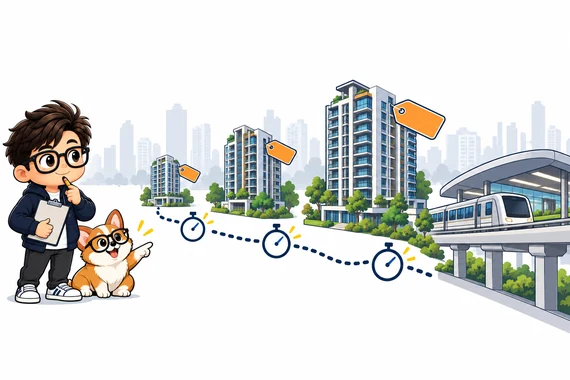
How much more does a condo near the MRT cost?
A condo within about 5 minutes’ walk of an MRT station costs around 7% more per square foot than a similar condo 5 to 10 minutes away. “Similar” here means in the same URA planning area, such as Hougang or Bishan, compared as if the two condos had the same age, tenure, unit size and type (private condo or EC).
The farther the walk, the bigger the difference:
| Walk to the nearest MRT station | Condos | A condo within 5 minutes costs |
|---|---|---|
| Within 5 minutes | 170 | (the comparison point) |
| 5 to 10 minutes | 225 | around 7% more |
| 10 to 15 minutes | 103 | around 13% more |
| More than 15 minutes | 100 | around 19% more |
This covers 598 condos and ECs with at least 5 resales between October 2024 and 10 October 2026, 22,144 resales in all.
Does a condo right next to the station cost even more?
No. Condos under 3 minutes from a station cost about the same as condos 3 to 5 minutes away, around 1% less. So buyers pay more for being within about 5 minutes’ walk of a station, not for being the nearest condo to it. 71 of the 598 condos are under 3 minutes away.
Do prices of condos near the MRT rise faster than prices of condos farther from it?
No. Prices of units bought and later sold increased by about the same percentage a year, whether the condo was within 5 minutes’ walk of a station or more than 5 minutes’ walk.
| Walk to the nearest MRT station | Bought 2010 to 2014 | Bought 2015 to 2019 |
|---|---|---|
| Within 5 minutes | 2.1% a year8,174 resales | 3.5% a year3,375 resales |
| 5 to 10 minutes | 1.7% a year9,955 resales | 3.2% a year4,156 resales |
| 10 to 15 minutes | 2.3% a year5,364 resales | 4.1% a year2,114 resales |
| More than 15 minutes | 2.2% a year7,801 resales | 3.5% a year3,823 resales |
These are median price rises a year, for private condos, not ECs. When the comparison is made within the same planning area, for units bought in the same year and owned for the same length of time, the difference between walk-time groups was never more than 0.3% a year.
What does that look like in dollars? Here’s an example with round numbers, not taken from the data. Two owners sell after 8 years, and both condos’ prices rose 3.5% a year.
| Near the MRT | 5 to 10 minutes’ walk | |
|---|---|---|
| Paid | $1,500,000 | $1,400,000 |
| Sold for | about $1,975,000 | about $1,844,000 |
| Gain in dollars | about $475,000 | about $444,000 |
| Gain as % of price paid | about 32% | about 32% |
The owner near the MRT gained about $32,000 more, because the $100,000 more they paid rose at the same rate. As a percentage of the price paid, both gained about 32%. With the same loan share, each owner’s own cash made the same percentage gain too.
So a buyer near the MRT paid more and sold for more. The condo’s price increased by about the same percentage as the prices of condos more than 5 minutes’ walk from a station. Paying more near the MRT meant selling for more, not making a bigger percentage gain.
So a condo 5 to 10 minutes from a station cost around 6% less to buy, and its price increased by about the same percentage. Being nearer the MRT is worth paying for if the walk matters to you, not as a way to make more.
How a resale condo’s price compares with a new launch nearby is a different question; Geek Out #08 looks at that.
Is the price difference near the MRT bigger in OCR than in CCR?
Not clearly. Compared with a similar condo 5 to 15 minutes away, a condo within 5 minutes costs around 7% more in OCR, around 6% more in RCR and around 4% more in CCR. Each figure could be a few points higher or lower, and their likely ranges overlap, so the data can’t say which region has the biggest difference.
| Region | Within 5 min costs | Likely range | Condos within 5 min / 5 to 15 min |
|---|---|---|---|
| Outside Central Region (OCR) | around 7% more | 3% to 9% | 63 / 135 |
| Rest of Central Region (RCR) | around 6% more | 2% to 8% | 65 / 102 |
| Core Central Region (CCR) | around 4% more | 0% to 8% | 42 / 90 |
Likely range: I re-ran the comparison 300 times, each time on a random redraw of the 598 condos. 9 times in 10, the figure landed inside this range.
Does the price difference depend on the MRT line?
Not clearly. Across each line’s stations, a condo within 5 minutes costs between about 2% and 7% more than a similar condo 5 to 15 minutes away. The likely ranges overlap, so the data can’t rank the lines.
| Line | Within 5 min costs | Likely range | Condos within 5 min / 5 to 15 min |
|---|---|---|---|
| East West Line | about 2% more | −1% to 6% | 50 / 61 |
| Thomson-East Coast Line | about 3% more | −2% to 8% | 33 / 70 |
| Circle Line | around 5% more | 0% to 11% | 25 / 49 |
| North South Line | around 5% more | 0% to 10% | 24 / 78 |
| North East Line | around 6% more | 2% to 11% | 32 / 37 |
| Downtown Line | around 7% more | 1% to 10% | 40 / 80 |
Stations on the same line can differ a lot. Look up a station above to see its condos. Condos near an interchange count for each of its lines.
Which condos will be near an MRT station that hasn’t opened yet?
17 condos are more than 10 minutes’ walk from any MRT station today but will be within 8 minutes of a station LTA is building.
- Otto Place ECBukit Batok West (JRL) · LTA’s target: 2028 (date under review)Walk now: 12 min · to the future station: 7 min · No resales yet
- Inz Residence ECChoa Chu Kang West (JRL) · LTA’s target: mid-2028Walk now: 20 min · to the future station: 8 min · $1,444 psf (98 resales)
- Parc VeraDefu (CRL) · LTA’s target: 2030Walk now: 13 min · to the future station: 8 min · $1,527 psf (28 resales)
- Vue 8 ResidenceElias (CRL) · LTA’s target: 2032Walk now: 22 min · to the future station: 6 min · $1,438 psf (36 resales)
- Whitewater ECElias (CRL) · LTA’s target: 2032Walk now: 27 min · to the future station: 8 min · $1,119 psf (44 resales)
- The Floravale ECGek Poh (JRL) · LTA’s target: mid-2028Walk now: 22 min · to the future station: 4 min · $1,110 psf (43 resales)
- Westwood Residences ECGek Poh (JRL) · LTA’s target: mid-2028Walk now: 25 min · to the future station: 8 min · $1,369 psf (71 resales)
- Tengah Garden ResidencesHong Kah (JRL) · LTA’s target: mid-2028Walk now: 24 min · to the future station: 2 min · No resales yet
- The Esparis ECPasir Ris East (CRL) · LTA’s target: 2030Walk now: 19 min · to the future station: 7 min · $1,117 psf (22 resales)
- Affinity at SerangoonSerangoon North (CRL) · LTA’s target: 2030Walk now: 22 min · to the future station: 8 min · $1,824 psf (181 resales)
- Hundred Palms Residences ECSerangoon North (CRL) · LTA’s target: 2030Walk now: 25 min · to the future station: 8 min · $1,847 psf (135 resales)
- TerrasseSerangoon North (CRL) · LTA’s target: 2030Walk now: 20 min · to the future station: 7 min · $1,564 psf (34 resales)
- Bagnall HausSungei Bedok (DTL / TEL) · LTA’s target: second half of 2026Walk now: 19 min · to the future station: 4 min · No resales yet
- Aurelle of Tampines ECTampines North (CRL) · LTA’s target: 2030Walk now: 15 min · to the future station: 6 min · No resales yet
- Parktown ResidenceTampines North (CRL) · LTA’s target: 2030Walk now: 22 min · to the future station: 4 min · No resales yet
- Copen Grand ECTengah (JRL) · LTA’s target: mid-2028Walk now: 34 min · to the future station: 8 min · $1,632 psf (8 resales)
- Novo Place ECTengah Park (JRL) · LTA’s target: 2028 (date under review)Walk now: 14 min · to the future station: 6 min · No resales yet
Six of the 17 have no resales yet because they’re still being built or have only just been completed. LTA’s targets can move; this page shows the target as last stated. New launches near these stations are on the 2026 new launches page.
Do condos near an LRT station cost the same as condos near an MRT station?
In the data, no. In Sengkang, condos within 5 minutes of an LRT station but more than 10 minutes from the MRT had a median price of about $1,512 psf. Condos within 5 minutes of the MRT had a median price of about $1,702 psf. In Punggol, the two medians were about $1,474 psf and $1,686 psf. These are plain medians, not adjusted for age or tenure. On this page, “near the MRT” means near an MRT station; LRT stations appear in the checker with an “LRT” tag.
Questions people ask about this

What counts as “near the MRT” on this page?
Within about 5 minutes’ walk of an MRT station, worked out as explained below. LRT stations don’t count. They’re in the checker with an “LRT” tag.
How were the walk times worked out?
From the straight-line distance between the condo and the middle of the station’s exits, multiplied by 1.2 for the route, at 80 metres a minute. About 5 minutes is about 330 metres in a straight line. The real walk can be shorter or longer, depending on the nearest exit and the route.
Why is there no ranking of the best stations?
Around most stations, there are only 2 to 8 condos to compare. With so few, one older or freehold condo can swing the result. Even averaged across a whole region or MRT line, the figures are too close to rank. The checker shows each station’s condos side by side instead.
Does it matter if the MRT station is above ground or underground?
Not that the data can show. Condos near above-ground stations and condos near underground stations both cost around 5% to 6% more than similar condos 5 to 15 minutes away, and there are too few condos near above-ground stations to tell them apart.
Are the new Circle Line stations included?
Keppel, Cantonment and Prince Edward Road opened on 12 July 2026. They’re in the checker, but most of their resales happened before they opened, so they’re left out of the figures on this page.
Does this cover HDB flats?
No. It covers private condos and ECs only.
Tell me and I’ll check it and update the page.
Message me on WhatsApp
How the numbers were worked out
- Prices: each condo’s price is the median price per square foot of its resales between October 2024 and 10 October 2026. Only resales where the data has both the purchase and the sale are included, and only condos with at least 5 such resales.
- Comparisons are between condos in the same URA planning area, compared as if they had the same completion year (in 5-year groups), tenure, years used on the lease, unit size and type (private condo or EC). Likely ranges come from 300 re-runs on random redraws of the condos.
- Price rise a year: the yearly rate at which a unit’s price changed between its purchase and its sale, using the same resales. Most of those units were bought new from the developer.
- Stations: LTA’s station exits, with the station placed at the middle of its exits. Future stations use each station’s published site as of 12 October 2026.
- Condo locations: from OneMap (Singapore Land Authority) and online maps, each checked against the project’s URA street and postal district.
Where the numbers come from
- Resale prices and price rises: URA caveat records, January 1995 to October 2026, from a property portal’s historical archive. Each record pairs a home’s purchase with its later sale; only homes that were resold are included.
- MRT and LRT stations: LTA’s published station exit locations (December 2025 extract).
- Which stations are above ground: Wikipedia’s pages on the East West Line, the North South Line, the Thomson-East Coast Line and Singapore’s MRT. The North East, Circle, Downtown and Thomson-East Coast lines are underground throughout. A station counts as above ground when any of its platforms is.
- Future stations: LTA and MOT announcements as last stated by 12 October 2026, with each station’s site from public station records. Circle Line Stage 6 opening: Ministry of Transport.
- Project locations, completion years and tenure: my project data, with locations from OneMap (Singapore Land Authority) and online maps, each checked against the project’s URA street and postal district.
- URA regions: URA’s Core Central Region (CCR), Rest of Central Region (RCR) and Outside Central Region (OCR), as used in its property price statistics.
More from Geek Out: Live near an MRT? These primary schools may be closer than you think
Before you act on any of this. These are past prices from the data, not a forecast or a valuation. Check the latest figures before deciding on a property.
Your turn
Got a burning question you're dying to get an answer to?
Send it over. There's no such thing as a silly question — only the ones that keep you up at night.
Ask the Property GeekStay curious. See you down the next rabbit hole.The Property Geek & the corgi