15 min read • Last updated 8 September 2026
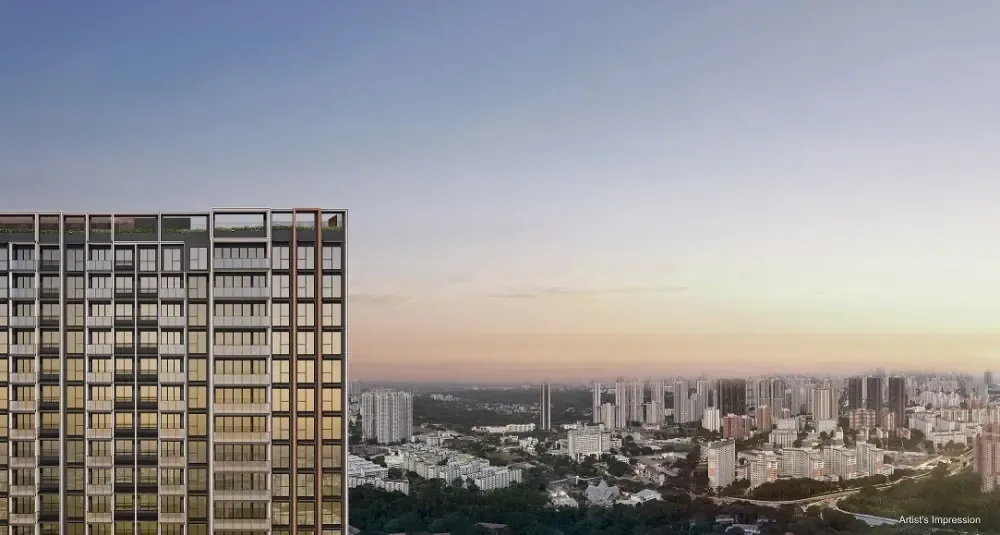
Two plots on the same road, bought by the same developer, fourteen months apart.
The second one cost 12.9% less than the first.
Every piece of marketing you will read about Hudson Place Residences is built on that fact, and the fact is true.
What almost none of it tells you is that the homes built on the cheaper land came to market only 1.7% below the ones on the dearer land.
So the discount is real. It just did not land where most buyers assume it landed.
Working out where it did land is the only way to know whether this project is a bargain, a fair price, or simply a low quantum in an expensive part of Singapore.
My answer is the third one, with a caveat that matters more than the discount ever did.
1. Hudson Place Residences At A Glance
Hudson Place Residences is a 327-unit, 99-year leasehold condominium at Media Circle in the one-north precinct of District 5, built by a consortium led by Qingjian Realty and Forsea Holdings. URA awarded the site in March 2025 for $315 million, or $1,037 per square foot per plot ratio. It sold 201 units on its launch weekend of 16 to 17 May 2026 at an average $2,458 psf, and is roughly 74% sold today.
Key Takeaways
- Land at $1,037 psf ppr is 12% below the $1,178 psf ppr peer median on PropertyInsider.sg's land cost tracker, and 12.9% below the $1,191 psf ppr the same consortium paid for the Bloomsbury Residences plot opposite in January 2024.
- That 12.9% land discount became a 1.7% price discount. Hudson Place averages $2,482 psf against Bloomsbury's $2,525 psf.
- 201 of 327 units sold on launch weekend at $2,458 psf. 214 of 325 by 15 August 2026 on PropertyInsider.sg's record. About 74% today.
- Two-bedrooms are 80% cleared. Four-bedrooms are 28% cleared. That is the whole shape of the remaining stock.
- 40 of the 110 unsold units sit in just two four-bedroom stacks, which also carry the highest median prices in the project at $2,594 and $2,659 psf.
- Dover Drive, 50% dearer land awarded 31 March 2026, is expected by CBRE to launch at $2,800 to $2,900 psf. That is 13% to 17% above Hudson Place, not the 25% the decks imply.
- Nearest MRT is Commonwealth (EW20) at about 1.10 km, roughly a 16-minute walk. This is not a station-adjacent project.
- Across 8,204 matched District 5 exits since 1995, the middle seller made 3.8% a year and 90.2% of exits made money.
Three terms this review cannot avoid
- psf ppr, per square foot per plot ratio. What a developer paid for land, divided by the floor area it is allowed to build on that land. It is fixed years before the showflat opens and it is the first hard clue to what a project must eventually charge.
- Breakeven. The estimated all-in cost of building and selling the project, per square foot. Anything above it is the developer's margin. Anything below it is a loss.
- Quantum. The total price of a home in dollars, rather than its price per square foot. Buyers borrow in quantum and pay stamp duty on quantum, which is why it often decides what sells.
| Item | Detail |
|---|---|
| Project | Hudson Place Residences |
| Address | Media Circle, District 5 (one-north, Queenstown planning area) |
| Developer | Consortium led by Qingjian Realty and Forsea Holdings, with Jianan Capital |
| Tenure | 99 years from the date of the state lease |
| Site area | 82,125 sq ft (URA tender) |
| Maximum gross floor area | 303,865 sq ft, about 28,230 sqm |
| Plot ratio | 3.7, derived from GFA divided by site area |
| Units and blocks | 327 homes in two towers of 23 and 15 storeys, plus about 400 sqm of first-storey commercial space |
| Land price | $315,000,000, or $1,037 psf ppr |
| Tender | Media Circle (Parcel A), closed 4 March 2025. Three bids |
| Estimated breakeven | $2,052 psf (est., PropertyInsider.sg) |
| Transacted range | $1,455,000 to $3,810,000 |
| Average transacted | $2,482 psf as at 15 August 2026 |
| Unit sizes | 646 to 1,432 sq ft, two to four bedrooms plus five penthouses |
| Preview and launch | Preview from 1 May 2026, booking day 16 May 2026 |
| Sold | About 74% as at early September 2026. 66% on PropertyInsider.sg's 15 August record |
| Nearest MRT | Commonwealth EW20, about 1.10 km, roughly a 16-minute walk |
| Expected completion | 2029 |
One number needs a footnote before we go further.
The press and the developer count 327 units. PropertyInsider.sg's tracked record counts 325, and its unit-by-unit grid resolves 322.
The gap is almost certainly the five penthouses and how each source treats them.
It changes no conclusion in this review, but I would rather flag it than quietly pick the number that suits the sentence.
2. Where Exactly Is It, And What Is one-north?
Mediapolis, at the eastern edge of one-north.
one-north is a 200-hectare JTC-planned research and innovation district covering Biopolis for biomedical science, Fusionopolis for infocomm and engineering, Mediapolis for media and technology, and LaunchPad @ one-north for startups.
It sits inside the Queenstown planning area, which is why the address reads District 5 and the segment reads Rest of Central Region rather than suburban.
Grab, Razer and Sea are here. So are NUS, INSEAD's Asia campus, A*STAR's research institutes and Tanglin Trust School, which is 0.56 km away.
Alexandra Hospital is 0.95 km. Queenstown Polyclinic is 0.89 km. Three hawker centres sit inside a kilometre.
Directly behind the site is Wessex Estate, a preserved cluster of 1930s black-and-white colonial houses now occupied largely by artists and expatriate tenants.
That is an unusual thing to have as a backyard in Singapore, and it is one of the few things about this address that cannot be built again.
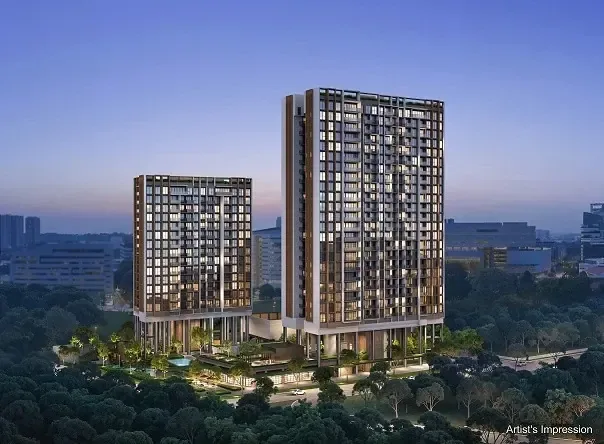
The precinct is being deliberately converted from a pure workplace into a place people live.
Under the URA Draft Master Plan 2025, released on 25 June 2025, Mediapolis is slated for up to 5,000 private homes, and the neighbouring Dover-Medway neighbourhood for about 6,000 public and private homes in its first phase.
Subtract Bloomsbury's 358 and Hudson Place's 327 from the Mediapolis figure and roughly 4,315 private homes are still to come on that side alone.
Hold that number. It is the strongest argument for buying here and the strongest argument against, and I will come back to both.
3. What Have Buyers Actually Paid?
Less than almost anything else launching in the central region this year.
The lowest transacted price in the project is $1,455,000, for a 646 sq ft two-bedroom on the second floor.
The highest is $3,810,000, for a 1,432 sq ft four-bedroom on the twenty-second.
Everything in between looks like this.
| Type | Avg price | Avg psf | Transacted range | Size range | Sold | Available |
|---|---|---|---|---|---|---|
| 2 Bedroom | $1.66M | $2,491 | $1.46M to $1.86M | 646 to 689 sq ft | 146 | 37 |
| 3 Bedroom | $2.44M | $2,450 | $2.05M to $2.76M | 893 to 1,055 sq ft | 47 | 24 |
| 4 Bedroom | $2.94M | $2,489 | $2.71M to $3.81M | 1,152 to 1,432 sq ft | 19 | 49 |
Read the last two columns rather than the first three.
Two-bedrooms are 80% cleared. Four-bedrooms are 28% cleared.
All fourteen of the 893 sq ft three-bedroom deluxe units went on launch weekend, and more than 88% of the 1,152 sq ft four-bedroom premium units went with them.
So the four-bedroom problem is not four bedrooms in general. It is the larger and dearer four-bedroom formats specifically.
Note also what the psf columns do not say.
Two-bedrooms average $2,491 psf and three-bedrooms average $2,450 psf, a gap of $41.
In quantum, that same gap is $780,000.
Buyers did not choose between two prices per square foot. They chose between $1.66 million and $2.44 million, and most of them could only reach one of those.
4. Where Are The Unsold Units Hiding?
In two stacks.
At PropertyInsider.sg's 31 July 2026 unit-level extraction, 110 of the 322 units in the grid were still available.
Stacks 16 and 17 in the taller tower are both four-bedroom stacks of 21 units each. Between them they had sold two.
That leaves 40 unsold units in those two stacks alone, which is 36% of everything still available in the project.
Add stack 11, a three-bedroom stack with 14 of 22 unsold, and three stacks account for 49% of the remaining inventory.
Now look at what those stacks cost.
Stack 16 carries a median of $2,594 psf and stack 17 a median of $2,659 psf, the two highest in the development.
Against a project average of $2,482 psf, that is a 4.5% to 7.1% premium.
The stock that has not sold is the stock that was priced highest, in the format that costs most.
That is worth saying plainly because it is the opposite of a demand failure.
Nobody rejected the location. A few hundred people bought into it in a weekend.
What stalled is a specific product at a specific quantum, and that distinction matters if you are the buyer looking at what is left.
It means the remaining inventory is where a developer has the most reason to negotiate, and the least reason to hold out.
It also means that if you want a two-bedroom, you are shopping among 37 units and the leverage is not yours.
5. Was $1,037 psf ppr Genuinely Cheap?
Yes. Unambiguously.
URA's Media Circle (Parcel A) tender closed on 4 March 2025 with three bids. The Qingjian and Forsea consortium took it at $315 million for a maximum gross floor area of 303,865 sq ft.
That reproduces exactly, which is the first thing I check on any launch and the first thing most marketing decks never show you.
Against the comparable set, it sits third cheapest of twelve tracked sites, and 12% below the $1,178 psf ppr peer median.
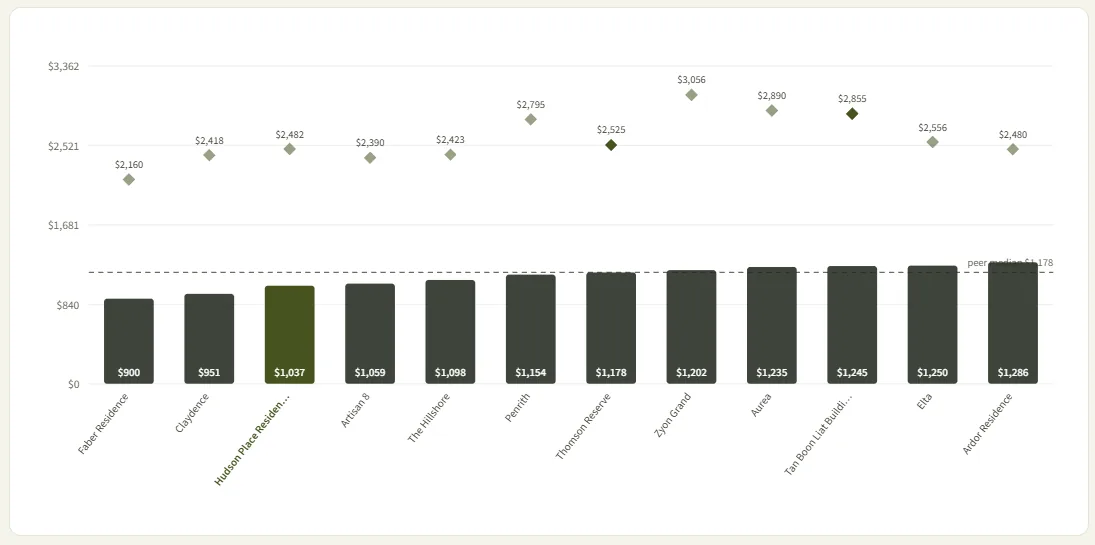
Only Faber Residence at $900 and Claydence at $951 were bought more cheaply, and both are smaller and older stories.
The developer's estimated breakeven is $2,052 psf.
At a transacted average of $2,482 psf, that is a margin of about 21%.
Which is a useful thing for a buyer to know, and I want to be precise about why.
A developer with a 21% margin is not under pressure to dump the remaining 110 units below cost when the sales period closes.
It also cuts the other way. A developer with a 21% margin has plenty of room to discount hard if it wants to clear stock, and every dollar of that discount competes with whatever you paid.
A low land cost is protection against a distressed developer. It is not protection against a motivated one.
6. What Happened To The Land Discount?
Most of it stayed with the developer.
Here is the comparison the marketing rarely runs, because it is the only one where every variable is controlled.
Same consortium. Same road. Same product type. Fourteen months apart.
| Bloomsbury Residences | Hudson Place Residences | Difference | |
|---|---|---|---|
| Land awarded | January 2024 | March 2025 | 14 months apart |
| Land cost | $1,191 psf ppr | $1,037 psf ppr | 12.9% cheaper |
| Units | 358 | 327 | — |
| Average transacted | $2,525 psf | $2,482 psf | 1.7% cheaper |
A 12.9% saving on land became a 1.7% saving on price.
The same pattern shows up at segment level. Hudson Place's land is 12% below the peer median, and its price is 0.9% below the peer median launch price of $2,503 psf across the same twelve projects.
Expressed as a multiple, the project sold at 2.39 times its land cost, against a peer median of 2.32 times.
"Cheap land means I am buying cheap."
Not by itself, no.
Cheap land tells you what the developer paid. It tells you nothing about what the developer decided to charge, and the two are set two years apart by different logic.
What cheap land actually buys a purchaser is a lower floor, not a lower price.
That distinction runs through the rest of this review, and it is where the honest case for the project sits.
7. Does Dover Drive Really Set A Floor Under This?
It does, but a lower one than you have been told.
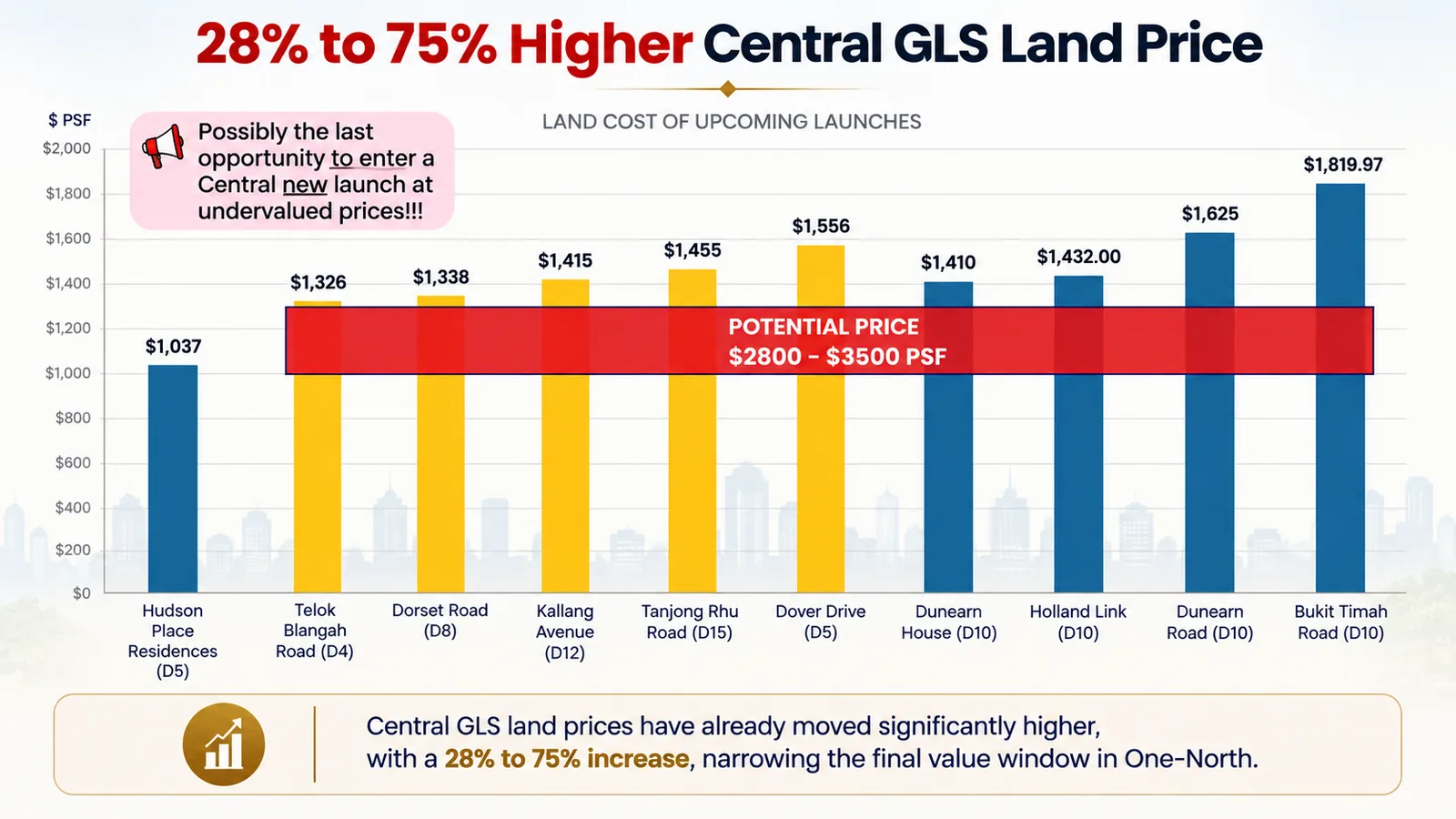
On 31 March 2026, URA awarded the Dover Drive site to a Qingjian-led joint venture for $951 million, or $1,556 psf ppr, from six bids.
That is 50% above what the same group paid for Hudson Place thirteen months earlier, and it set a new benchmark for a Rest of Central Region government land sale.
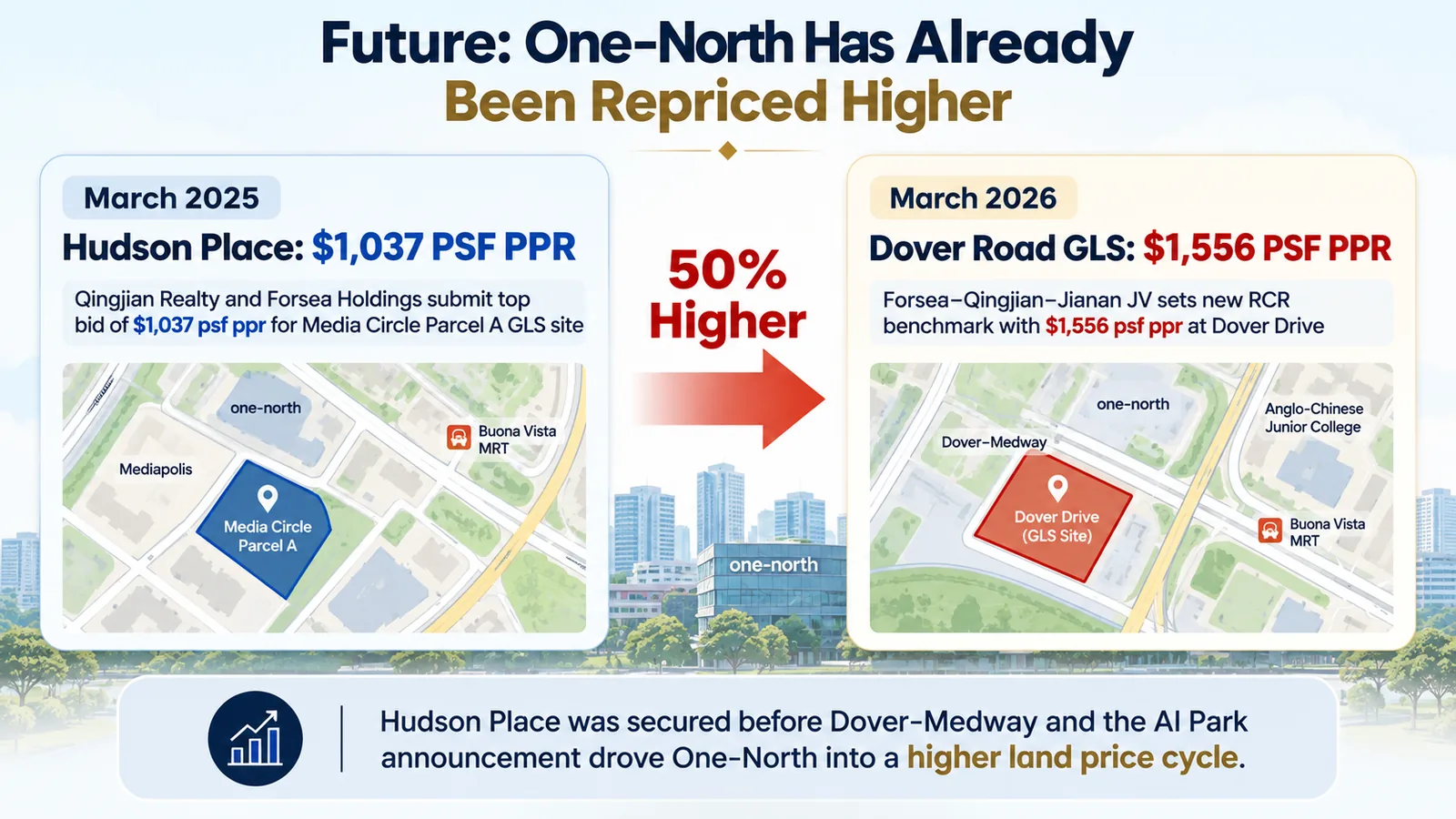
The seminar version of this argument runs straight from a 50% land gap to a $3,000-plus launch price, and that step is where it overreaches.
Named analysts have actually put a number on it.
CBRE expects the Dover Drive project to launch at $2,800 to $2,900 psf. PropNex expects above $2,900 psf.
Against Hudson Place's $2,482 psf average, that is a gap of 13% to 17%.
Meaningful. Not the 25% to 30% the decks imply, and not $3,500.
PropertyInsider.sg's own model, which applies a published cost stack rather than an analyst view, runs higher at an estimated $3,170 to $3,580 psf for the Dover Drive site, and I would treat that as the top of a range rather than the middle of one.
Either way, the direction is not in dispute.
The next new home built in this precinct will be built on land that cost half as much again, and it will have to be priced accordingly.
That is what a floor means in practice.
If you own a 1,000 sq ft home here in 2031 and the buyer's alternative is a newer flat down the road that had to be priced from a $1,556 land base, your asking price has something real to lean on.
It is not a guarantee. Replacement cost sets a reference, not a clearing price, and a resale unit at TOP competes on age and condition as well as on cost.
But of everything in the Hudson Place pitch, this is the part that stands up best.
8. Is one-north Supply Genuinely That Tight?
Today, yes. In 2029, much less so.
The claim you will see on every deck is that one-north has a working population of about 50,000 against a total private housing stock of only 1,672 units.
Both halves are broadly right, and the second one is worth taking apart.
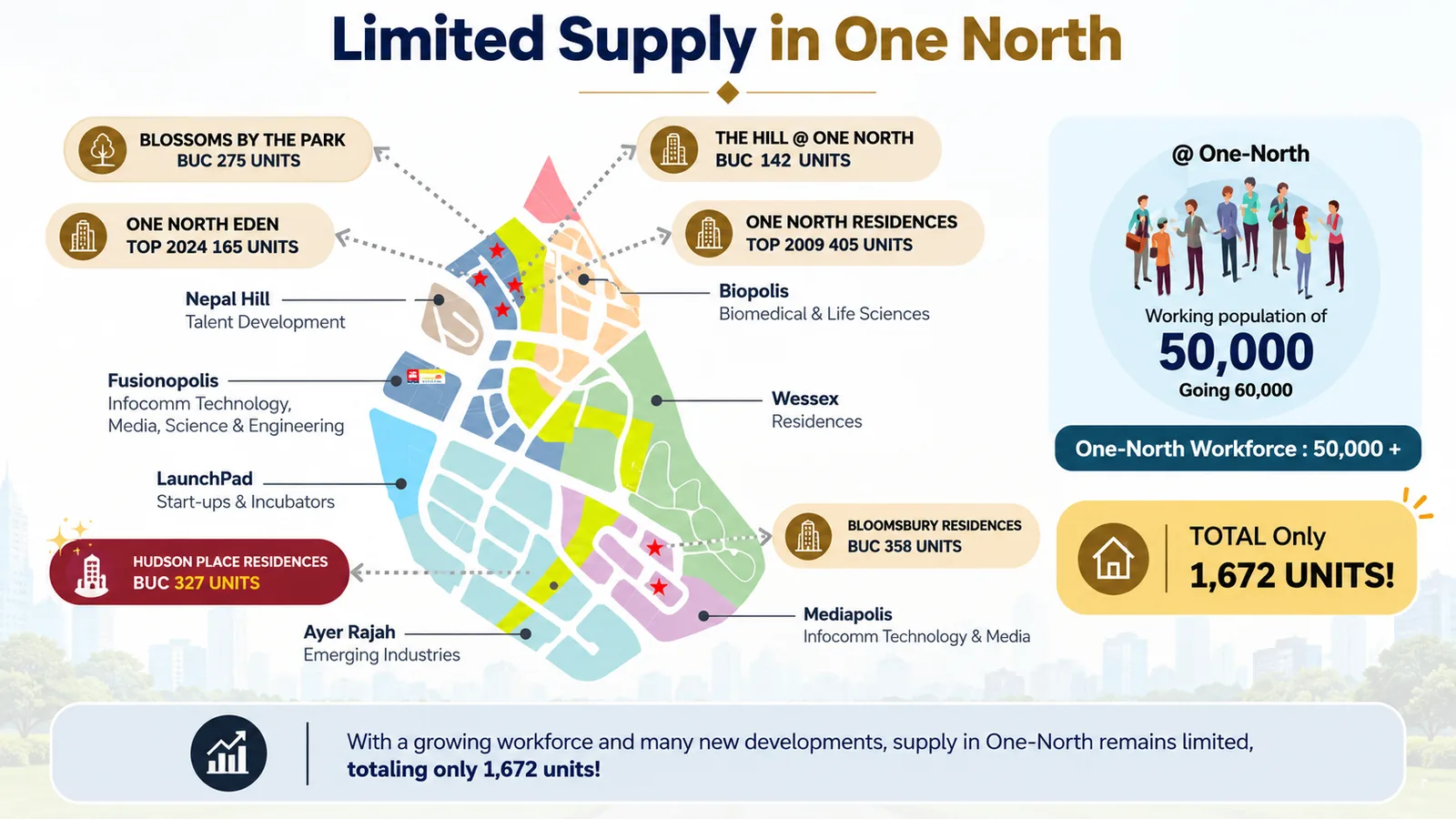
Add the six projects on that map and you get 1,672 units. The arithmetic holds.
Now split them by whether they have been built.
one-north Residences completed in 2009 with 405 units. one-north Eden completed in 2024 with 165.
That is 570 homes actually standing in one-north today.
The other 1,102 units, at Blossoms by the Park, The Hill @ one-north, Bloomsbury Residences and Hudson Place Residences, are all still under construction.
So the correct version of the supply story has two halves, and the decks only tell you the first.
Supporting prices now: roughly 50,000 workers against 570 completed private homes is an extraordinary imbalance, and it is why one-north rents have held a premium over the surrounding area.
Limiting them later: that stock is about to triple by 2029, and 4,315 further private homes are planned for Mediapolis after that.
Hudson Place completes into the crowded half of that story, not the tight half.
Which does not make the project a bad buy. It makes the rental case a 2029 question rather than a 2026 one, and anyone underwriting this on today's one-north rents should say so out loud.
9. What Is Kampong AI, Actually?
Two refurbished blocks.
The AI story is doing a lot of work in the marketing for this project, so it is worth reading the primary source rather than the summary of it.
JTC announced Kampong AI on 2 March 2026 as part of a refreshed master plan for LaunchPad @ one-north.
According to JTC's press release, it comprises two adjacent seven-storey blocks: one with 14,500 sqm of business park space for around 70 companies, and one with over 200 residential units.
A pilot phase began in March 2026. Full completion is targeted for 2028.
That is a real commitment, and it is a first: Singapore has not previously put startup workspace and housing in one place.
It is also considerably smaller than the phrase "Singapore's AI Park" suggests to a buyer reading a slide.
Seventy companies in 14,500 sqm is a building, not a district.
The detail I would actually price in is quieter and appears in the same release: JTC is adding covered linkways that will put LaunchPad within a ten-minute sheltered walk of one-north and Kent Ridge stations.
In a precinct where the honest complaint is the walk to the MRT, sheltered pedestrian infrastructure is worth more than a headline.
10. What Has District 5 Actually Returned?
Steadily, and almost always positively.
This is the part of a project review that no showflat covers, because it is the only part that describes what happened to people who already did what you are considering.
Across 8,204 matched buy-and-sell pairs in District 5 from March 1995 to August 2026, the middle seller realised 3.8% a year.
90.2% of those exits made money.
The median gain was $315,000 gross. The median loss, on the 807 exits that lost, was $101,000. The median hold was 7.2 years.
Those are matched pairs, profitable and unprofitable, over thirty-one years and three crises.
Read the loss rate honestly, though. An owner sitting on a paper loss can simply decline to sell, so the true share of purchases that would have lost money is higher than the 9.8% recorded on completed sales.
Narrow it to the ten District 5 projects with at least twenty matched exits and the picture sharpens.
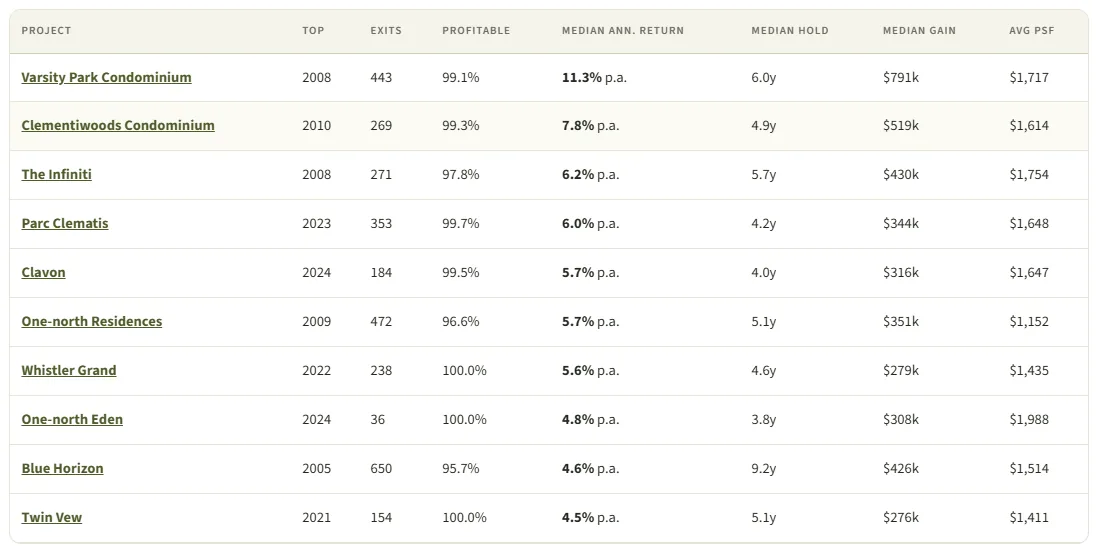
The middle project of the ten returned 5.7% a year.
Two of them are the relevant ones here.
one-north Residences returned 5.7% a year across 472 exits, with 96.6% of them profitable.
one-north Eden returned 4.8% a year across 36 exits, all of which made money, on a median hold of just 3.8 years.
Thirty-six exits is a small sample and I would not build a thesis on it.
But one-north Eden's average resale price of $1,988 psf is the highest of the ten, which tells you the market has been willing to pay a premium for a one-north address rather than a District 5 address generally.
The obvious caution applies. Every project in that table was bought at land costs a fraction of today's, and past exits are context rather than forecast.
What the table does establish is that this district has paid its owners with unusual consistency, which is not true everywhere in Singapore.
11. What The Project Does Not Have
A station at the door.
Commonwealth (EW20) is about 1.10 km away in a straight line, roughly a 16-minute walk. one-north (CC23) is 1.14 km and Kent Ridge (CC24) is 1.18 km.
Straight-line distances understate real walks, so treat those as floors rather than journey times.
Whichever way you measure it, this is a bus, a bicycle or a car for most households, most days.
The developer is providing a one-year shuttle to one-north and Buona Vista stations, and Infinite Studios runs its own service nearby.
A one-year shuttle is a nice launch inclusion. It is not infrastructure, and I would not capitalise it into a price.
There is talk of a future line cutting through Mediapolis, and it is plausible given how many homes are planned here without a station.
It is also, at the time of writing, a line under study with no confirmed alignment and no station.
Do not pay for it. If it arrives, it is upside you did not fund.
The school position is thinner than the area suggests
Only one MOE primary school falls inside a straight-line 1 km: New Town Primary School, at about 0.92 km, which had vacancies at every phase of the 2026 Primary 1 exercise.
The school families actually chase here is Fairfield Methodist School (Primary), and it sits at about 1.40 km.
Its 2026 Phase 2C ballot cut into citizens living within 1 km, a band this address is outside.
These are straight-line estimates from a site centroid, not MOE's official home-to-school measurement, so check your exact unit on the OneMap School Query tool before treating any of it as a reason to buy. Phase and distance figures are from PropertyInsider.sg's primary schools dataset.
What the address does have, in unusual density, is international and tertiary education: Tanglin Trust at 0.56 km, Kindle Kids at 0.79 km, INSEAD at 1.22 km and NTU@one-north at 1.34 km.
That is a tenant profile, not a P1 ballot position, and the two should not be confused in the same sentence.
On the building itself I have fewer reservations.
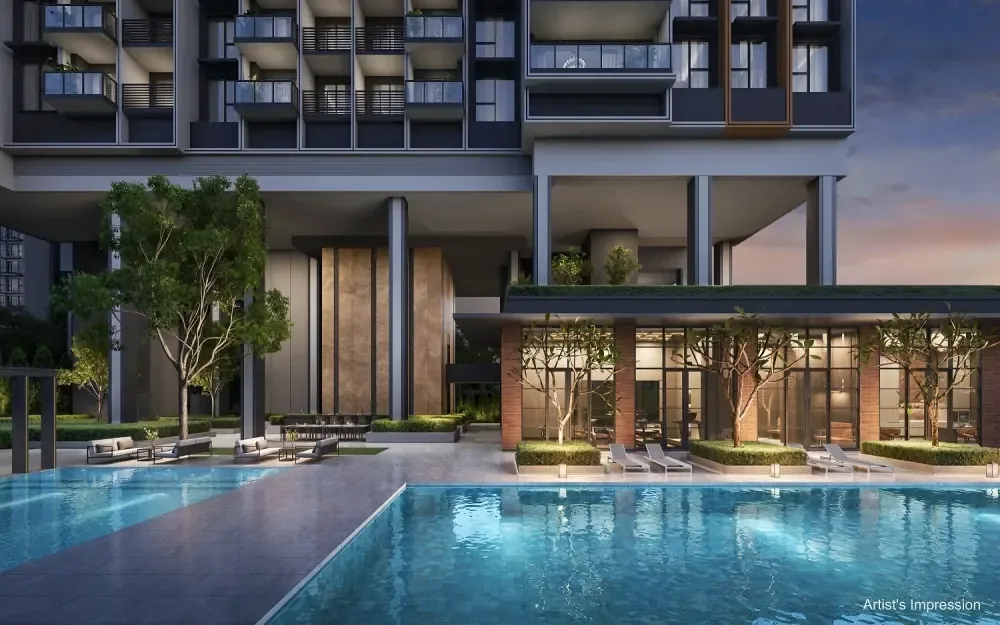
Lifting the lowest homes to roughly 17 metres removes the low-floor stock that usually drags a small project's average, and the two towers are offset rather than facing each other, which protects views on both sides.
A 50-metre lap pool and a tennis court on 82,125 sq ft is a generous allocation, and only one other development in one-north has a tennis court.
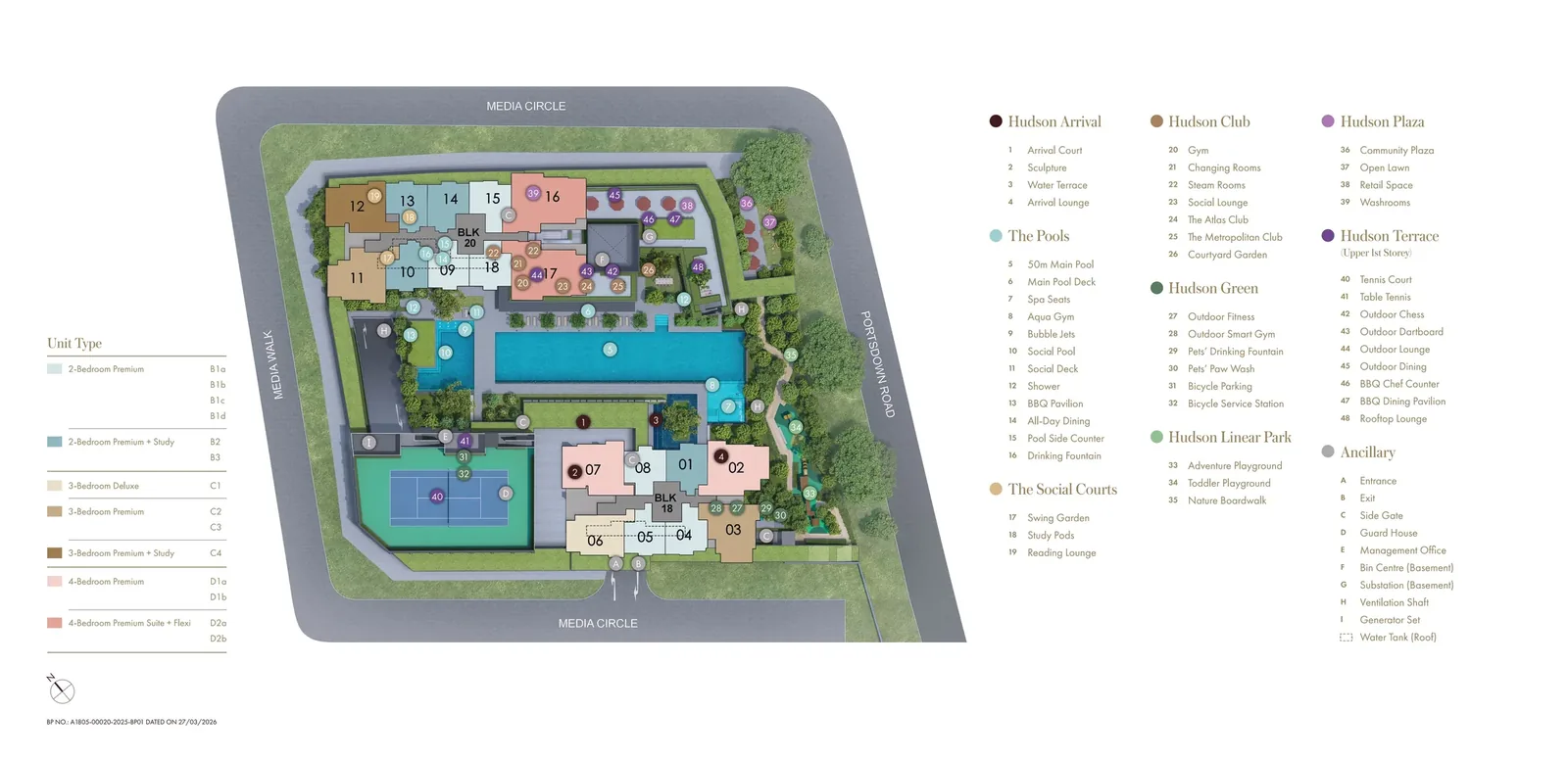
Those are real design decisions rather than marketing, and they are part of why I am comfortable with the price relative to the neighbours.
12. How Much Of The Exit Plan Holds?
The spine of it, yes. The timing, no.
The launch material sets out a seven-stage timeline running from 2026 to 2035, with an exit opportunity at almost every stage.
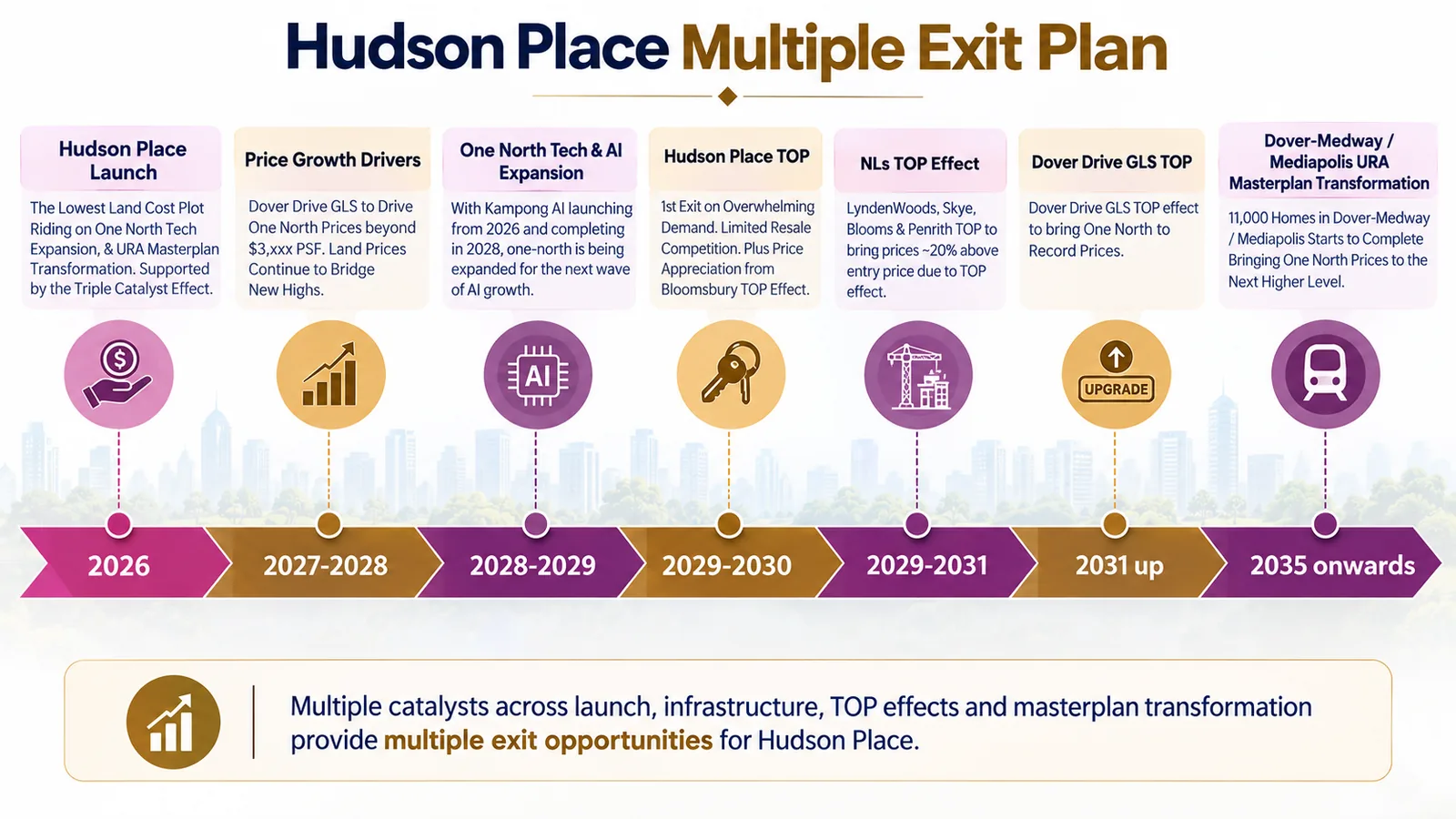
Strip the projections out and what remains is a list of dated, verifiable events.
Kampong AI completes in 2028. Hudson Place completes in 2029. Dover Drive launches from 2027 and completes early in the next decade. Mediapolis and Dover-Medway release homes progressively from 2027.
That is an unusually dense calendar of catalysts for one address, and it is a fair thing to point out.
What I will not endorse is the arithmetic layered on top of it.
Several stages carry an assumed 20% uplift with no stated basis, and the graphic treats each catalyst as additive.
Catalysts are not additive. A precinct that gets a station, an AI campus and 11,000 new homes gets all three effects at once, and two of them push prices up while the third pushes supply up.
There is also a structural point buried in the timeline that the timeline does not make.
Every one of those catalysts arrives after you can sell without a seller's stamp duty penalty, and most arrive after 2029.
This is a four-year hold minimum on the construction period alone, and realistically a seven-year story if you want the precinct to have done what the deck says it will do.
Buy it on that horizon or do not buy it.
13. What Could Go Wrong
Four things, in the order I would worry about them.
The 2029 supply wall. Bloomsbury and Hudson Place hand over within roughly a year of each other, adding 685 homes to a precinct that has 570 today. If you plan to rent yours out on completion, you will be doing so alongside several hundred other owners with the same idea and the same handover date.
The segment has already softened. URA's Q2 2026 data showed overall private prices up 0.5% for the quarter, but non-landed prices in the Rest of Central Region fell 1.4%. Hudson Place launched into that quarter. The project outperformed its segment; it did not float on it.
The remaining stock is concentrated and expensive. Forty of 110 available units sit in two stacks priced above the project average. If the developer decides to move them on price rather than time, that reprices the comparable set your own unit will eventually be measured against.
The MRT that is not there. Everything about the transformation case assumes people want to live in one-north. The single largest obstacle to that today is a 16-minute walk to a station, and no announced project fixes it inside this decade.
None of those is a reason to walk away. Each is a reason to buy at a quantum you can hold through 2029 without needing the market's help.
14. Who Is It For?
Three buyers, clearly. One buyer, clearly not.
The one-north or Science Park professional
If you work at Fusionopolis, Mediapolis, Science Park or NUS, this is the shortest commute available to you in private housing, and the entry quantum on a two-bedroom is around $1.66 million. The 16-minute walk to the MRT stops being a problem when your office is closer than the station.
The HDB upgrader with a Queenstown-area flat
About a third of matched buyers here came from a prior HDB address. If you are sitting on a Tanglin Halt, Dawson or Queenstown flat, a move into a District 5 leasehold condominium at $1.66 million to $2.44 million keeps you in the same postcode, the same schools and the same hawker centres. That is a very different decision from moving your family across the island for a lower psf.
The patient investor with a 2032 horizon
The replacement-cost argument is real, and the rental case is real from about 2030 once the completion cluster is absorbed. Both need time. If you can hold past the seller's stamp duty window without pressure and past the 2029 handover glut, the entry price is defensible.
Not for the buyer who needs a station
If a five-minute covered walk to an MRT is on your list, no amount of land-cost analysis will fix this address. There are better answers for you in the same price band, and I would rather tell you that here than at the showflat.
15. My View: The Floor Is Real, The Discount Is Not
I have spent this review testing the same claim from four directions, and it keeps resolving the same way.
The land was cheap. The homes were not sold cheap. What buyers got instead was a lower floor.
That is worth more than it sounds, and it is worth less than the marketing says.
It is worth more than it sounds because a floor is the only thing that protects a new launch buyer in a soft quarter, and the Rest of Central Region has just had one.
When the next project in this precinct has to clear land bought at $1,556 psf ppr, the cost of building an alternative to your home goes up by half. On CBRE's estimate that puts the newer product 13% to 17% above what you paid.
It is worth less than the marketing says because none of that reaches your pocket until someone else has to pay the higher number, and that is 2027 at the earliest for a launch and 2031 for a completion.
So here is the honest shape of the trade.
You are not buying a discount. You are buying an early position in a precinct that the government has committed to filling with 11,000 homes, at the last land price of the old cycle.
What makes me comfortable recommending it to the right buyer is the combination, not any single fact.
A $1.66 million entry into a Rest of Central Region address. A district where 90.2% of 8,204 recorded exits made money. A developer on its third site here with 85% of the last one already sold. A workforce of 50,000 against 570 completed homes. And a replacement cost that has already gone up 50% while the project was still selling.
What stops me calling it a bargain is the 1.7%.
The consortium priced this project against Bloomsbury, not against its own cost base, and it was entitled to. Buyers who think they captured a 13% land discount captured about an eighth of it.
My base case, and I will say plainly that it is a view and not a forecast: this performs in line with what District 5 has historically delivered rather than dramatically ahead of it, and the precinct story shows up in the resale record from about 2031 rather than at handover.
What would prove me wrong is the Tengah line getting a confirmed Mediapolis station, or Dover Drive launching above $3,000 psf. Either would reprice this address faster than I expect.
What would prove me too optimistic is Bloomsbury and Hudson Place completing into a rental market that has not grown with them.
16. The Short Version
What to take away
- The land at $1,037 psf ppr was cheap, 12.9% below the plot across the road and 12% below the peer median.
- Buyers received about an eighth of that discount. Hudson Place launched 1.7% below Bloomsbury.
- The real benefit is a lower replacement cost, not a lower entry price. Dover Drive's land is 50% dearer and CBRE expects it to launch 13% to 17% above Hudson Place.
- Small units are nearly gone and large units are not. 80% of two-bedrooms have sold against 28% of four-bedrooms.
- The unsold stock is concentrated in the project's two most expensive stacks, which is where any negotiating room will be.
- The precinct's supply tightness is real today and temporary. Completed private stock roughly triples by 2029.
- District 5 has paid its owners: 3.8% a year median and 90.2% profitable across 8,204 matched exits since 1995.
- The weakness is the 1.10 km walk to Commonwealth station, and nothing announced fixes it this decade.
So what should you do with this?
If you are considering one of the units still available, three questions decide it.
- Which stack is it, and how much of that stack is unsold?
- Can you hold it comfortably to 2031, past both the seller's stamp duty window and the 2029 completion cluster?
- Does the 16-minute walk to the MRT genuinely not matter for your household, or are you telling yourself it does not?
Take those three to a showflat rather than a price list, and you will get a straighter answer than any brochure gives you.
17. Frequently Asked Questions
What is Hudson Place Residences?
Hudson Place Residences is a 327-unit, 99-year leasehold condominium at Media Circle in the one-north precinct of District 5, inside the Queenstown planning area. It has two towers of 23 and 15 storeys, about 400 sqm of commercial space on the first storey, and is being built by a consortium led by Qingjian Realty and Forsea Holdings with Jianan Capital. The land was awarded by URA in March 2025 for $315 million, or $1,037 per square foot per plot ratio. Completion is expected in 2029.
How many units at Hudson Place Residences have been sold?
About 74% as at early September 2026, on my own check of developer sales. The project sold 201 units, or 61.5%, over its launch weekend of 16 and 17 May 2026. PropertyInsider.sg's tracked record put it at 214 of 325 units, or 66%, as at 15 August 2026. The pace since launch has therefore been slow and steady rather than a second surge.
How much does a unit at Hudson Place Residences cost?
On matched developer-sale transactions to 15 August 2026, two-bedrooms averaged $1.66 million at $2,491 psf, three-bedrooms $2.44 million at $2,450 psf and four-bedrooms $2.94 million at $2,489 psf. The lowest transacted price in the project was $1.46 million and the highest $3.81 million. The project average is $2,482 psf. Units run from 646 to 1,432 sq ft.
Was the land at Hudson Place Residences genuinely cheap?
Yes, on the land alone. At $1,037 psf ppr it is 12% below the $1,178 psf ppr peer median on PropertyInsider.sg's land cost tracker, and 12.9% below the $1,191 psf ppr that the same consortium paid in January 2024 for the Bloomsbury Residences plot across the road. The caveat is that the discount did not fully reach buyers: Hudson Place launched only about 1.7% below Bloomsbury's average price.
Which units are still available at Hudson Place Residences?
Mostly the large ones. At PropertyInsider.sg's 31 July 2026 unit-level extraction, 110 of 322 tracked units were unsold, and 49 of those were four-bedrooms against 37 two-bedrooms and 24 three-bedrooms. Forty of the 110 sit in just two four-bedroom stacks in the taller tower, stacks 16 and 17, which also carry the highest median prices in the project at $2,594 and $2,659 psf. Availability changes without notice, so confirm with the developer.
Is Hudson Place Residences near an MRT station?
Not really. The nearest station is Commonwealth (EW20) at about 1.10 km in a straight line, roughly a 16-minute walk, with one-north (CC23) at 1.14 km and Kent Ridge (CC24) at 1.18 km. That is a bus, cycle or drive for most people rather than a walk, and it is the clearest structural weakness in the project. The developer is providing a one-year shuttle bus service, which is a convenience rather than a permanent fix.
What primary schools are within 1km of Hudson Place Residences?
One. New Town Primary School is about 0.92 km away by straight-line estimate and had vacancies at every phase of the 2026 Primary 1 exercise. Fairfield Methodist School (Primary) at about 1.40 km is the high-demand school in the area, and its 2026 Phase 2C ballot cut into citizens living within 1 km, a band this site sits outside. These are straight-line estimates, not MOE's official home-to-school measurement, so check your exact unit on the OneMap School Query tool.
What have District 5 condominiums actually returned?
Across 8,204 matched buy-and-sell pairs in District 5 from March 1995 to August 2026, the middle seller realised 3.8% a year and 90.2% of those exits made money, over a median hold of 7.2 years. The median gain was $315,000 gross and the median loss $101,000. Among the ten District 5 projects with at least 20 matched exits, the middle project returned 5.7% a year, with one-north Residences at 5.7% and one-north Eden at 4.8%.
Will the Dover Drive site push one-north prices higher?
Probably, but by less than the marketing suggests. URA awarded the Dover Drive site on 31 March 2026 at $1,556 psf ppr, 50% above Hudson Place's land rate. CBRE expects the resulting project to launch at $2,800 to $2,900 psf and PropNex expects above $2,900 psf, which is 13% to 17% above Hudson Place's $2,482 psf average rather than the $3,000-plus commonly quoted. That project is not expected until 2027.
When will Hudson Place Residences be completed?
2029, on a 99-year lease. The wider precinct arrives around the same time: Kampong AI at LaunchPad @ one-north is due for completion in 2028, and the URA Draft Master Plan 2025 sets out up to 5,000 private homes at Mediapolis and about 6,000 public and private homes in the first phase of Dover-Medway, which will be released progressively from 2027 onwards.
18. My Thoughts
There is a version of this review that writes itself.
Cheapest land in one-north. Land next door repriced 50% higher. Fifty thousand workers, almost nowhere to live. An AI district being built around the site. Seventy-four per cent already sold.
Every one of those statements is true, and I have checked all five.
What none of them settles is the only question a buyer is actually asking, which is whether the price paid today leaves room for the price received later.
On that, the number I keep returning to is not $1,037 or $2,482.
It is 1.7%.
Two plots, one road, one developer, a 12.9% difference in cost and a 1.7% difference in price. The consortium priced against its neighbour, not against its own cost base, which is exactly what a rational developer does and exactly what the marketing never mentions.
Understand that, and the project stops being a bargain and becomes something more useful: a fairly priced home in a precinct with a rising floor under it.
A low land cost protects the developer first. It only reaches the buyer when someone else has to pay the newer, higher number.
Here, someone else will. Dover Drive already bought the land at half as much again, and it has to sell homes on it from 2027.
So buy the stack, not the story. Buy at a quantum you can carry to 2031 without needing the market to cooperate. And buy it knowing the walk to the station is 16 minutes and will still be 16 minutes when you sell.
Looking at one of the units still available? Send me the stack and floor you are considering and I will work the quantum, stamp duty, loan and holding cost against your actual numbers, show you how the same money reads at a comparable project, and tell you plainly if this is the wrong fit. If the answer is stay put, that is what I will say. Get in touch today.
If you want the wider framework behind how I assess any launch, it is set out in what I look at when advising a buyer on a new launch. For a launch where the take-up split told a very different story, see how ten layouts at Dunearn House ran from a sell-out to 14%, and the rest of the coverage sits on the project reviews pillar.
19. Sources And Update Log
Land and tender. The 82,125 sq ft site area, the 303,865 sq ft maximum gross floor area, the $315 million tendered price, the 4 March 2025 tender close, the three-bid field and the winning consortium are from URA's Media Circle (Parcel A) tender records as reported at the close by EdgeProp and The Edge Singapore. Converting the tendered price to $1,037 psf ppr and deriving the plot ratio of 3.70 are my own arithmetic, and both reproduce. The $1,191 psf ppr paid for the adjacent Bloomsbury Residences plot in January 2024 is from the same reporting.
Prices, take-up and unit-level data. The bedroom-level averages, the $1,455,000 to $3,810,000 transacted range, the $2,482 psf project average, the $2,052 psf estimated breakeven, the 110 unsold units, the stack-by-stack sold and available counts, the stack median prices for stacks 11, 16 and 17, and the station distances all come from the Hudson Place Residences project record on PropertyInsider.sg, the Singapore property research platform I founded and publish. Its unit-level grid is compiled from an EdgeProp Tower View extraction dated 31 July 2026; the project record was refreshed 15 August 2026. The stack concentration finding in section 4, and the percentages attached to it, are my own arithmetic on that grid.
Launch weekend figures. The 201 units sold, the 61.5% take-up, the $2,458 psf launch-weekend average, the full clearance of the 893 sq ft three-bedroom deluxe, the 88%-plus take-up of the 1,152 sq ft four-bedroom premium, the single penthouse sale and the 99% Singaporean and PR buyer share are as reported by EdgeProp and The Edge Singapore on 17 May 2026, sourced to the developers. Bloomsbury Residences' $2,525 psf average and 85% to 88% sold status are from the same coverage.
The 74% figure. This is my own check of developer sales as at early September 2026 and is not yet reflected in caveat-based records. PropertyInsider.sg's tracked figure remains 66% as at 15 August. I have used 74% where the current position matters and named the 15 August figure everywhere the underlying unit-level analysis depends on it, because the stack data has not been re-extracted since 31 July.
Dover Drive. The 31 March 2026 award, the $951 million bid, the $1,556 psf ppr rate, the six-bid field, the roughly 625-unit yield and the new Rest of Central Region benchmark are from URA's tender award and ERA's and The Edge Singapore's commentary on the close. CBRE's $2,800 to $2,900 psf launch expectation is attributed to Tricia Song, and PropNex's above-$2,900 expectation to Wong Siew Ying's team, both as quoted in that coverage. PropertyInsider.sg's higher $3,170 to $3,580 psf estimate is model-derived and its method is documented at how the launch price estimates are built.
Comparable land costs. The ranking of third cheapest of twelve, the $1,178 psf ppr peer median and the individual site rates and launch prices in the chart in section 5 come from PropertyInsider's land cost tracker, compiled from URA land sales records. The 2.39 times launch-to-land multiple, the 2.32 peer median multiple and the $2,503 psf peer median launch price are my own arithmetic on the twelve projects shown.
Resale returns. The 8,204 matched District 5 exits, the 3.8% median annualised return, the 90.2% profitable share, the $315,000 median gain, the $101,000 median loss, the 7.2-year median hold and the ten-project District 5 table are from PropertyInsider's matched resale returns dataset, built from URA caveat data covering March 1995 to August 2026.
Schools. The 0.92 km, 1.40 km and 1.45 km distances and the 2026 Primary 1 phase ratios are from PropertyInsider's primary schools dataset, compiled from Ministry of Education registration outcomes. All distances are straight-line estimates from a site centroid and are not MOE's official home-to-school measurement; use the OneMap School Query tool for that.
Kampong AI and LaunchPad. The two seven-storey blocks, the 14,500 sqm of business park space, the roughly 70 companies, the 200-plus residential units, the March 2026 pilot, the 2028 completion target and the covered linkways giving a ten-minute sheltered walk to one-north and Kent Ridge stations are from JTC's press release of 2 March 2026 and the accompanying Ministry of Trade and Industry Committee of Supply speech.
Master plan. The up-to-5,000 private homes at Mediapolis and the roughly 6,000 public and private homes in the first phase of Dover-Medway are from URA's Draft Master Plan 2025, released 25 June 2025. The residual figure of about 4,315 further Mediapolis homes is my own subtraction of Bloomsbury's 358 and Hudson Place's 327 from the 5,000.
Market backdrop. The Q2 2026 private residential price index rising 0.5% quarter on quarter while non-landed prices in the Rest of Central Region fell 1.4% is from URA's Q2 2026 real estate statistics and the accompanying agency commentary.
Marketing material. The three infographics in sections 7, 8 and 12, and the seven-stage exit timeline, were produced for the project's launch campaign. They are reproduced here as attributed claims, not as findings of mine. Where I have checked their arithmetic I have said so; where their projections carry no stated basis, such as the repeated 20% uplift assumptions and the $2,800 to $3,500 psf price band, I have said that too.
Two discrepancies I am flagging rather than smoothing over. First, the unit count: the developer and the press report 327 units, PropertyInsider.sg's record carries 325, and its unit-level grid resolves 322. The most likely explanation is differing treatment of the five penthouses. No conclusion here turns on it. Second, PropertyInsider.sg's Hudson Place record lists a plot ratio of 2.1 and derives its site area from that figure, which does not reconcile with URA's 82,125 sq ft site and 303,865 sq ft gross floor area. Those give a plot ratio of 3.70. I have used the URA-derived figures throughout and have raised the field for correction upstream.
What is still unknown. Whether the 74% figure holds once caveats lodge. Whether the two stalled four-bedroom stacks move on price, on a payment scheme, or not at all. The estimated monthly maintenance charge. Dover Drive's approved scheme, unit mix and price list. Whether the Tengah line under study receives a confirmed alignment through Mediapolis. Every forward-looking figure in this review is an estimate and should be read as one.
Update Log
- 8 September 2026. First published, using PropertyInsider.sg's project record refreshed 15 August 2026, its unit-level extraction dated 31 July 2026, and a September 2026 developer sales check for the 74% figure.
This page will be updated when caveat data catches up with the 74% figure, when the remaining four-bedroom stock moves, and when Dover Drive releases a price list.
Disclaimer: This article is provided for informational purposes only and should not be construed as financial advice, investment recommendation, or an offer to buy or sell property. While we have made efforts to ensure the accuracy of the information presented, market conditions, developer plans, and regulatory environments are subject to change. Property prices, launch dates, unit availability, and other details mentioned are based on current market intelligence and may be subject to revision. Prospective buyers should conduct independent research, verify all information directly with developers and relevant authorities, and consult with qualified financial and legal advisors before making any property purchase decisions. We are committed to accuracy and transparency; however, the information provided should not be regarded as an offer, statement, representation, or guarantee. While we strive to ensure the information is correct, it may not always be complete, up to date, or free from errors. Users are strongly encouraged to exercise due diligence and verify details through direct inquiries. Our agents and this website shall not be held liable for any decisions or actions taken based on the information provided here.