14 min read • Last updated 3 September 2026
1. Singapore Has An Ageing Condo Problem
Property asset renewal means moving your capital out of a property that has stopped growing and into one earlier in its life cycle. It matters now because more than 800 of Singapore's 2,703 private non-landed developments are already past 30 years old, and old stock trades at roughly half the psf of new.
Key Takeaways
- More than 800 of 2,703 private non-landed developments in Singapore are already past 30 years old, as reported by The Straits Times in September 2025.
- Between January and July 2025, leasehold condos under five years old had a median price of $2,479 psf against $1,115 psf for those 40 years and older, a gap of 122% (URA data).
- Only 323 leasehold condos aged 40 and above were resold in 2024, out of 14,053 private resale transactions. That is 2.3% of the market.
- Fewer than one in ten older condos has been sold collectively in the past decade, according to Savills.
- The lower en bloc consent thresholds tabled on 4 August 2026 are a Bill, not law, and they arrive with tighter rules on starting and restarting a sale.
- Seller's Stamp Duty now runs to four years for property bought on or after 4 July 2025, which changes the arithmetic of any short renewal cycle.
Singapore turned 61 this year.
Our private condominium stock is not far behind.
The first big wave of private apartments went up in the 1970s and 1980s, and those buildings are now crossing the 40-year mark in numbers. The Straits Times reported in September 2025 that more than 800 out of 2,703 developments are already past 30 years old.
That is close to one in three.
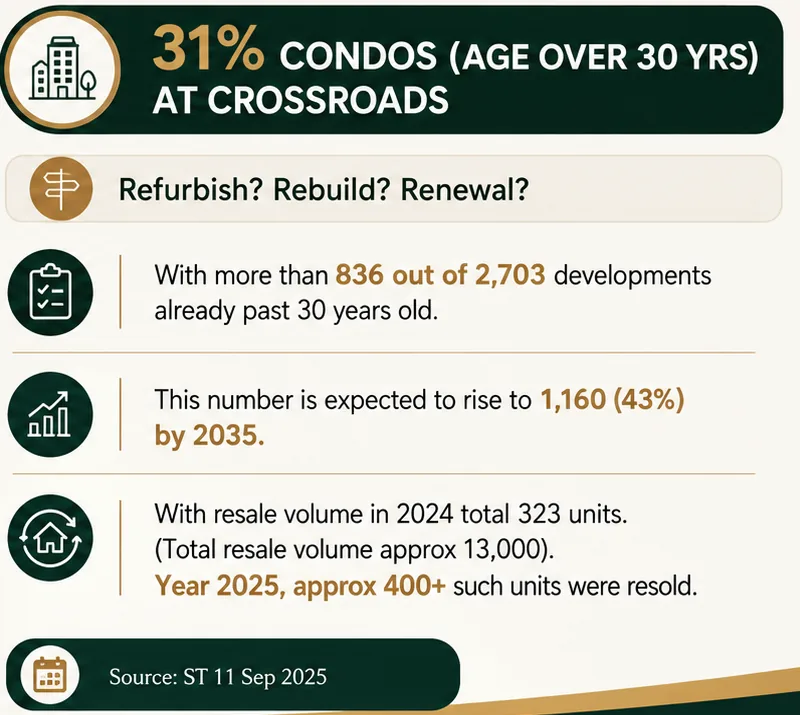
The number by itself is not the problem.
Buildings age everywhere. What matters is whether the market still wants them, and here the answer is measurable.
URA data covering January to July 2025 showed the median price of leasehold condos less than five years old at $2,479 psf. For leasehold condos at least 40 years old, the median was $1,115 psf.
That is a gap of 122%.
And liquidity tells the same story from a different angle.
In 2018, 101 leasehold condos aged 40 and above were resold. By 2024 that had tripled to 323. Tripling sounds like a recovery until you set it against the whole market: URA recorded 14,053 private resale transactions in 2024, and 14,622 in 2025.
So roughly one resale in forty-three involved a condo forty years or older.
| What the data shows | Figure | Source |
|---|---|---|
| Developments already past 30 years old | More than 800 of 2,703 | The Straits Times, 11 Sep 2025 |
| Median psf, leasehold condos under 5 years | $2,479 psf | URA, Jan–Jul 2025 |
| Median psf, leasehold condos 40 years and over | $1,115 psf | URA, Jan–Jul 2025 |
| Resales of leasehold condos 40 years and over, 2018 | 101 units | URA, via The Straits Times |
| Resales of leasehold condos 40 years and over, 2024 | 323 units | URA, via The Straits Times |
| All private resale transactions, 2024 | 14,053 units | URA 4Q2025 statistics release |
| Older condos sold collectively, past decade | Fewer than 10% | Savills, via The Straits Times |
One more thing worth saying early, because it gets misunderstood constantly.
Ageing is a building issue, not a tenure issue.
Freehold does not exempt a development from spalling concrete, failing lifts, tired plumbing or a sinking fund that cannot cover a major replacement. Property professionals quoted in the same Straits Times report made exactly this point. A freehold 1980s block and a leasehold 1980s block face the same physical decay; they differ only in what the land underneath is worth at the end.
2. So What Is Property Asset Renewal?
It is the decision to move the capital rather than the building.
When a property reaches the stage where growth has flattened and the pool of buyers has narrowed, you have three options. Hold and keep collecting rent. Hold and hope for a collective sale. Or sell, take the equity out, and place it into something earlier in its own life cycle.
The third one is asset renewal.
Notice what it is not. It is not a claim that new is always better than old, and it is not a claim that you should be selling every few years. It is a claim about where in a property's life your money is currently sitting, and whether that is where you want it.
Most Singaporeans were taught the opposite instinct.
"Property always goes up, so just hold."
That advice is not wrong so much as incomplete. Holding works when the asset is still in the part of its life where value accrues. It stops working when the asset has moved into the part where value mostly leaks out through lease decay, maintenance and a shrinking buyer pool.
The whole framework below exists to help you work out which of those two situations you are in.
It applies to owner-occupiers and investors differently, and I will be explicit about that difference as we go. For an investor, the question is close to purely financial. For someone living in the home, the calculation includes things that do not appear on a spreadsheet, and those things are allowed to win.
3. What Are The Four Phases Of A Property's Life?
Every development, whatever its tenure, moves through four phases.
I describe them to clients using two variables only: how fast capital value is growing, and how much rent the property throws off. Those two move in opposite directions over a building's life, and the point at which they cross is where most owners get stuck.
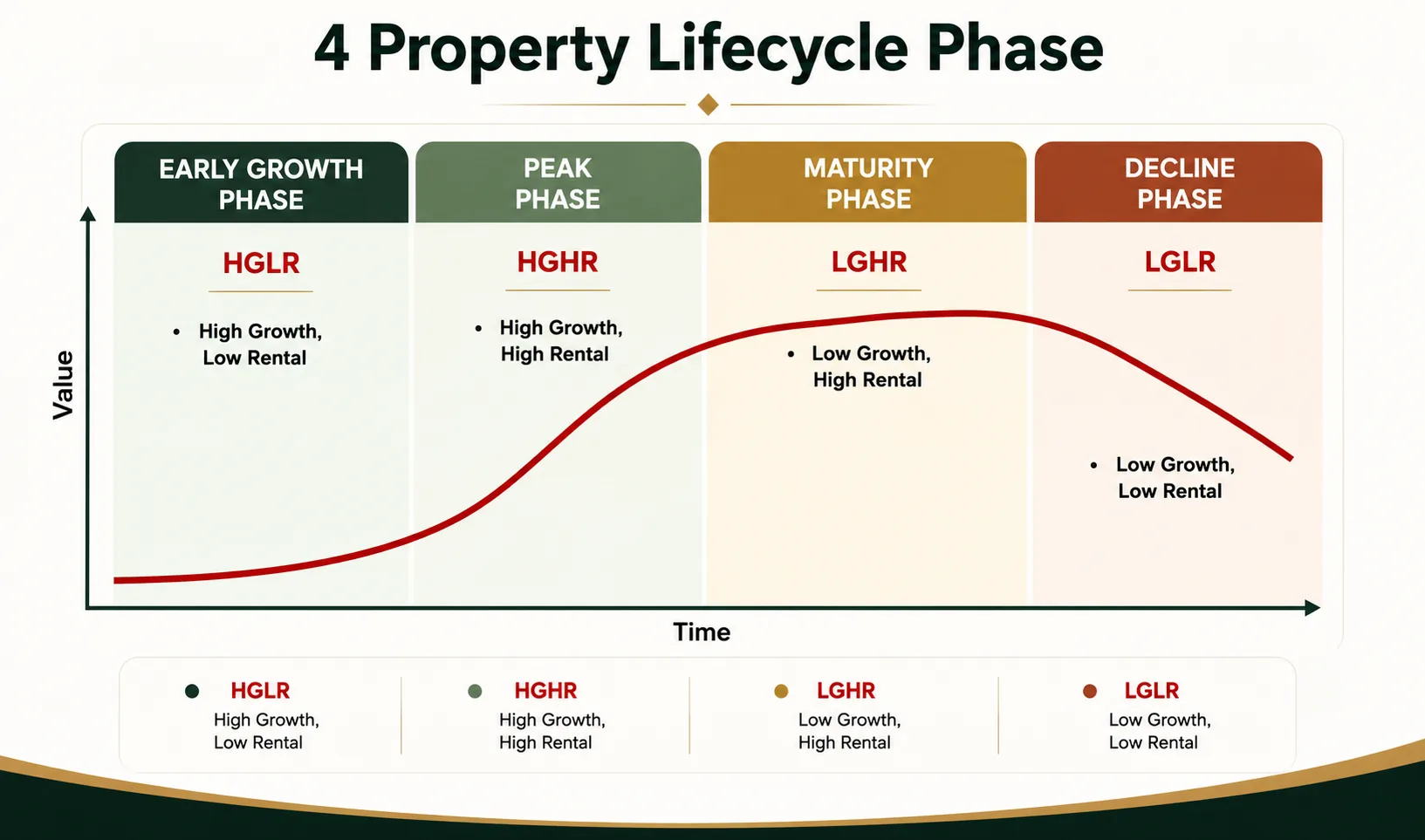
| Phase | Capital growth | Rental | Typically |
|---|---|---|---|
| Early growth | High | None or low | Launch to completion, roughly 1 to 4 years |
| Peak | High | High | Sold out through completion, plus 1 to 3 years |
| Maturity | Low, tracks the market | High | A long stretch, often 5 to 15 years |
| Decline | Low or negative | Falling | Lease decay, ageing plant, shrinking buyer pool |
Two observations before we go into each phase.
The first is that rent and growth are not the same reward, and they arrive at different times. Early on you get growth and almost no rent. Later you get rent and almost no growth. Owners who anchor on monthly cash flow tend to migrate into the maturity phase and stay there, because that is where the cash flow feels best.
The second is that these phases are about the building, not about the market. A rising market lifts everything. What the phase framework tells you is how much of that market movement your particular asset is likely to capture.
4. Why Is A New Launch The Lowest Entry Price It Will Ever Have?
Because of supply.
On launch day, a developer with a thousand units to sell has the largest inventory it will ever hold. Every unit sold after that reduces what is left. This is the ordinary mechanics of a fixed-quantity seller working through stock, and it runs in one direction.
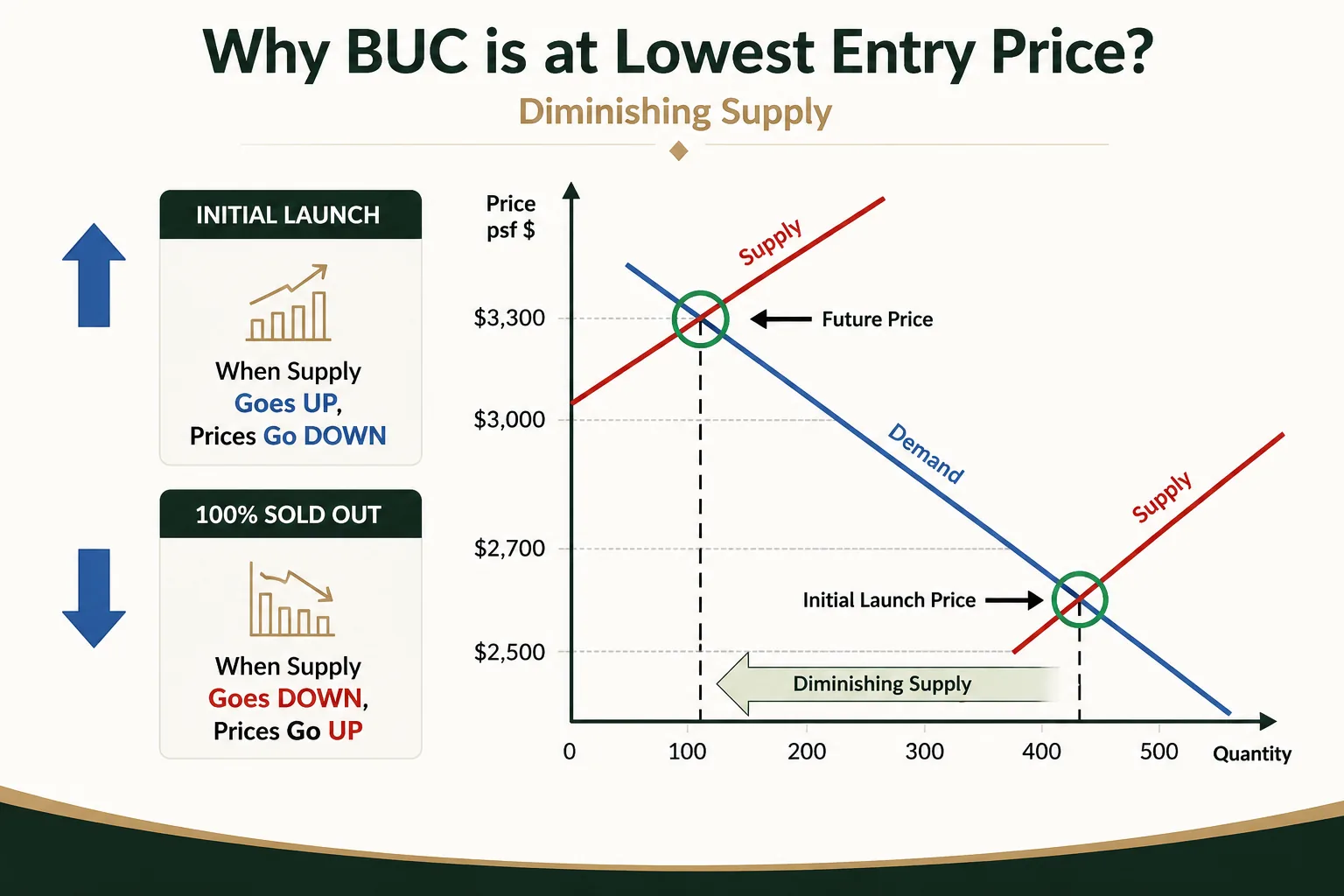
There is a second reason, and it is a financing one.
Developers borrow to build. Lenders release construction funding against sales progress, so a project that has moved a meaningful share of its units is a different credit risk from one that has not. Once a developer is comfortably past its funding milestone, the commercial pressure to discount falls away and the incentive shifts toward holding price.
What follows is a pattern of small, periodic revisions rather than one big jump.
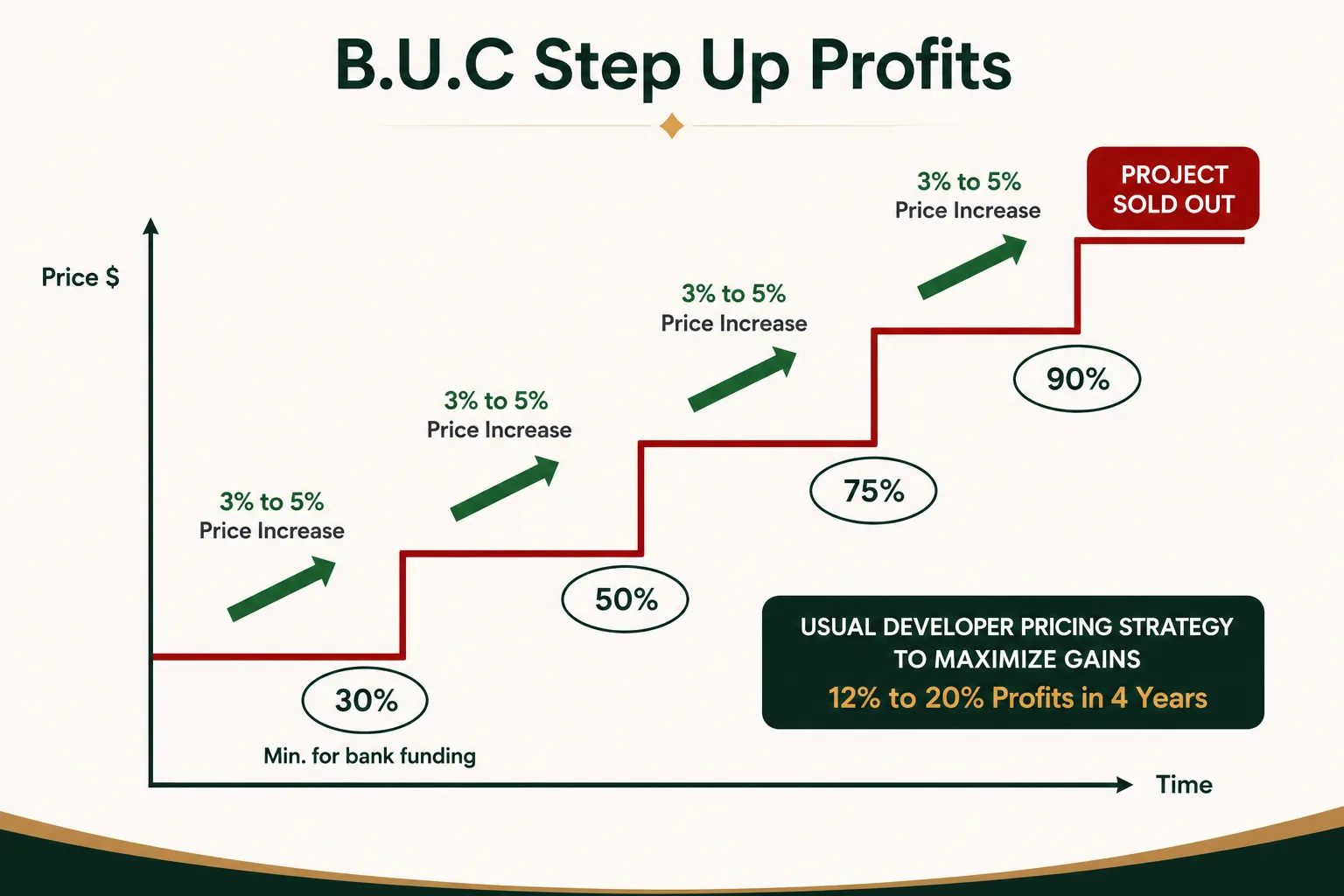
I want to be careful here, because this is the point where new launch commentary usually overreaches.
Nothing obliges a developer to raise prices.
Price revisions are discretionary. A project that sells slowly will not step up, and some projects go the other way with better package terms once the launch weekend is behind them. The mechanism is real and it is common, but it is a tendency, not a guarantee, and any number attached to it is an estimate.
What is not discretionary is the direction of supply. That part is arithmetic. I go through how I weigh this against the alternative in my comparison of what a new launch and a resale condo really cost once the full stack is counted.
There is also a floor beneath new launch pricing that most buyers never think about, and it sits at the land stage.
When URA tenders a Government Land Sales site, it is not obliged to accept the highest bid. In February 2024, URA declined to award the Marina Gardens Crescent site because the sole bid, from a GuocoLand-led consortium, was assessed to be too low. The site went onto the Reserve List instead.
That matters to an existing owner, not just to a developer.
If the state routinely sold land cheaply, the next launch in your area could be priced well below yours, and your resale value would have to compete with it. A reserve price mechanism makes that less likely. It is not a guarantee of your price; it is a constraint on how far the reference point beneath you can fall. I work through how land cost translates into launch price in my analysis of Singapore GLS tenders.
5. What Does Progressive Payment Actually Save You?
Interest, mostly. And it saves it at the point in your life when you are least able to absorb it.
A completed property is fully financed from day one. You borrow the whole amount and you service the whole amount. A building under construction is financed in stages, so the loan is drawn down as the building goes up, and you pay interest only on what has been drawn.
Here is what that looks like on a $2 million purchase.
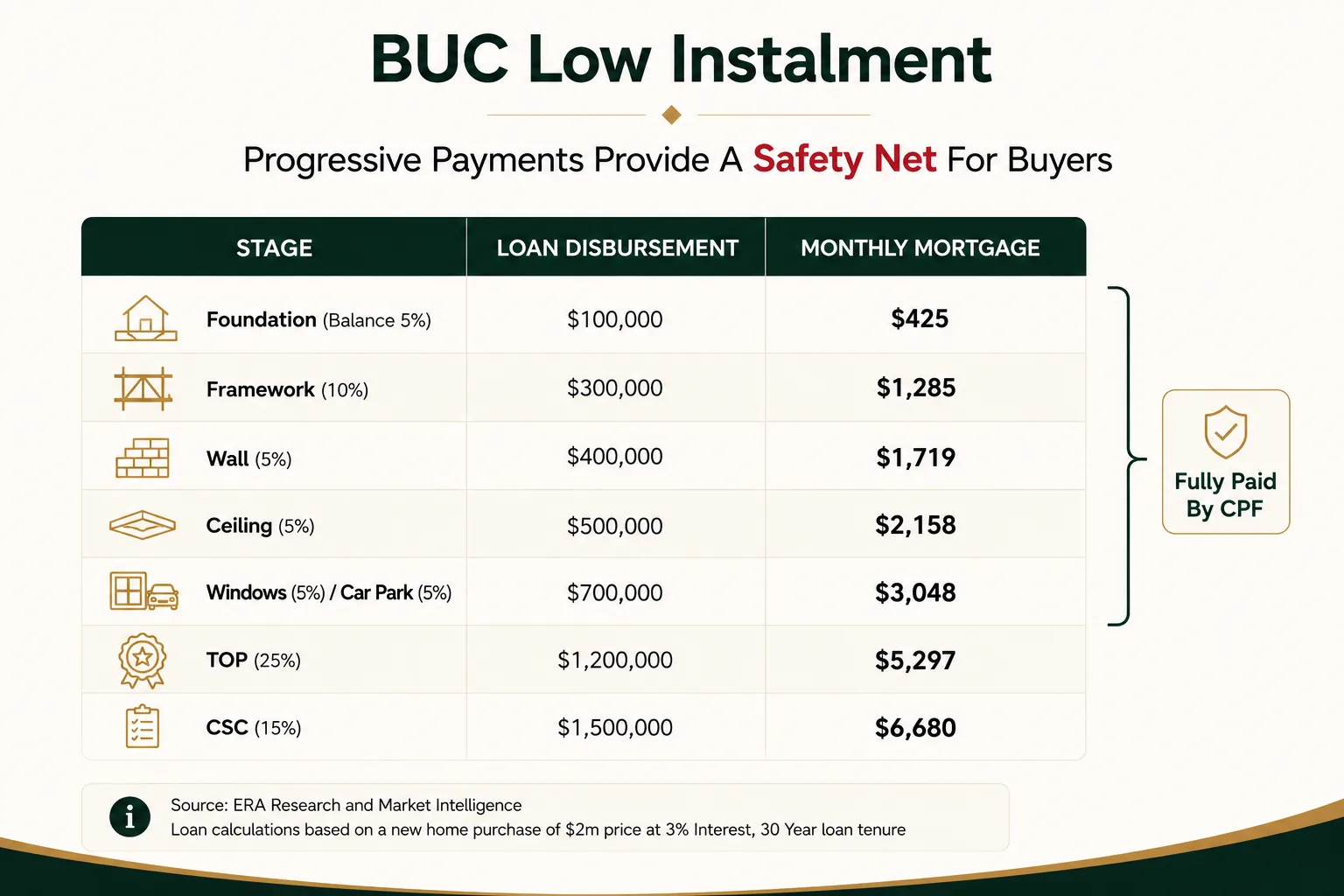
| Construction stage | Loan drawn | Monthly instalment |
|---|---|---|
| Foundation | $100,000 | $425 |
| Framework | $300,000 | $1,285 |
| Walls | $400,000 | $1,719 |
| Ceiling | $500,000 | $2,158 |
| Windows and car park | $700,000 | $3,048 |
| Completion (TOP) | $1,200,000 | $5,297 |
| Certificate of Statutory Completion | $1,500,000 | $6,680 |
Now put CPF against it.
From 1 January 2026, the CPF Ordinary Wage ceiling reached $8,000 a month. That was the final step of the schedule announced at Budget 2023, which moved the ceiling up from $6,000 in four stages.
For a member aged 35 and below, 23% of wages is allocated to the Ordinary Account.
For a couple both at the ceiling: $3,680 per month.
Compare that against the table.
Through the construction years, the instalment sits between $425 and $3,048. A couple contributing at the ceiling is covering all of it from CPF, with cash untouched.
At completion, the instalment jumps to $5,297 and the picture changes. CPF covers the waiting, not the owning.
That is the honest version of the progressive payment advantage, and it is a real one. It is also the version that tells you what to plan for, because the month the keys arrive is the month the cash requirement steps up.
Two qualifications, since this is the part people over-read.
The $1,840 figure assumes wages at or above the ceiling and the allocation rate for members aged 35 and below. Older members have progressively less going to the Ordinary Account, so the cover is thinner. And every dollar of CPF used for property comes back out of your sale proceeds later with accrued interest at 2.5% a year, which is a real cost even though it never feels like one.
6. What Happens At The Peak Phase?
The building appears.
That sounds trivial. It is not. For the whole of the construction period, a new launch is a floor plan, a scale model and a show unit. At completion it becomes a real address with a real lobby that people drive past, and a large group of buyers who would not commit to a drawing will now commit to a building.
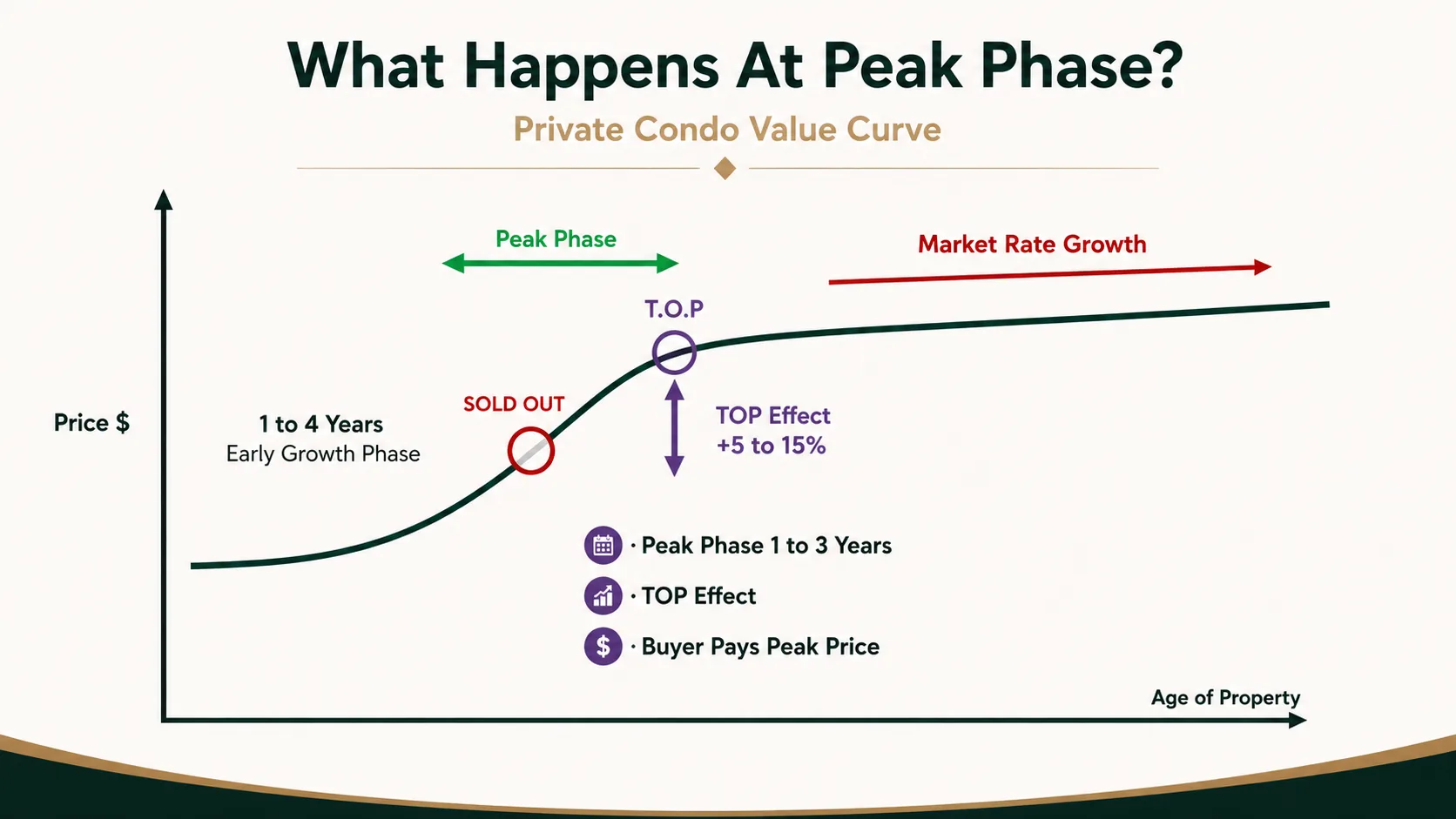
Three things arrive at once.
The unit can be rented, so investors who need immediate income can now transact. The unit can be occupied, so buyers who need a home in the next three months can now transact. And the project is sold out, so anyone who wants in has to go to the resale market and outbid an existing owner.
That combination produces the strongest bidding a development will ever see.
It is also short. The hype does not survive the next launch down the road, and it certainly does not survive ten years.
Here is the part that gets skipped.
The buyer at the peak is usually the most cautious buyer in the market.
They waited because they wanted to see the thing before committing. That is an entirely reasonable preference, and it costs money. The person who accepted four years of construction risk is the one selling to them, and the price difference between those two positions is what the earlier buyer was paid for waiting.
Whether that payment is worth it depends on the project, the entry price and the market at the time. I set out what I check before advising anyone on any of this in my 5-point new launch framework.
7. Why Is Buying At The Peak Riskier Than It Looks?
Because of who your neighbours are.
This is the single most useful idea in the whole framework and the one clients most often have not heard before. It has a name: margin of safety. It means the distance between your entry price and the entry price of everyone else who might list a unit in the same development.
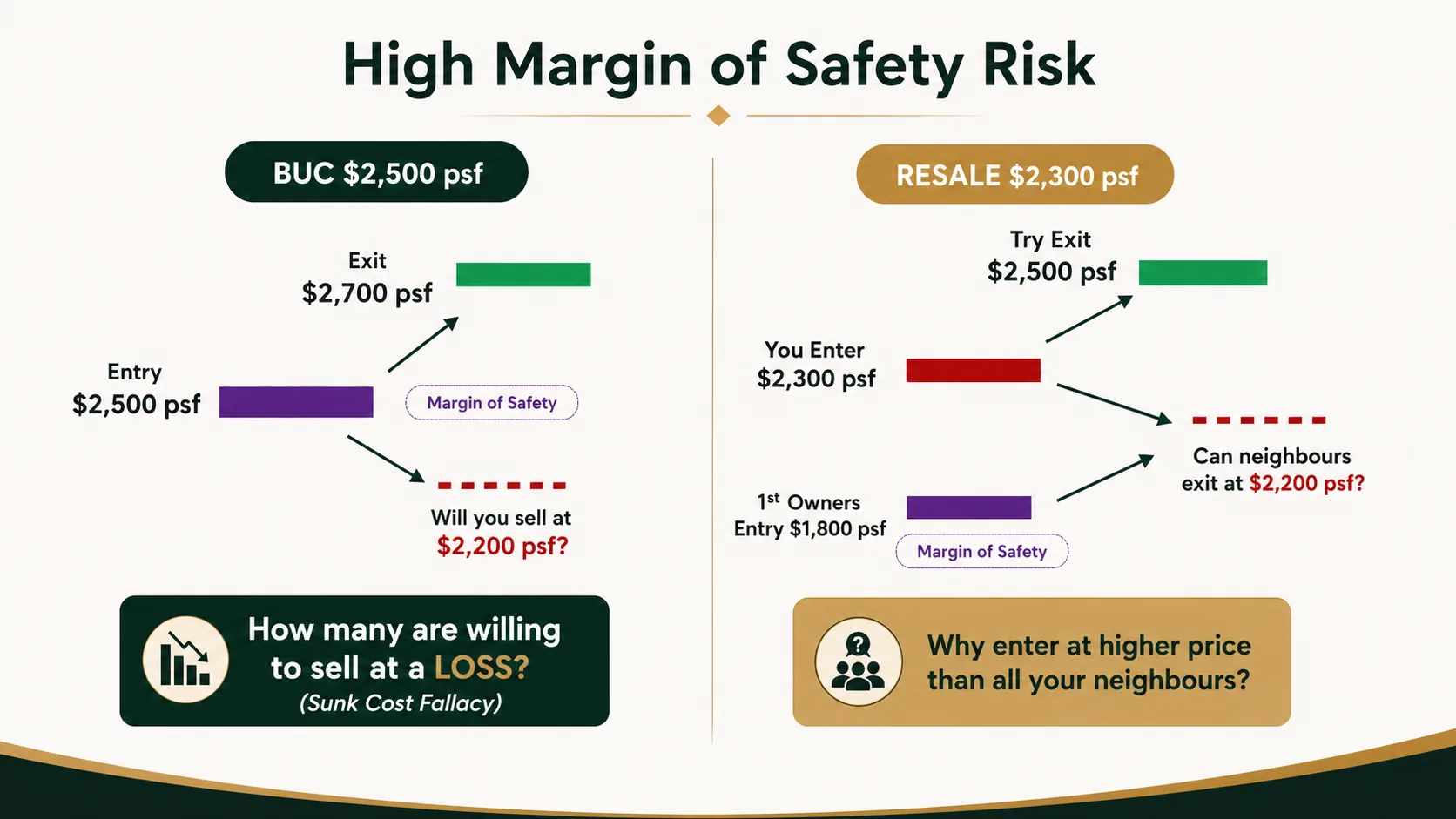
Take the illustration on the left.
Everybody in a new launch enters within a narrow band, because they all bought from the same price list within the same window. If you paid $2,500 psf, so did most of your neighbours. When you come to sell, none of them can undercut you very far without taking a loss themselves, and very few people sell at a loss voluntarily.
Your floor is held up by their cost base.
Now the illustration on the right.
You buy into a completed development at $2,300 psf. It looks like a discount, because the units are currently listing higher than that. But the original owners bought at $1,800 psf, and they are still comfortably in profit at $2,200.
So when the market softens, they can list at $2,200 and take a gain. You cannot match them without taking a loss.
Your exit is capped by their entry, and there is nothing you can do about it.
This is why a headline like "first owners made a million, second owners lost money" is usually not two different markets. It is one market, and two different cost bases.
The fair counter-argument, which I will make because it is true: a resale unit at the peak is a real asset you can inspect, occupy or rent immediately, and it carries no construction or completion risk at all. If your holding period is long and your purpose is to live there, the margin-of-safety problem matters much less, because you are not planning to compete with your neighbours on a listing page in three years.
The risk is concentrated on short and medium holds.
8. Why Does Rental Income Feel Better Than It Is?
Because the tenant's transfer arrives whole and the costs leave in pieces.
A landlord collecting $5,000 a month against a $5,000 instalment usually describes that as breaking even. It is a natural thing to say and it is not how the money works.
An instalment is principal plus interest. The principal portion is you moving money from one pocket to another, so it is not a cost. The interest portion is gone.
On a $1.2 million loan at 3% over 30 years, the instalment is about $5,059 a month. In the first year, roughly $35,700 of that goes to interest and about $25,100 reduces the loan.
So nearly 59% of what the tenant pays you in year one goes straight to the bank.
Before property tax, maintenance fees, agent commission, repairs and any vacant month.
Net that down for a non-owner-occupier property tax bill, monthly maintenance, a letting commission and one month of vacancy between tenants, and the figure that reaches you is materially smaller again.
I am not arguing that rental income is bad.
It is dependable, it is not correlated with your job, and for many owners it is exactly the right thing to want. The point is narrower than that. Rent is not a substitute for capital growth, and it is much slower than it looks.
Where that becomes a decision is when an owner in the maturity phase is choosing between two paths that feel similar and are not. Continuing to collect a yield on an asset whose capital value is tracking the market at a few percent a year. Or moving that same equity into something that still has its growth phase in front of it.
Neither is automatically right. But most people never make the comparison at all, because the rent keeps arriving and nothing forces the question.
9. Is Waiting For En Bloc A Plan?
For most owners, no.
It is an outcome you can hope for. It is very hard to treat as a plan, because you control almost none of the variables and the base rate is poor.
Savills told The Straits Times that fewer than one in ten older condos has been successfully sold collectively over the past decade.
Two developments in that same report show what the other nine look like.
Loyang Valley, a 40-year-old estate in Changi, went to tender for the third time. The tender closed on 9 September 2025 with expressions of interest but no firm bids.
Lakeview Estate in Upper Thomson, 48 years old, is on its fifth attempt in eight years. Across the previous four, the highest consent it reached was 56% of share value, against a threshold of 80%.
Eight years is a long time to hold an asset for an event that has not happened.
And there is a structural reason the odds are what they are.
The government is the competition.
A developer choosing where to spend its land budget compares a collective sale site against a Government Land Sales plot. The GLS site comes with a clean title, a fixed tender timetable and no minority owners. The collective sale site comes with a sale committee, a consent threshold, possible objections to the Strata Titles Board, and a timeline nobody can commit to.
ERA's Eugene Lim made this point in the same Straits Times report: developers have shown stronger interest in GLS tenders lately, and that reduces appetite for the more complex private-treaty route.
When two sites are priced similarly, the simpler one wins.
There is a further constraint on the older stock that is rarely mentioned in en bloc conversations. EdgeProp reported in May 2025 that many private residential developments built after 1990 have already maximised their allowable gross floor area under the Master Plan. A developer redeveloping such a site can only rebuild roughly the same quantum of floor area, which means there is little uplift to pay a premium out of.
No uplift, no premium.
Meanwhile the clock runs on the lease.
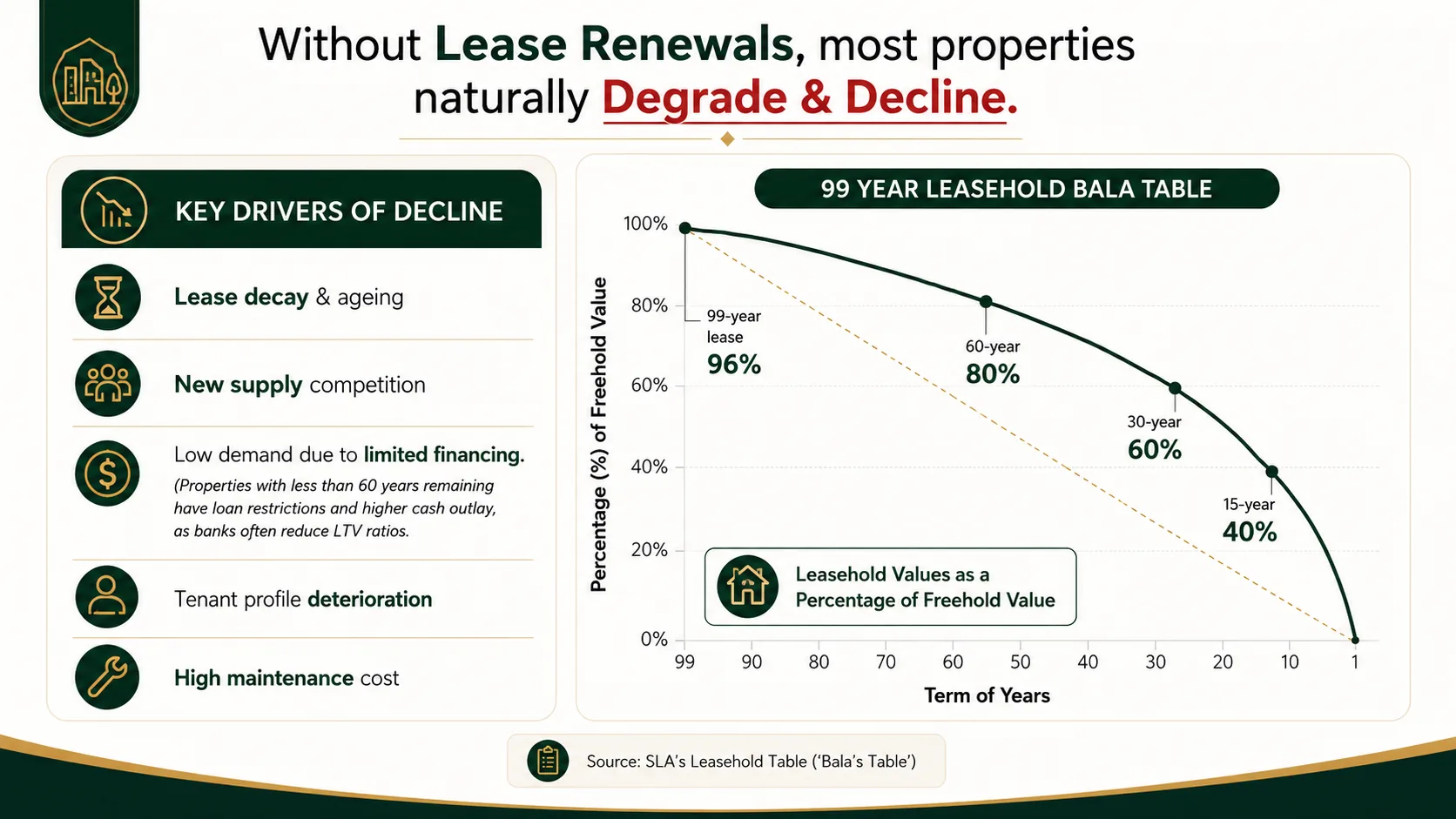
SLA's leasehold table puts a 99-year lease at 96% of freehold value, a 60-year lease at 80%, a 30-year lease at 60% and a 15-year lease at 40%.
The 60-year mark carries a second effect beyond the table.
Banks apply tighter loan-to-value limits and shorter tenures as remaining lease falls, and CPF usage is restricted where the remaining lease will not cover the youngest buyer to age 95. So the buyer pool for a short-lease unit does not just shrink because people prefer new things. It shrinks because fewer people can obtain the financing to buy it.
That is the part owners underestimate.
10. Will The New En Bloc Rules Change That?
Partly. And less than the headlines suggested.
On 4 August 2026, the Ministry of Law introduced the Land Titles (Strata) (Amendment) Bill 2026 for First Reading. It proposes replacing the current two-tier consent structure with an age-based one.
| Age of development | Current threshold | Proposed threshold |
|---|---|---|
| Under 10 years | 90% | 90%, unchanged |
| 10 to 39 years | 80% | 80%, unchanged |
| 40 to 59 years | 80% | 70% |
| 60 years and older | 80% | 65% |
Read the second half of the Bill before celebrating.
The same set of amendments tightens three things.
Starting a collective sale gets harder. The requisition threshold to convene the general meeting that forms a sale committee rises to 35% of owners by share value or unit count, up from the current 20% or 25%.
Collecting signatures gets faster and therefore harder. Sale committees will have six months instead of twelve to reach the consent threshold.
And restarting after a failure gets harder. The restriction period after a failed attempt goes from two years to three, with heightened requisition requirements during it.
So the picture cuts both ways.
An estate with real, settled majority support now has a lower bar to clear, and for a 60-year-old development the drop from 80% to 65% is substantial. Lakeview Estate's best result of 56% would still fall short, but it is a great deal closer to 65% than to 80%.
An estate where support is thin gets fewer bites at the apple and less time on each one.
That is, I think, the intended effect. Fewer exercises, better ones.
Two caveats that matter for anyone making a decision on the back of this.
It is not law. As of early September 2026 the Bill has had its First Reading and is due for a Second Reading at the next available sitting. The commencement date has not been announced.
And a lower consent threshold does not create a buyer. Consent is one obstacle out of several; price expectation, developer appetite and the plot ratio ceiling are the others, and none of them are addressed here. Loyang Valley did not fail for lack of consent. It failed because nobody bid.
11. How Do You Tell Which Phase You Are In?
Compare your development against its own district over the same window.
This is the most practical test I know, and any owner can run it. Pull the average psf trend for your project over the past ten years. Then pull the average for all condos in your postal district over exactly the same period. Put the two lines on one chart.
If your project has broadly tracked the district, it is behaving normally for its age.
If a visible gap has opened and widened, your development has stopped participating in its own neighbourhood's growth, and that is the signature of late maturity.
Here is the same comparison run between two projects rather than against a district.
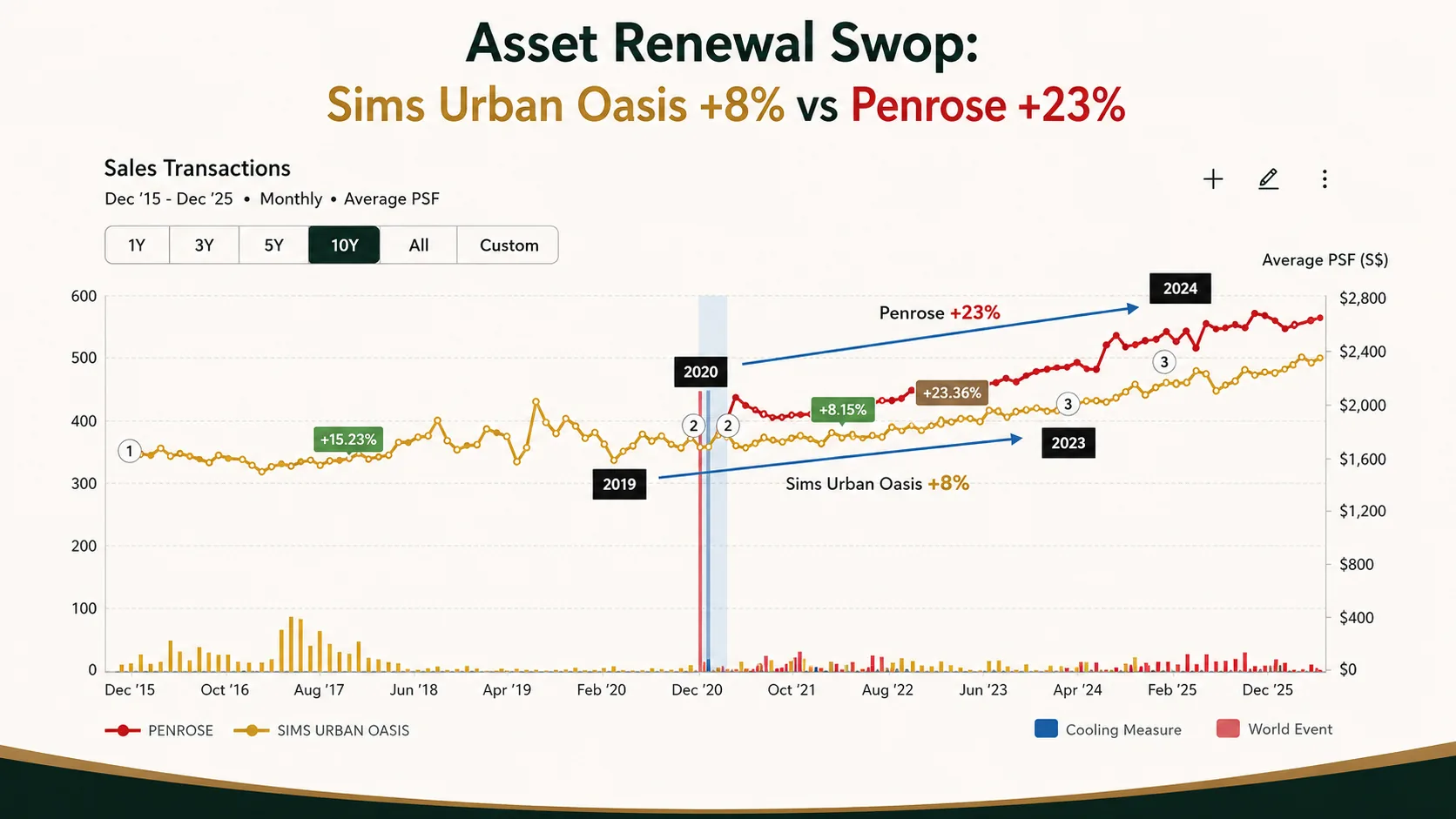
The chart plots average transacted psf by month for both projects from December 2015 to December 2025.
Sims Urban Oasis is the older of the two. Penrose launched later, and over its own measured window the chart marks a considerably steeper climb.
I want to flag the limits of this chart rather than lean on it, because average psf per project is a noisy measure. A month with three penthouse transactions will look different from a month with three one-bedders, and the two annotated windows do not start in the same year, so the two percentages are not directly comparable. Treat it as an illustration of shape, not as a return calculation.
The district comparison is the more reliable version of the same test, because the district average smooths out unit-mix noise.
Three other checks I run alongside it.
Remaining lease. Anything approaching 60 years is entering the financing constraint described above, and the constraint arrives before the buyers notice it.
Sinking fund health. Ask the managing agent what the sinking fund holds and what major replacements are due. Lifts, roofing, external repainting and piping are the big four. A development with an ageing plant and a thin fund is one annual general meeting away from a special levy.
Recent transaction volume. Count how many units in your development actually changed hands in the past twelve months. Thin volume is the early warning that the buyer pool has narrowed, and it usually shows up before price does.
12. What Asset Renewal Is Not
It is not a schedule.
I want to be direct about this, because the idea is often taught as "sell every four years", and the tax code no longer supports that framing even if it once did.
Seller's Stamp Duty was changed on 4 July 2025. For residential property bought on or after that date, the holding period runs to four years, at rates of 16%, 12%, 8% and 4%.
| Sold within | SSD rate | On a $2m sale |
|---|---|---|
| 1 year | 16% | $320,000 |
| 1 to 2 years | 12% | $240,000 |
| 2 to 3 years | 8% | $160,000 |
| 3 to 4 years | 4% | $80,000 |
| After 4 years | Nil | Nil |
Read the fourth row again.
An owner who buys today and sells in year four still pays 4%. On a $2 million exit that is $80,000 before agent commission, legal fees and the buyer's stamp duty on whatever they purchase next.
The four-year cycle is now a five-year cycle, at least.
That is not a small adjustment to the framework. It is the framework's main constraint, and any version of this concept that still says "every four years" is quoting a pre-July-2025 world.
The other things asset renewal is not.
- A reason to sell a home you are happy living in
- A judgement that old buildings are bad
- Costless: buyer's stamp duty, legal fees, agent commission, renovation and moving all sit between the two transactions
- Free of CPF consequences, since the CPF you used comes back with accrued interest and is not cash in hand
- Safe from additional buyer's stamp duty if you buy before you sell
- A guarantee, since a newer property can also underperform
And it is not equally applicable to everyone.
An owner in their sixties with a paid-off home and no intention of borrowing again is in a different position from a couple in their thirties with thirty years of loan tenure ahead. Renewal costs money to execute, and the case for spending that money weakens as the runway shortens.
The honest version of this concept is that it gives you a way to check whether your capital is somewhere sensible. What you do about the answer depends on facts the framework cannot see.
13. My Take: The Cycle Is Real, The Four-Year Rule Is Not
Put the pieces next to each other and something interesting happens.
The ageing stock problem, the SSD change and the en bloc Bill were not designed together, and they were not announced together. But they push in the same direction, and I do not think that is a coincidence.
The SSD change of July 2025 lengthened the minimum sensible holding period. The en bloc Bill of August 2026 made collective sales easier to complete but harder to start and much harder to keep restarting. The ageing stock is what both are responding to.
Read together, the message is fairly clear.
Move deliberately, and not often.
That is a narrower prescription than the version of asset renewal usually taught, and I think it is the more defensible one. A framework that says "cycle every four years" is a framework that produces transactions. A framework that says "know which phase you are in, and act when the phase changes" is one that produces decisions, and most of those decisions will be to do nothing this year.
There is a second interaction worth naming, because it affects who competes with whom.
If the en bloc thresholds pass, some owners in 40 to 59-year-old developments will get an exit they did not expect. Those owners then arrive in the market as buyers, usually with cash from a collective sale and a need to rehouse quickly.
They will be competing for the same replacement stock as ordinary upgraders.
That is a small effect at current volumes. It is worth watching if the Bill passes and collective sale activity actually picks up, because the timing of your own move interacts with theirs.
Where I would push back on the framework as it is usually presented.
The phase model treats a building as an asset with a predictable arc, and that is broadly right. But it undersells location. A mature development in a district that is genuinely improving can outperform a new one in a district that is not, and the phase framework will not tell you that, because it only looks at the building's age.
So the phase test tells you when to ask the question.
It does not answer it. The answer requires the same location, developer, unit mix and price work that any purchase requires, which is why I treat this framework as a screening tool rather than a strategy in itself.
And the case for staying put is stronger than the framework admits. If you are living in the home, know your neighbours, are within reach of the schools you want, and are not planning to borrow again, the transaction costs of renewal buy you very little. I say this to clients often enough that it should be in writing: a plan that ends in "so I am staying" is still a plan.
14. My Thoughts
Most owners in Singapore have never been shown a picture of their property's life.
They were shown a purchase, and then twenty years of monthly statements.
The result is a country full of people who know precisely what their home is worth and have never once asked what phase it is in. Those are different questions, and the second one is the one that decides what the first one will say in ten years.
None of this is a case for churning.
The transaction costs are real, the stamp duties have got heavier, and there is a version of this idea that gets used to manufacture activity. That version is easy to spot: it starts with a number of years rather than with your property.
The version I find useful starts somewhere else.
Look at what you own. Work out where it is in its own arc. Compare it against its district over the same window. Ask what the sinking fund holds and what breaks next.
Then decide, with the costs of moving fully counted.
Most years the answer will be to stay, and that is fine. What is not fine is arriving at the answer by default, five years after the moment when the decision was still cheap.
Buildings age on a schedule. Owners tend to notice on an anniversary, or on a repair bill, or when a neighbour's unit sits unsold for eight months.
The whole point of having a framework is to notice earlier than that.
Not sure which phase your property is in? I run this comparison for clients using their actual development against their own district, alongside the sale proceeds, CPF refund and borrowing capacity that would decide whether a move is even worth executing. If the numbers say stay, that is what you will hear. Get in touch to work through yours.
15. Frequently Asked Questions
What is property asset renewal?
Property asset renewal is the practice of moving your capital out of a property that has reached the mature or declining part of its life cycle and into one that is earlier in its own cycle. It is a decision about where your equity is sitting rather than a rule about how often to transact. The alternative approaches are to hold and collect rent, or to hold and hope for a collective sale.
How old is too old for a Singapore condo?
There is no single cut-off, but two markers matter. Past roughly 30 years, a development is in the group that URA data shows trades at a large discount to newer stock. Past roughly 60 years of remaining lease, financing tightens: banks reduce loan-to-value ratios and shorten tenures, and CPF usage is restricted where the remaining lease will not cover the youngest buyer to age 95. The financing constraint usually bites before buyers consciously start avoiding the development.
Does freehold protect against ageing?
Not from the physical side of it. Ageing is a building issue, not a tenure issue. Spalling concrete, failing lifts, tired plumbing and an underfunded sinking fund affect freehold and leasehold developments the same way. What freehold protects is the residual land value at the end, which is why freehold sites can attract collective sale interest that comparable leasehold sites do not.
Should I just wait for my condo to go en bloc?
For most owners this is a hope rather than a plan. Savills told The Straits Times that fewer than one in ten older condos has been sold collectively in the past decade. Lakeview Estate in Upper Thomson is on its fifth attempt in eight years, and its best result across the previous four was 56% consent by share value against a threshold of 80%. Loyang Valley's third tender closed in September 2025 with no firm bids at all.
What are the new en bloc consent thresholds in Singapore?
The Land Titles (Strata) (Amendment) Bill 2026, introduced on 4 August 2026, proposes 70% consent for developments aged 40 to 59 years and 65% for those 60 years and older. The 90% threshold for developments under 10 years and the 80% threshold for those aged 10 to 39 years stay unchanged. The Bill has had its First Reading only and is not yet law, and the commencement date has not been announced.
Do the new rules make en bloc easier overall?
They cut both ways. The consent thresholds fall for older developments, but the same Bill raises the requisition threshold for starting a sale from 20% or 25% to 35% of owners, cuts the signature collection window from twelve months to six, and extends the restriction period after a failed attempt from two years to three. An estate with settled majority support has an easier path; an estate with thin support gets fewer and shorter attempts.
Why is a new launch said to be at its lowest entry price?
Because supply at a single project only falls. On launch day the developer holds its largest inventory, and every sale reduces what remains. Developers also face less commercial pressure to discount once they have passed the sales milestone that unlocks construction financing. Price revisions after that are discretionary though, so this is a tendency rather than a guarantee, and a slow-selling project may not step up at all.
What is margin of safety risk when buying a condo?
It is the risk created by entering a development at a higher price than the owners you will later compete with. If the original buyers paid $1,800 psf and you paid $2,300 psf, they can list at $2,200 and still take a profit while you would be taking a loss. Your exit price is effectively capped by their entry price. Buyers in a new launch mostly enter within the same narrow band, so this risk is much smaller there.
How much does Seller's Stamp Duty cost if I sell early?
For residential property bought on or after 4 July 2025, the rates are 16% within one year, 12% in the second year, 8% in the third and 4% in the fourth, with nothing payable after four years. On a $2 million sale in year four that is $80,000. Property bought before 4 July 2025 remains on the previous three-year schedule of 12%, 8% and 4%. SSD is charged on the higher of sale price or market value.
Does progressive payment really mean CPF covers my instalments?
During construction, often yes. At the CPF Ordinary Wage ceiling of $8,000 from 1 January 2026, a member aged 35 and below has 23% of wages, or $1,840 a month, going to the Ordinary Account, so a couple contributes $3,680. On a $2 million purchase the instalment stays below that through most construction stages. At completion it rises to roughly $5,297 and the gap has to be met in cash. Older members also have less allocated to the Ordinary Account, so the cover is thinner.
Is asset renewal the same as asset progression?
Asset renewal is one part of asset progression. Asset progression covers the whole plan for how each property move funds the next, including the sale proceeds, CPF refund, borrowing capacity, stamp duties and sequencing. Asset renewal is the narrower question of whether your current property has reached a stage where the capital would work harder somewhere else.
How do I check which phase my property is in?
Compare your development's average psf trend against the average for all condos in your postal district over the same ten-year window. If a gap has opened and widened, the development has stopped participating in its own neighbourhood's growth. Then check three things alongside it: remaining lease, what the sinking fund holds against upcoming major replacements, and how many units in the development actually transacted in the past twelve months.
16. Sources And Method
The ageing stock figures. The count of more than 800 developments out of 2,703 past 30 years old, the January to July 2025 median psf figures of $2,479 and $1,115, the 2018 and 2024 resale counts of 101 and 323 units, the Savills observation on collective sale success rates, and the Loyang Valley and Lakeview Estate details all come from Joyce Lim's report for The Straits Times on 11 September 2025. The psf and resale-count figures in that report are attributed to URA data.
Total resale volume. The 14,053 private resale transactions in 2024 and 14,622 in 2025 are from URA's 4th Quarter 2025 real estate statistics release. The data panel reproduced in section 1 rounds this to about 13,000; I have used URA's figure in the text and noted the difference in the caption rather than reconciling it silently.
A figure I have not used. The same panel carries a projection that the count of developments past 30 years old rises to 1,160, or 43%, by 2035. I could not trace that projection to the September 2025 Straits Times report, so it does not appear anywhere in my text. It remains visible in the image, and I would treat it as unverified until its origin is confirmed.
The en bloc amendments. The proposed consent thresholds, the 35% requisition threshold, the reduction of the signature window from twelve months to six, and the extension of the post-failure restriction from two years to three are set out in the Ministry of Law's press release of 4 August 2026 on the Land Titles (Strata) (Amendment) Bill 2026. As at the date of this article the Bill has had its First Reading and awaits a Second Reading.
Seller's Stamp Duty. The four-year holding period and the 16/12/8/4 rate schedule for property purchased on or after 4 July 2025 come from the joint MAS, MOF and MND announcement of 3 July 2025. IRAS sets out how the holding period is counted from the date of acceptance of the option to purchase.
CPF. The $8,000 Ordinary Wage ceiling from 1 January 2026 is the final step of the schedule announced at Budget 2023 and is published in CPF's employer contribution tables. The 23% Ordinary Account allocation applies to members aged 35 and below; the $1,840 and $3,680 monthly figures are my arithmetic on that rate at the ceiling.
The GLS reserve price example. URA's decision not to award the Marina Gardens Crescent site, on the basis that the sole bid from GuocoLand, Intrepid Investments and TID Residential was assessed to be too low, is recorded in URA's tender decision release of 8 February 2024. The site was moved to the Reserve List.
Post-1990 plot ratios. The observation that many developments built after 1990 have already maximised their allowable gross floor area, which limits redevelopment upside, was reported by EdgeProp Singapore on 16 May 2025.
The progressive payment table. The stage-by-stage instalment figures are from ERA Research and Market Intelligence, based on a $2 million purchase at 3% interest over a 30-year tenure. I reran the amortisation independently and landed within about 5% at every stage, which is close enough to treat the table as a fair representation of the shape without being an exact match.
My own arithmetic. The 122% price gap, the 2.3% share of 2024 resale volume represented by 323 units, the one-in-forty-three framing, the $5,059 instalment and the year-one split of roughly $35,700 interest against $25,100 principal on a $1.2 million loan at 3% over 30 years, the CPF allocation figures, and the SSD dollar amounts on a $2 million sale are all my calculations on the sourced figures above. Each one is shown in the text so it can be checked.
The illustrative diagrams. The diminishing supply chart, the step-up pricing chart, the value curve and the margin of safety diagram use worked example figures to show a mechanism. They are not transacted prices from any development, and they are not forecasts. Where a real transaction chart is used, in section 11, I have said plainly what it can and cannot support.
What is uncertain. Whether the Land Titles (Strata) (Amendment) Bill passes in its current form, when it takes effect, and whether lower consent thresholds actually translate into completed collective sales. Developer pricing behaviour on any individual launch is discretionary and cannot be predicted from the pattern described here.
Update Log
- 3 September 2026. First published.
This page will be updated when the Land Titles (Strata) (Amendment) Bill has its Second Reading, when a commencement date is announced, and when URA publishes fuller data on transactions in the ageing condo segment.
Disclaimer: This article is provided for informational purposes only and should not be construed as financial advice, investment recommendation, or an offer to buy or sell property. While we have made efforts to ensure the accuracy of the information presented, market conditions, developer plans, and regulatory environments are subject to change. Property prices, launch dates, unit availability, and other details mentioned are based on current market intelligence and may be subject to revision. Prospective buyers should conduct independent research, verify all information directly with developers and relevant authorities, and consult with qualified financial and legal advisors before making any property purchase decisions. We are committed to accuracy and transparency; however, the information provided should not be regarded as an offer, statement, representation, or guarantee. While we strive to ensure the information is correct, it may not always be complete, up to date, or free from errors. Users are strongly encouraged to exercise due diligence and verify details through direct inquiries. Our agents and this website shall not be held liable for any decisions or actions taken based on the information provided here.