14 min read
Understanding Singapore's Economic Resilience and Property Fundamentals
Singapore's reputation as a premier global financial hub and livable city is anchored by robust economic policies and visionary urban planning. Its property market thrives on formidable fundamentals: political stability, sustained economic growth, and long-term development. These strengths form a resilient bedrock, guiding property values and investment returns.
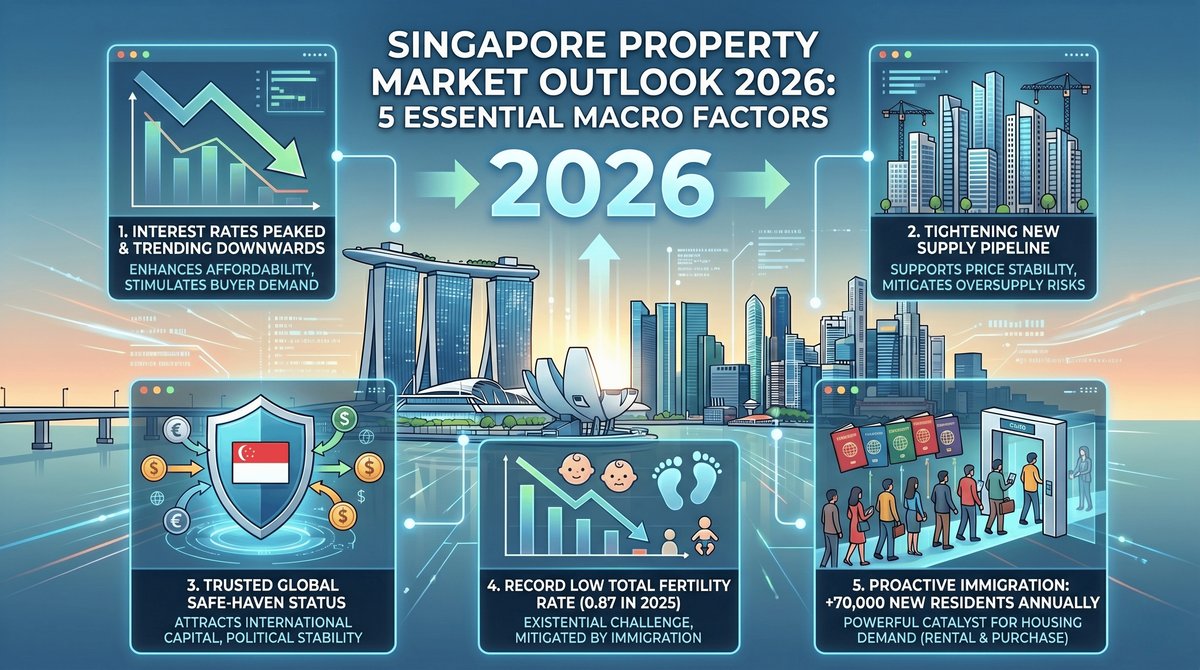
Dissecting the Singapore property market outlook 2026 reveals critical elements forging an advantageous environment for real estate stakeholders. The convergence of five macro factors creates a favorable investment window that warrants careful analysis.
| Macro Factor | Current Status | Impact on Property Market |
|---|---|---|
| 1. Interest Rates | Peaked and trending downwards | Enhances affordability, reduces borrowing costs, stimulates buyer demand |
| 2. Supply Pipeline | Low and tightening, especially in prime locations | Supports price stability, mitigates oversupply risks, potential for appreciation |
| 3. Safe-Haven Status | Trusted global safe-haven, strong governance | Attracts international capital, sustains premium demand, value preservation |
| 4. Total Fertility Rate | Record low of 0.87 in 2025 | Shifts demand patterns, mitigated by proactive immigration policies |
| 5. New Citizenship & PR Grants | 70,000 new residents annually (350,000 over 5 years) | Powerful driver of housing demand, supports long-term growth |
1. Interest Rates: A Favorable Shift for Buyers
Interest rates are a paramount determinant of property affordability and buyer sentiment. Historically, high rates dampen demand by escalating borrowing costs. However, authoritative data suggests rates have peaked and are now trending downwards. This decline is projected to alleviate the financial burden on prospective buyers, enhancing affordability and invigorating market demand.
For Singapore real estate investment, lower interest rates mean more manageable mortgage repayments and bolstered purchasing power. When borrowing costs decrease, the same monthly budget can support a higher loan quantum, effectively expanding the price range accessible to buyers. This shift is particularly significant for HDB upgraders transitioning to private property, where even a 0.5% reduction in interest rates can translate to savings of hundreds of dollars per month.
The timing is strategic. The 2023-2024 period saw interest rates at multi-year highs, which dampened transaction volumes and created pent-up demand. As rates normalize in 2026, this accumulated demand is expected to re-enter the market, positioning early movers to benefit from both favorable financing conditions and the momentum of returning buyer confidence.
2. Supply Pipeline: Sustained Scarcity and Price Stability
The immutable economic principle of supply and demand profoundly influences any property market. In Singapore, the supply side signals sustained scarcity. The new property supply pipeline is tightening, with fewer new launches, especially in prime locations. This constrained supply is a pivotal force, contributing to price stability and potential appreciation.
Limited inventory ensures demand consistently outstrips supply. This scenario is highly relevant for discerning investors prioritizing long-term value and stability in their Singapore property investment portfolios, mitigating oversupply-induced price correction risks. Recent mega-launches like Thomson Reserve in District 20 and Lentor Gardens Residences in District 26 demonstrate strong demand even with substantial unit counts.
The Urban Redevelopment Authority's cautious approach to land release has created a structural supply constraint. Unlike previous cycles where oversupply led to market corrections, the current pipeline suggests a balanced market where absorption rates remain healthy. This disciplined supply management provides a safety buffer for buyers entering at current price levels.
3. Singapore's Enduring Safe-Haven Status
Singapore's unparalleled political stability, transparent governance, and sound economy have cemented its global standing as a trusted safe-haven for wealth. In an unpredictable global landscape, astute investors are drawn to jurisdictions epitomizing security and robust legal frameworks.
This consistent influx of international capital bolsters Singapore's financial sector and directly translates into sustained demand for premium real estate. The perception of Singapore as an exceptionally secure asset repository means its property market exhibits remarkable resilience, less susceptible to external shocks, and more likely to preserve and enhance value.
This intrinsic appeal reinforces the long-term attractiveness of investing in Singapore property safe-haven assets, making it a cornerstone of prudent portfolio diversification. For high-net-worth individuals and family offices seeking stability amid global uncertainty, Singapore property represents more than real estate—it's wealth preservation insurance.
4. Total Fertility Rate (TFR): An Existential Challenge with Evolving Implications
While conventional demographic indicators like birth rates influence long-term housing demand, Singapore faces a distinctive challenge: its persistently record-low Total Fertility Rate (TFR). By 2025, the TFR plummeted to an unprecedented 0.87, starkly below the replacement level of 2.1. DPM Gan Kim Yong characterized this as an "existential challenge."
While a declining birth rate might suggest future housing demand contraction, market implications are more nuanced. Shifts in demand patterns, like increased need for smaller units or properties catering to evolving household structures, are likely. However, the government's proactive and strategic measures, particularly calibrated immigration policies, are poised to counterbalance the low TFR's potential adverse impact on housing demand.
Understanding the long-term effects of Singapore Total Fertility Rate 0.87 impact is vital for a comprehensive market outlook. The demographic challenge doesn't translate directly to market decline—instead, it reinforces the government's commitment to maintaining population growth through immigration, which directly supports property demand.
5. New Citizenship and Permanent Resident (PR) Grants: Boosting Demand
To strategically counteract the low TFR and sustain economic dynamism, Singapore has proactively implemented robust immigration policies. The government plans to admit up to 30,000 new citizens and 40,000 new Permanent Residents (PRs) annually over the next five years, totaling up to 70,000 new residents per year, or 350,000 new residents over five years.
This significant influx acts as a powerful catalyst for housing demand. New citizens and PRs contribute to both rental and purchase markets, strengthening overall demand across diverse segments. This consistent and planned increase in resident population is a key factor underpinning the long-term growth and stability of the Singapore property market outlook 2026, ensuring a continuous and healthy pipeline of potential buyers and tenants.
From an investment perspective, this policy creates a structural floor under demand. Unlike cyclical factors that ebb and flow, immigration-driven demand is policy-guaranteed for the foreseeable future, providing investors with confidence in sustained market fundamentals.
The Confluence of Factors: Is it the Right Time?
The compelling convergence of these five macro factors paints an optimistic picture for the Singapore property market in 2026. Declining interest rates will enhance affordability and stimulate demand. A tightening supply pipeline promises price stability and appreciation. Singapore's safe-haven status continues to draw global capital, providing an unshakeable foundation for asset values.
While the low TFR presents a demographic challenge, it is mitigated by proactive immigration policies ensuring sustained population growth and robust housing demand. Collectively, these interdependent factors suggest a market strategically poised for sustained growth.
For discerning buyers and astute investors, the question remains: Is it the right time to buy property in Singapore 2026? A meticulous analysis of these intertwined macro factors unequivocally indicates that fundamental underpinnings are firmly in place for a brighter, more prosperous property future. The market benefits from synergistic support of sound economic policies, a prudently controlled supply, and a consistent, planned influx of new residents, all contributing to an exceptionally favorable environment for strategic real estate investment.
Conclusion: Strong Fundamentals, Clear Opportunities
In summation, the Singapore property market outlook 2026 is unequivocally characterized by strong fundamentals and clear opportunities. The interplay of declining interest rates, a constrained supply pipeline, Singapore's enduring safe-haven appeal, and strategic population growth initiatives collectively forge a robust and attractive environment for real estate investment.
As emphatically highlighted by ERA Project Expert, "The best time to act is now." This assertion is deeply substantiated by the comprehensive analysis of macro factors presented herein. These factors collectively illuminate a market ripe with significant potential for investors and aspiring homeowners seeking to strategically acquire or expand property portfolios in Singapore.
Want a clear-eyed analysis of how these macro factors apply to your specific situation? Whether you're an HDB upgrader, investor, or international buyer — reach out for a consultative discussion tailored to your timeline, budget, and goals.
Disclaimer
Please note that the property names used on this website are based on road names from Government Land Sales (GLS) sites or en bloc sales, and may not reflect the official names of the developments. These provisional names are provided for reference only and may differ from the final official names.
All calculations, figures, prices, and costs displayed on this website are for illustrative purposes only and do not represent the actual or final selling prices of the developments.
We are committed to accuracy and transparency; however, the information provided should not be regarded as an offer, statement, representation, or guarantee. While we strive to ensure the information is correct, it may not always be complete, up to date, or free from errors. Users are strongly encouraged to exercise due diligence and verify details through direct inquiries. Our agents and this website shall not be held liable for any decisions or actions taken based on the information provided here.