18 min read • Last updated July 2026
Introduction: Beyond the Brochure – The True Foundation of a Sound New Launch Decision
In Singapore's dynamic property landscape, the allure of a new launch condominium is undeniable. Developers invest heavily in creating captivating showflats, glossy brochures, and compelling narratives. It's natural for prospective buyers to be drawn into the excitement, spending countless hours poring over floor plans, visualising their future in meticulously staged interiors, and comparing the latest incentives. Yet, in my experience advising countless buyers, the most significant mistakes are often made long before one ever steps into a showflat.
This might sound contrarian, but a truly successful new launch decision isn't forged in the glitz of a sales gallery; it's made through a disciplined, analytical framework applied well in advance. Many buyers, understandably, focus on what's immediately visible and appealing – the aesthetics, the facilities, the perceived 'deal.' However, this often distracts from the fundamental, less glamorous, but ultimately more impactful factors that dictate long-term value and investment resilience. As a trusted advisor, my role isn't merely to help you buy a launch; it's to help you decide whether a launch is truly worth buying.
This article offers a behind-the-scenes look at the exact framework I employ when evaluating new launch opportunities for my clients. It's a framework built on years of market observation, data analysis, and understanding the intricate interplay of micro and macro forces that shape Singapore's residential property market. This isn't about chasing the latest trend; it's about making informed, strategic decisions that align with your long-term financial and lifestyle goals.
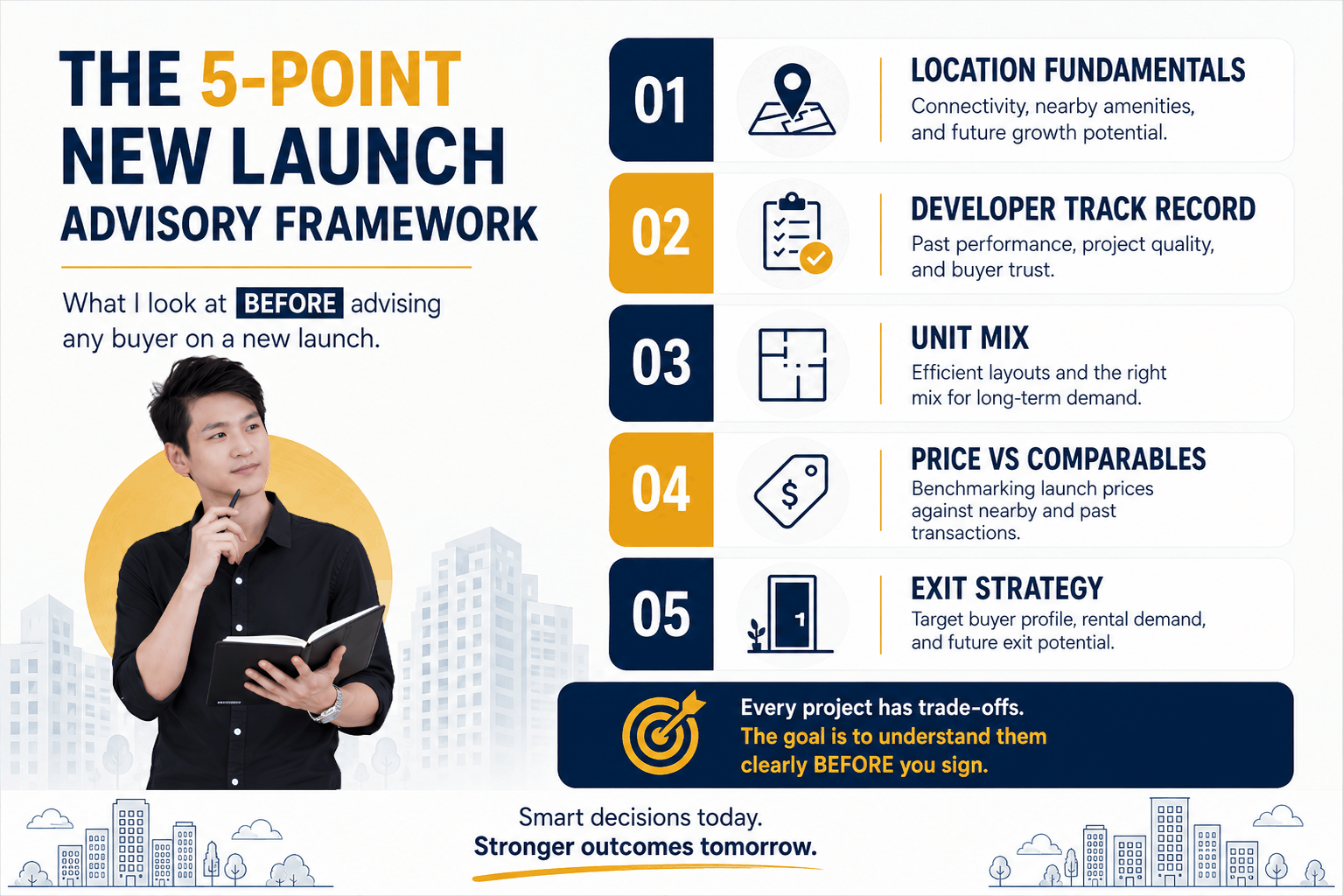
The 5-Point New Launch Advisory Framework outlining the critical factors to evaluate before committing to a new launch property.
1. Location Fundamentals – Looking Beyond the MRT Station
When I sit down with buyers, one of the first things they often highlight is a project's proximity to an MRT station. While convenient transport links are undoubtedly a plus, relying solely on this metric is a common mistake I see buyers make. The true value of a location extends far beyond immediate accessibility; it lies in its underlying fundamentals and future transformation potential.
Catchment Area Analysis and the HDB Ecosystem
One thing I often notice when reviewing a project is the importance of its surrounding catchment area. This isn't just about the immediate neighbourhood; it's about understanding the broader residential ecosystem, particularly the nearby HDB estates. These HDB towns often serve as a crucial feeder market for private condominiums. A vibrant, growing HDB community nearby signals a ready pool of potential upgraders who, in time, will seek private housing options. This organic demand is a powerful driver for future resale value and rental prospects.
For an HDB upgrader family, a new launch near a mature HDB town with good amenities and schools offers a familiar environment with enhanced lifestyle options. For a long-term investor, this catchment area translates directly into a sustainable tenant pool and future buyer demand.
Tenant Demand Drivers and Employment Hubs
Beyond upgraders, understanding tenant demand drivers is critical. Singapore's economic strategy is built on attracting global talent, and these professionals need places to live. I always assess a project's proximity to key employment hubs – be it the Central Business District (CBD), Jurong Innovation District, one-north, or the upcoming Punggol Digital District. A strong connection to these hubs ensures a consistent stream of potential tenants, which is vital for rental yield and overall investment attractiveness. This is where marketing narratives and investment realities often diverge; a project might be aesthetically pleasing, but if it's disconnected from where people work, its rental prospects can be significantly hampered.
School Clusters: A Magnet for Families
For many families, especially those with young children, access to reputable schools is a non-negotiable factor. When evaluating a location, I meticulously examine the school clusters within a 1km or 2km radius. Proximity to popular primary and secondary schools, particularly those with strong academic records, significantly enhances a location's appeal. This is often where a strong story does not always mean a strong investment; a compelling narrative about lifestyle can mask weak school accessibility.
URA Planning and Future Transformation Potential
This is perhaps the most critical, yet often overlooked, aspect of location analysis. The Urban Redevelopment Authority (URA) Master Plan is Singapore's blueprint for development over the next 10 to 15 years. It outlines future land use, infrastructure projects, and transformation corridors. Experienced advisors don't just look at what a location offers today; they analyse its potential tomorrow. Why? Because future transformation often matters more than current convenience for long-term capital appreciation.
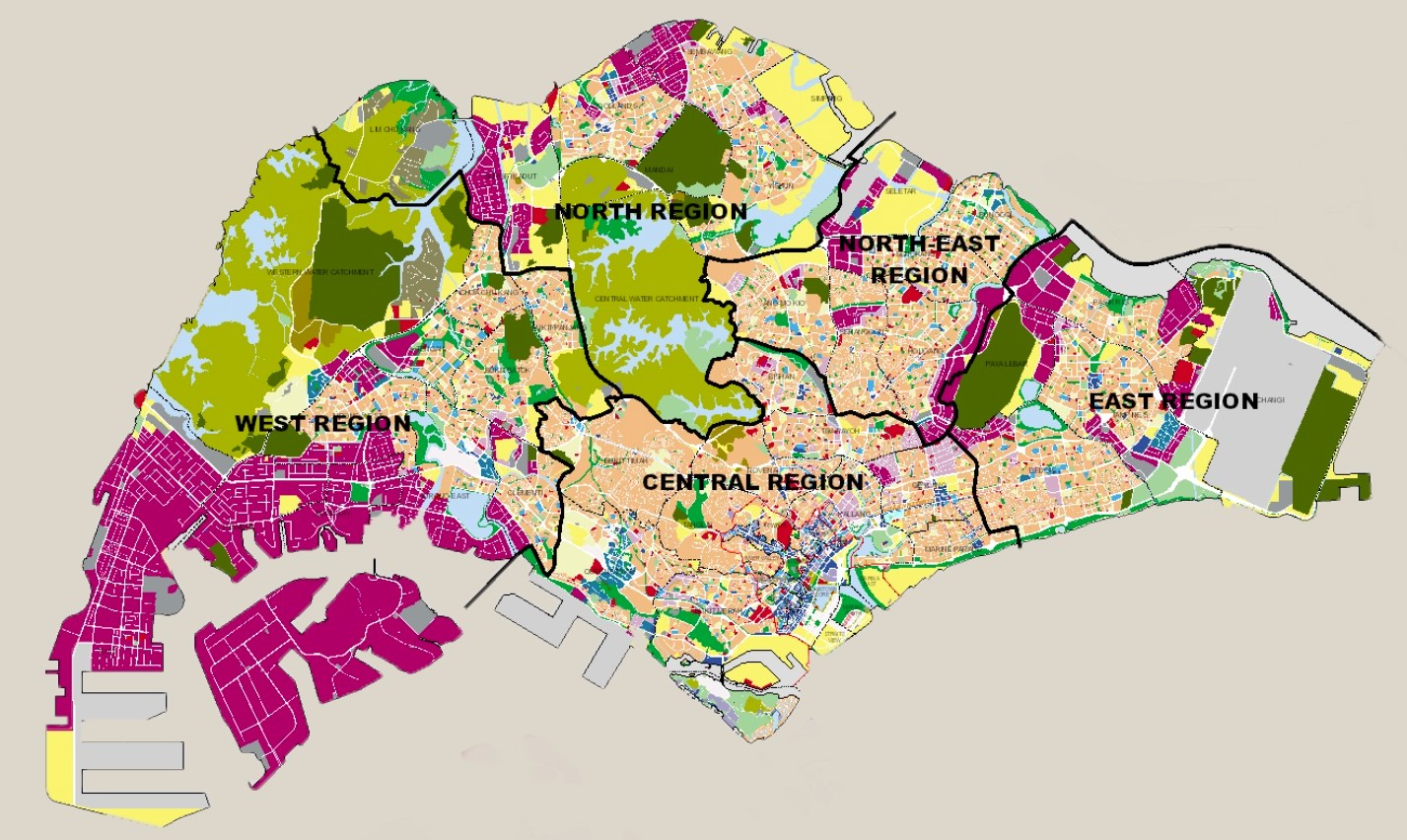
URA Master Plan highlighting strategic development zones across Singapore's nine districts, showcasing planned transformation corridors and future growth areas.
Source: Urban Redevelopment Authority (URA)
Consider areas like Lentor or the upcoming Paya Lebar Air Base redevelopment. These are precincts undergoing significant, planned transformation. While current amenities might be developing, the URA's commitment to creating new housing estates, commercial centres, and infrastructure signals immense future growth. These are not just new homes; they are strategic developments designed to support Singapore's decentralisation strategy, bringing jobs closer to homes and creating self-sufficient communities.

Jurong Lake District Master Plan illustrating the comprehensive transformation of this emerging economic hub with mixed-use developments, green spaces, and enhanced connectivity.
Source: URA & KCAP Urban Design Lab
My analysis delves into these plans: What new MRT lines are coming? What new parks, healthcare facilities, or commercial nodes are planned? How will these developments enhance connectivity, liveability, and economic vibrancy? A common mistake I see buyers make is prioritising current convenience over future potential. While a mature estate offers immediate gratification, a transforming precinct, if chosen wisely, can offer superior capital appreciation as its potential is realised over time.
Neighbourhood Maturity and Infrastructure Development
Finally, I assess the overall maturity of a neighbourhood and its planned infrastructure. A well-planned neighbourhood with a good mix of residential, commercial, and recreational facilities tends to be more resilient. These developments create a robust ecosystem that supports both residents and businesses, contributing to the long-term attractiveness of the location. For a first-time private property buyer, understanding these nuances can be the difference between a good purchase and a great one.
In essence, while an MRT station is a good starting point, a truly insightful location analysis requires a deeper dive into the demographic shifts, economic drivers, and strategic urban planning that will shape its destiny. I don't help people buy launches; I help people decide whether a launch's location fundamentals are robust enough to warrant buying.
2. Developer Track Record – Who Is Building This Project?
After a thorough assessment of a project's location fundamentals, my next critical area of focus is the developer behind the launch. It's easy to be swayed by a project's flashy marketing, but ultimately, the quality of the build, the efficiency of the layouts, and even the long-term resale value are inextricably linked to the developer's track record. This is often where buyers overlook a crucial element: the developer's reputation matters far more at the point of exit than at the initial launch.
Historical Project Performance and Resale Value Retention
When I evaluate a developer, I don't just look at their current project; I delve into their past. What is their historical project performance? How have their previous developments fared in terms of resale value retention? This involves analysing transaction data for their completed projects, comparing them against district averages and similar developments by other builders. A developer with a consistent history of delivering projects that hold or appreciate in value demonstrates a deep understanding of market demand and buyer preferences. For a wealth accumulation buyer, this historical data is paramount, as it directly impacts the defensibility and long-term attractiveness of the asset.
Construction Quality and Design Philosophy
Beyond financial performance, construction quality is a non-negotiable. While it's challenging to assess this during a new launch, a developer's reputation for robust construction, attention to detail, and use of quality materials can be gleaned from feedback on their past projects. Similarly, their design philosophy is crucial. Do they prioritise functional layouts, efficient use of space, and thoughtful amenities? Or do they tend towards more generic designs that might appeal broadly but lack practical insight? I have found that buyers tend to focus on the immediate visual appeal, but a well-designed, efficient layout contributes significantly to liveability and, consequently, to future desirability. This is particularly important for an HDB upgrader family who will be living in the space and values practical considerations.
Maintenance Standards and Market Reputation
A developer's commitment doesn't end at TOP (Temporary Occupation Permit). Their ongoing maintenance standards for common areas and facilities play a significant role in preserving a project's appeal and value over time. A well-maintained development enhances the living experience and signals to future buyers a commitment to quality. This contributes to the developer's overall market reputation and, by extension, buyer confidence. When I sit down with buyers, this is usually one of the first questions I ask: "What is the developer's reputation for post-TOP management?"
Why Developer Quality Matters More During Exit Than at Launch
This is a thought leadership observation that challenges conventional thinking: while a strong developer brand can generate initial buzz and sales velocity, its true impact is felt years down the line, at the point of resale. At launch, buyers are often drawn by price, location, and marketing. However, when it comes time to sell, the market scrutinises the project's enduring quality, the efficiency of its layouts, and its overall condition – all direct reflections of the developer's commitment. If I cannot clearly identify who will want this property 8 years from now, and why they would choose it over newer options, I am not comfortable recommending it. A developer with a proven track record of quality and thoughtful design provides a significant competitive advantage in a resale market, ensuring that your property remains attractive even as it ages. This is where the cheapest unit is not necessarily the best value, and a premium for a reputable developer can pay dividends in the long run.
In essence, a developer is not just a builder; they are a custodian of future value. My assessment goes beyond their current marketing spiel to understand their legacy and their long-term commitment to quality and design. I don't help people buy launches; I help people decide whether a launch, built by a specific developer, is worth buying for its enduring value.
3. Unit Mix – What The Product Strategy Reveals
Beyond location and developer, the unit mix of a new launch project offers profound insights into the developer's intended market and, crucially, the project's long-term investment viability. Many buyers focus on their specific unit type, but a holistic understanding of the entire unit distribution can reveal potential challenges or advantages down the line. This is often where marketing narratives and investment realities diverge; a project might seem perfect for your needs, but its overall unit mix could impact its future performance.
Occupier-Driven vs. Investor-Driven Projects
One thing I often notice when reviewing a project's unit mix is whether it's primarily occupier-driven or investor-driven. Projects with a higher proportion of larger units (3-bedroom and above) tend to attract families and owner-occupiers. These buyers typically have longer holding periods and are less likely to be influenced by short-term market fluctuations, contributing to price stability. Conversely, projects dominated by smaller units (1- and 2-bedroom) often appeal to investors seeking rental income. While these can offer good rental yields, they can also face higher competition during resale, especially in areas with an oversupply of similar unit types.
For an HDB upgrader family, a project with a healthy mix of family-sized units indicates a community aligned with their lifestyle. For a long-term investor, understanding this balance helps assess future resale competition and tenant profiles.
Rental and Future Resale Competition
The unit mix directly influences future rental and resale competition. If a project has an unusually high concentration of a specific unit type, say 1-bedroom units, it could lead to an oversupply in the rental market once the project obtains TOP, potentially depressing rental rates. Similarly, at resale, a glut of similar units can make it harder to differentiate your property and command a premium. This is a common mistake I see buyers make; they focus on their unit's attributes without considering the broader competitive landscape within the development itself.
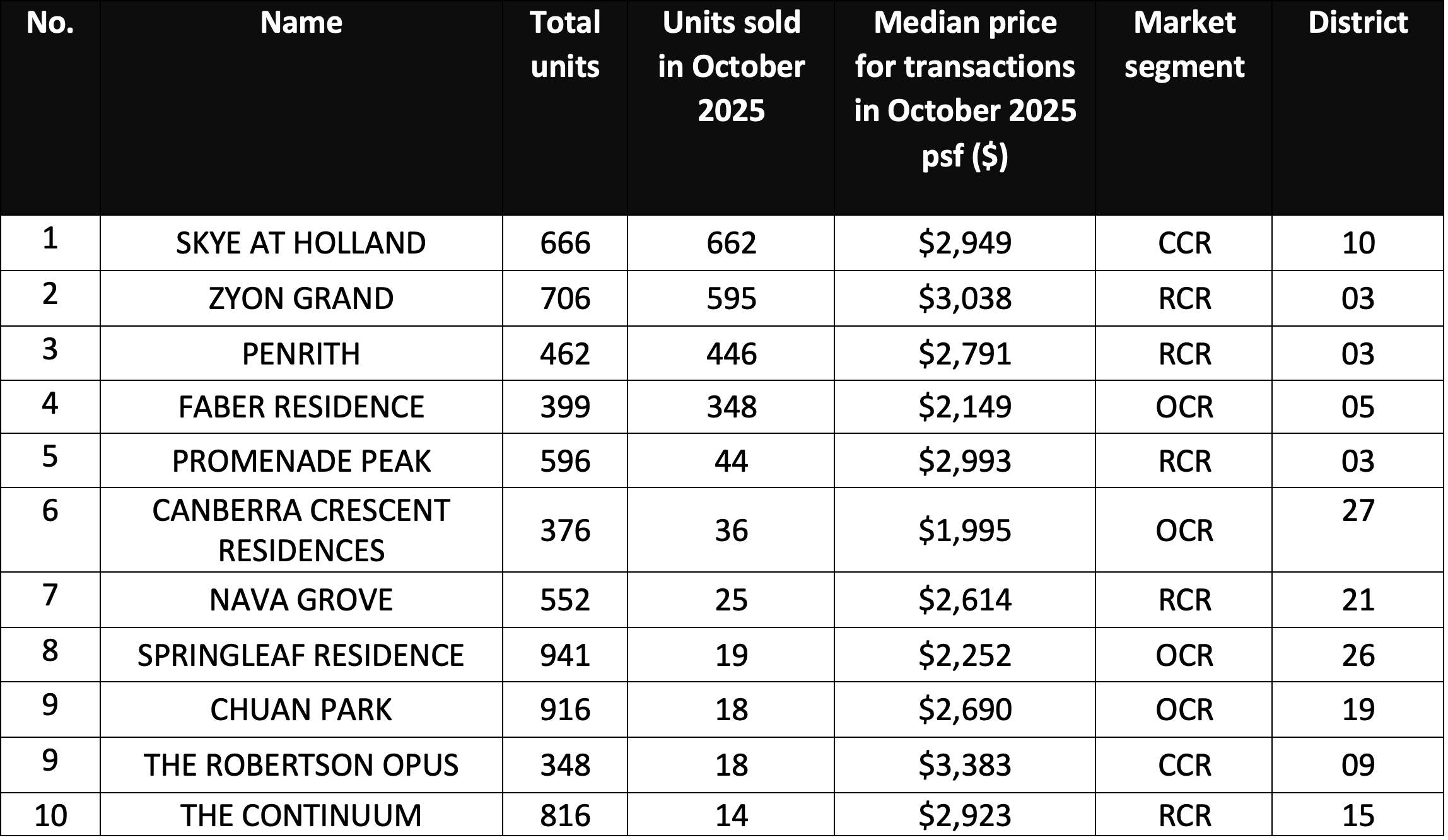
October 2025 Monthly Developer Sales Report highlighting top-performing new launches, unit mix distribution, and market segment performance across different property types.
Source: ERA Singapore Property Research
Stack Planning and Layout Efficiency
Beyond the number of units, the stack planning and layout efficiency are critical. How are the units distributed across the blocks? Are there many similar units facing the same direction, or is there thoughtful differentiation? Layout efficiency, often overlooked, significantly impacts liveability and perceived value. A well-designed layout maximises usable space, minimises wasted corridors, and provides functional living areas. I have found that buyers tend to focus on the overall size, but a smaller, more efficient layout can often feel more spacious and command better value than a larger, poorly configured one. This is particularly relevant for a first-time private property buyer who needs to make every square foot count.
Implications for Long-Term Value Retention
The unit mix reveals the developer's product strategy and, by extension, the project's long-term value retention potential. A balanced unit mix that caters to a diverse buyer pool (both owner-occupiers and investors) tends to be more resilient across market cycles. It suggests a developer who has thought deeply about the project's place in the market and its enduring appeal. This is often where a strong story does not always mean a strong investment; a compelling narrative about lifestyle can mask an imbalanced unit mix that poses long-term risks.
In summary, the unit mix is not just a statistical breakdown; it's a strategic indicator. My analysis goes beyond simply counting bedrooms to understand the developer's vision, the competitive landscape it creates, and its implications for your property's future liquidity and value. I don't help people buy launches; I help people decide whether a launch's product strategy, as revealed by its unit mix, aligns with their long-term objectives.
4. Price Versus Comparables – Context Matters More Than Price
One of the most common questions I encounter from buyers is, "Is this project expensive?" While a natural concern, the question itself often misses the point. The real inquiry isn't whether a project is expensive, but whether it is expensive for what it offers. Price, in isolation, tells you very little. Its true meaning emerges only when placed within the context of comparables, market dynamics, and future value. This is where a professional advisor's perspective diverges significantly from a casual buyer's.
New Launch Premiums and Resale Benchmarks
It's a well-known fact that new launch projects often command a premium over resale properties in the immediate vicinity. This 'new launch premium' accounts for factors like brand-new facilities, modern designs, and the deferred payment scheme. However, the critical assessment lies in understanding if this premium is justified and sustainable. I meticulously analyse resale benchmarks in the surrounding area, looking at similar-sized units in comparable developments that have recently transacted. This provides a realistic baseline against which to measure the new launch's pricing. A common mistake I see buyers make is to focus solely on the absolute price per square foot (PSF) without considering the relative value against established resale prices. For a first-time private property buyer, understanding this premium is crucial to avoid overpaying.
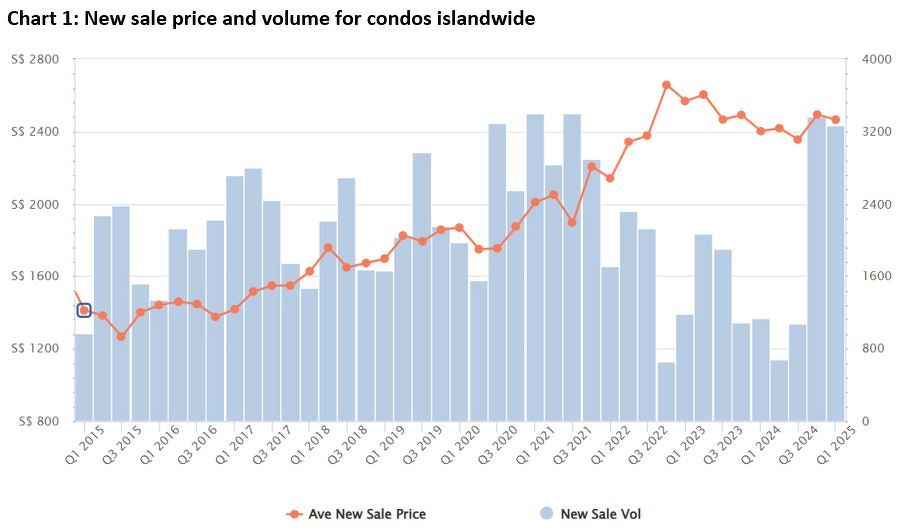
Market analysis showing new launch price trends and demand drivers, illustrating how pricing correlates with market fundamentals and buyer sentiment across different market segments.
Source: ERA Singapore Property Research
District Comparisons and Nearby Competing Projects
My analysis extends beyond immediate neighbours to broader district comparisons. How does the project's pricing stack up against similar developments in adjacent planning areas or districts with comparable attributes? More importantly, I scrutinise nearby competing projects – both existing and upcoming. If a new launch is priced aggressively in an area with a significant pipeline of similar projects, it signals potential future competition that could impact both rental yields and resale values. This is often where a strong story does not always mean a strong investment; a compelling narrative can distract from an impending supply glut.
Relative Value and Entry Pricing Discipline
The principle I adhere to is that context matters more than the sticker price. A project might appear 'expensive' on paper, but if it offers superior location fundamentals, a reputable developer, and a well-thought-out unit mix that justifies its premium, then it represents strong relative value. Conversely, a seemingly 'cheap' project might be expensive in the long run if it suffers from weak fundamentals, poor design, or an unsustainable pricing strategy. This is why the cheapest unit is not necessarily the best value. Entry pricing discipline is paramount; it's about ensuring that the price paid today allows for reasonable capital appreciation and a defensible exit strategy tomorrow. For a long-term investor, securing a good entry price is foundational to capital preservation and growth.
Future Supply Risks and Replacement Cost
I also consider future supply risks. An area with a high concentration of undeveloped land or upcoming GLS sites could face increased competition in the future. Additionally, I assess the replacement cost – what would it cost to build a similar project today, factoring in land costs, construction, and developer margins? If the new launch price is significantly below the estimated replacement cost, it could indicate good value. Conversely, if it's far above, it warrants deeper scrutiny. This analytical reasoning helps position a buyer's decision within broader market context.
In essence, price is merely a number until it's contextualised. My role is to help you benchmark value, understand the true cost relative to its offerings, and ensure that your entry price is disciplined and strategic. I don't help people buy launches; I help people decide whether a launch's pricing offers genuine value relative to its fundamentals.
5. Exit Strategy – The Most Important Question
This is, without a doubt, the most crucial section of my evaluation framework, and it's where I spend the majority of my analytical effort. While many buyers are understandably focused on the entry – the purchase itself – experienced advisors understand that every acquisition should begin with the end in mind. The question isn't just "Should I buy this?" but rather, "Who will buy this from me, and why, eight years from now?" If I cannot clearly identify who will want this property 8 years from now, I am not comfortable recommending it.
Future Buyer Demand and Tenant Demand
My primary focus is on projecting future buyer and tenant demand. This involves a deep dive into demographic shifts, economic forecasts, and urban planning trajectories. Will the area continue to attract families, young professionals, or a specific expatriate segment? What are the long-term employment prospects in nearby hubs? For example, the transformation of areas like Jurong Lake District or the North Coast Innovation Corridor will create new employment nodes, thereby generating future demand for housing. A property's long-term attractiveness is intrinsically linked to the sustained vitality of its surrounding ecosystem.
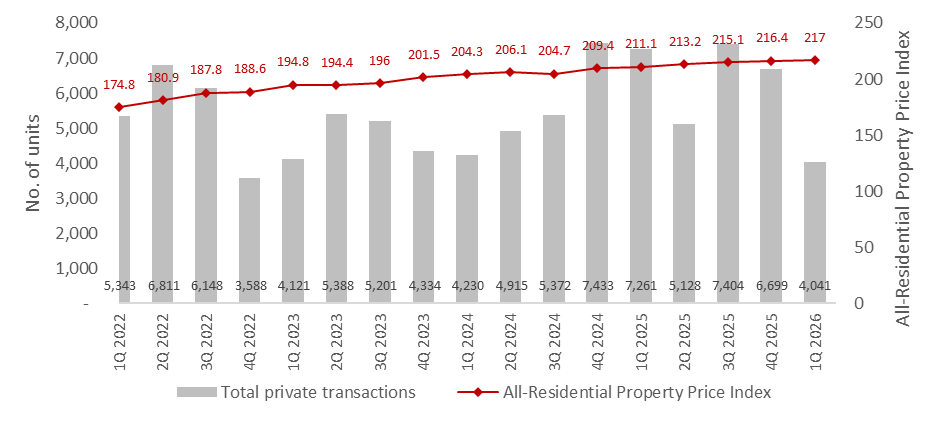
1Q 2026 URA Private Residential Report highlighting transaction volumes, price indices, and market sentiment, providing crucial data for exit strategy planning and future demand assessment.
Source: Urban Redevelopment Authority (URA)
Liquidity and Exit Competition
Liquidity – the ease with which you can sell your property at a fair price – is paramount. This is influenced by the project's unique selling propositions, its unit mix (as discussed in Section 3), and the broader supply landscape. I scrutinise potential future competition to understand if a project is situated in an area slated for a significant influx of similar new launches, which could face increased exit competition down the line. My goal is to identify properties that will stand out, even amidst future supply, due to their defensible attributes. For a wealth accumulation buyer, liquidity and the ability to exit efficiently are key to portfolio management.
Market Cycles and Asset Defensibility
Property markets are cyclical. A robust exit strategy accounts for this by identifying assets that are defensible across various market conditions. What competitive advantages will this property retain even during a downturn or when newer projects emerge? This could be a unique location attribute, a highly sought-after school zone, a rare unit type, or a developer's enduring reputation for quality. The cheapest unit is not necessarily the best value if it lacks defensibility. Conversely, a seemingly expensive unit might be cheap if its inherent advantages ensure its appeal for decades. This is often where a strong story does not always mean a strong investment; a compelling narrative about lifestyle can mask an imbalanced unit mix that poses long-term risks.
Holding Periods and Future Buyer Profiles
Every purchase should be made with a clear understanding of the intended holding period and the profile of the likely future buyer. For an HDB upgrader family, their exit might be driven by children growing up or a desire for a larger space. For a long-term investor, it's about capital appreciation and potentially recycling capital into new opportunities. I help clients visualise their future buyer: Who will they be? Why would they choose this specific unit over others? What needs will it fulfil for them? This forward-looking perspective ensures that the property remains relevant and desirable in the future market.
Why Every Purchase Should Start with the Exit Strategy
This thought leadership observation is central to my advisory philosophy. Showroom impressions can distract buyers from fundamentals, leading to purchases based on emotion rather than logic. By prioritising the exit strategy, we reverse-engineer the decision-making process. We identify the characteristics that will be valued by future buyers and tenants, and then we seek out projects that embody those characteristics today. This approach ensures that the property is not just a good buy, but a good sell. It positions exit demand as the ultimate filter for any new launch consideration.
In essence, my advice is not about finding you a property; it's about finding you a property that future buyers will want. I don't help people buy launches; I help people decide whether a launch offers a clear, compelling, and defensible exit strategy.
6. What Buyers Rarely Ask But Should
After establishing the five major pillars of evaluation – Location, Developer, Unit Mix, Price, and Exit Strategy – there's a second layer of scrutiny that experienced advisors apply. These are the nuanced, often overlooked details that buyers rarely ask about but can significantly impact liveability, long-term satisfaction, and even future value. This is where experienced advisors look deeper than marketing materials, uncovering insights that differentiate a good purchase from a truly exceptional one.
Nearby Future Land Plots and Competing Supply
One critical question I always investigate is the presence of nearby future land plots and their potential for competing supply. While the URA Master Plan provides a broad overview, a more granular analysis involves looking at specific vacant land parcels, their zoning, and their potential for future development. A project might enjoy unblocked views today, but what if an adjacent plot is zoned for a high-rise residential development in five years? This is a common mistake I see buyers make; they assume the current landscape is permanent. Understanding the potential for future competition allows for a more informed assessment of long-term value defensibility. For a long-term investor, this foresight is invaluable in mitigating future risks.

Jurong Lake District Government Land Sale site announcement, illustrating how URA's strategic land releases can signal future supply and competitive dynamics in emerging precincts.
Source: Urban Redevelopment Authority (URA)
Maintenance Fees and Facility-to-Unit Ratios
Maintenance fees, while seemingly a minor detail, can accumulate significantly over time. I delve into the projected maintenance costs and, more importantly, the facility-to-unit ratio. A project with extensive facilities but a small number of units might have disproportionately high maintenance fees. Conversely, a project with a high unit count but limited facilities might offer lower fees but also less exclusivity. This balance impacts the overall cost of ownership and the perceived value of the amenities. For an HDB upgrader family, managing recurring costs is a practical consideration that affects their household budget.
Layout Efficiency and Sun Orientation
While I touched upon layout efficiency in Section 3, here I consider it in finer detail, alongside sun orientation. A unit's orientation can significantly impact its thermal comfort, natural light, and even the lifespan of interior furnishings. West-facing units, for instance, might experience intense afternoon sun, leading to higher air-conditioning costs. Conversely, units with good cross-ventilation and optimal sun exposure enhance liveability. These are the practical buyer insights that often get overlooked in the excitement of a new launch. I have found that buyers tend to focus on the immediate visual appeal, but these subtle factors contribute significantly to daily comfort and long-term satisfaction.
Noise Exposure and Road Frontage
Noise exposure is another factor that can severely impact liveability. Is the unit facing a busy road, an MRT track, or a common facility area that might generate noise? Similarly, units with direct road frontage might offer convenience but could also be subject to higher noise levels and reduced privacy. These are the elements that are difficult to ascertain from a brochure or even a showflat visit, but a detailed site analysis and understanding of the surrounding environment are crucial. This is often where marketing narratives and investment realities diverge; a quiet, serene environment is often promised, but the reality can be quite different.
Construction Risks and Future Neighbourhood Density
Finally, I consider potential construction risks and future neighbourhood density. While Singapore has stringent building regulations, understanding the developer's history (Section 2) and the complexity of the project can provide insights. Furthermore, the URA Master Plan indicates future plot ratios and potential for increased density in the surrounding area. A significant increase in neighbourhood density could strain existing infrastructure and amenities, impacting liveability. These second-level checks, after the five major pillars, ensure a comprehensive and robust evaluation. They reinforce the idea that good decisions are usually made before booking a unit, by looking beyond the obvious and anticipating future scenarios.
In essence, these are the questions that move beyond the surface, revealing the true nuances of a new launch project. My role is to uncover these details, providing you with a complete picture that empowers you to make a decision based on comprehensive understanding, not just initial impressions. I don't help people buy launches; I help people decide whether a launch has been thoroughly vetted against all potential future scenarios.
7. Why I Sometimes Tell Buyers Not To Buy
This section is perhaps the most critical in defining the role of a trusted advisor. In a market often driven by urgency and promotional narratives, my commitment to objectivity sometimes means advising patience, or even recommending against a purchase. This might seem counter-intuitive for a property specialist, but true credibility is built on balanced commentary and a willingness to prioritise a client's long-term interests over a transactional outcome. This is where the differentiation between a salesperson and a trusted advisor becomes most apparent.
When Pricing is Too Aggressive
One of the primary reasons I might advise against a purchase is when the pricing is simply too aggressive relative to its comparables and long-term value proposition. As discussed in Section 4, the question isn't whether a project is expensive, but whether it is expensive for what it offers. If my analysis reveals that the new launch premium is unsustainable, or that the entry price leaves little room for capital appreciation, I will voice that concern. A common mistake I see buyers make is getting caught up in the launch excitement and overlooking an inflated price point, believing that all new launches will appreciate. My role is to provide that objective reality check, even if it means walking away from a potential sale.
Excessive Future Supply and Weak Exit Strategy
Another significant red flag is the presence of excessive future supply in the immediate vicinity, which can severely weaken the exit strategy. If the pipeline indicates a glut of similar projects coming online around the same time, it creates a highly competitive environment for both rentals and resales. This directly impacts liquidity and the ability to command a good price when it's time to sell. As I emphasised in Section 5, if the exit strategy is weak – if I cannot clearly identify who will want this property 8 years from now – then it's not a recommendation I am comfortable making. This is often where marketing narratives and investment realities diverge; a project might be marketed as unique, but if its competitive landscape is saturated, its long-term appeal is diminished.
Poor Product Differentiation or Better Opportunities Elsewhere
Sometimes, a project simply lacks sufficient product differentiation. In a crowded market, properties that blend into the background struggle to stand out. If a new launch offers generic layouts, uninspired facilities, or a location that doesn't truly distinguish itself, its long-term defensibility is compromised. Furthermore, my analysis often reveals that better opportunities exist elsewhere – perhaps a project with stronger fundamentals, a more attractive entry price, or a clearer growth trajectory. For a wealth accumulation buyer, identifying these superior alternatives is key to optimising their portfolio. This is why waiting may be the better decision; patience often uncovers more compelling prospects.
Credibility Through Objectivity
My approach is rooted in the belief that credibility comes from objectivity, not transaction volume. My primary objective is to help buyers make better decisions, avoid costly mistakes, and identify opportunities with strong long-term fundamentals. This means providing balanced commentary that acknowledges risks, trade-offs, and situations where buying may not be the best decision. It's about being educational and data-driven, never pushy or salesy. This trust is earned by demonstrating a willingness to advise against a purchase when it's not in the client's best interest, reinforcing the idea that I don't help people buy launches; I help people decide whether a launch is worth buying.
Conclusion: The Discipline of a Strategic New Launch Decision
Navigating Singapore's new launch property market can feel like a complex maze, filled with enticing promises and urgent calls to action. Yet, as we've explored, truly successful property purchases are rarely about chasing the latest launch or succumbing to market hype. Instead, they are the culmination of disciplined decisions, grounded in a rigorous, analytical framework that prioritises long-term value and strategic foresight.
We've delved into the critical pillars that form this framework: understanding the true potential of a Location beyond mere proximity; scrutinising the Developer's Track Record for enduring quality; deciphering the Unit Mix to reveal product strategy; contextualising Price against true comparables; and, most importantly, beginning every consideration with a clear Exit Strategy. We've also examined the subtle yet significant details that buyers often overlook, and the crucial instances where a trusted advisor might counsel against a purchase, reinforcing that objectivity is the cornerstone of sound advice.
Ultimately, good decisions in new launch property are made long before you book a unit. They are made through careful research, critical analysis, and a willingness to look beyond the immediate appeal to the underlying fundamentals that dictate future performance. My commitment is to provide that objective, data-driven perspective, helping you cut through the noise and make choices that align with your unique financial aspirations and lifestyle needs.
If you're evaluating a new launch in Singapore and would appreciate an objective second opinion, or wish to apply this strategic framework to your own property considerations, I'm here to help. Let's discuss how these seven pillars apply to your specific situation and ensure that your next property decision is not just a good buy, but a great investment.
Ready to evaluate a new launch with confidence? Whether you're an HDB upgrader, a long-term investor, or a wealth accumulation buyer — reach out for a consultative discussion tailored to your timeline, budget, and strategic goals. Schedule your free strategy session today.
Disclaimer
Please note that the property names used on this website are based on road names from Government Land Sales (GLS) sites or en bloc sales, and may not reflect the official names of the developments. These provisional names are provided for reference only and may differ from the final official names.
All calculations, figures, prices, and costs displayed on this website are for illustrative purposes only and do not represent the actual or final selling prices of the developments.
We are committed to accuracy and transparency; however, the information provided should not be regarded as an offer, statement, representation, or guarantee. While we strive to ensure the information is correct, it may not always be complete, up to date, or free from errors. Users are strongly encouraged to exercise due diligence and verify details through direct inquiries. Our agents and this website shall not be held liable for any decisions or actions taken based on the information provided here.
See the framework applied: Read the full Lentor Gardens Residences five-pillar review and the Thomson Reserve D20 launch analysis, or see how the numbers played out for a real family in the HDB to freehold upgrade case study.
Frequently Asked Questions
What is the 5-Point New Launch Advisory Framework?
It is the evaluation structure I apply to every new launch before advising a buyer: location fundamentals, developer track record, unit mix, price versus comparables, and exit strategy. A project needs to hold up across all five pillars — not just present well in a showflat.
Why does location mean more than MRT proximity?
MRT access is only one input. I also assess the surrounding HDB catchment that feeds future upgrader demand, proximity to employment hubs that drive tenant demand, school clusters within 1km and 2km, and URA master plan transformation that can re-rate the whole precinct over time.
Why does developer track record matter for a new launch?
You are buying a product that does not exist yet. A developer's completed projects tell you about build quality, delivery reliability and how their past developments have transacted in the resale market — evidence that matters far more than marketing narratives.
What is an exit strategy when buying property?
It means identifying, before you buy, who your future buyer or tenant will be and why they would pay more than you did. If a unit's future demand pool is unclear at purchase, no amount of showflat appeal fixes that later.
Do you ever advise buyers not to buy a new launch?
Yes — regularly. My role is not to help you buy a launch; it is to help you decide whether a launch is worth buying. When a project fails on fundamentals like pricing against comparables or exit demand, walking away is the right advice.
Disclaimer: This article is provided for informational purposes only and should not be construed as financial advice, investment advice, or a recommendation to buy or sell any property. Property investment carries inherent risks, and past performance does not guarantee future results. Always consult with qualified professionals, including financial advisors, legal counsel, and property agents, before making any property investment decisions. Jamus Lee and JamusProperty.com are not liable for any direct or indirect losses resulting from the use of information on this website.